
The vegetable garden notebook / Crops
Growing headed cabbage: sowing, planting and harvesting
Growing a winter cabbage starts several months before the first frosts. Select a variety for the target season, then plan its space until a firm head forms.
Adapt this guidance to your garden’s climate and conditions.
Which headed cabbage should you choose?
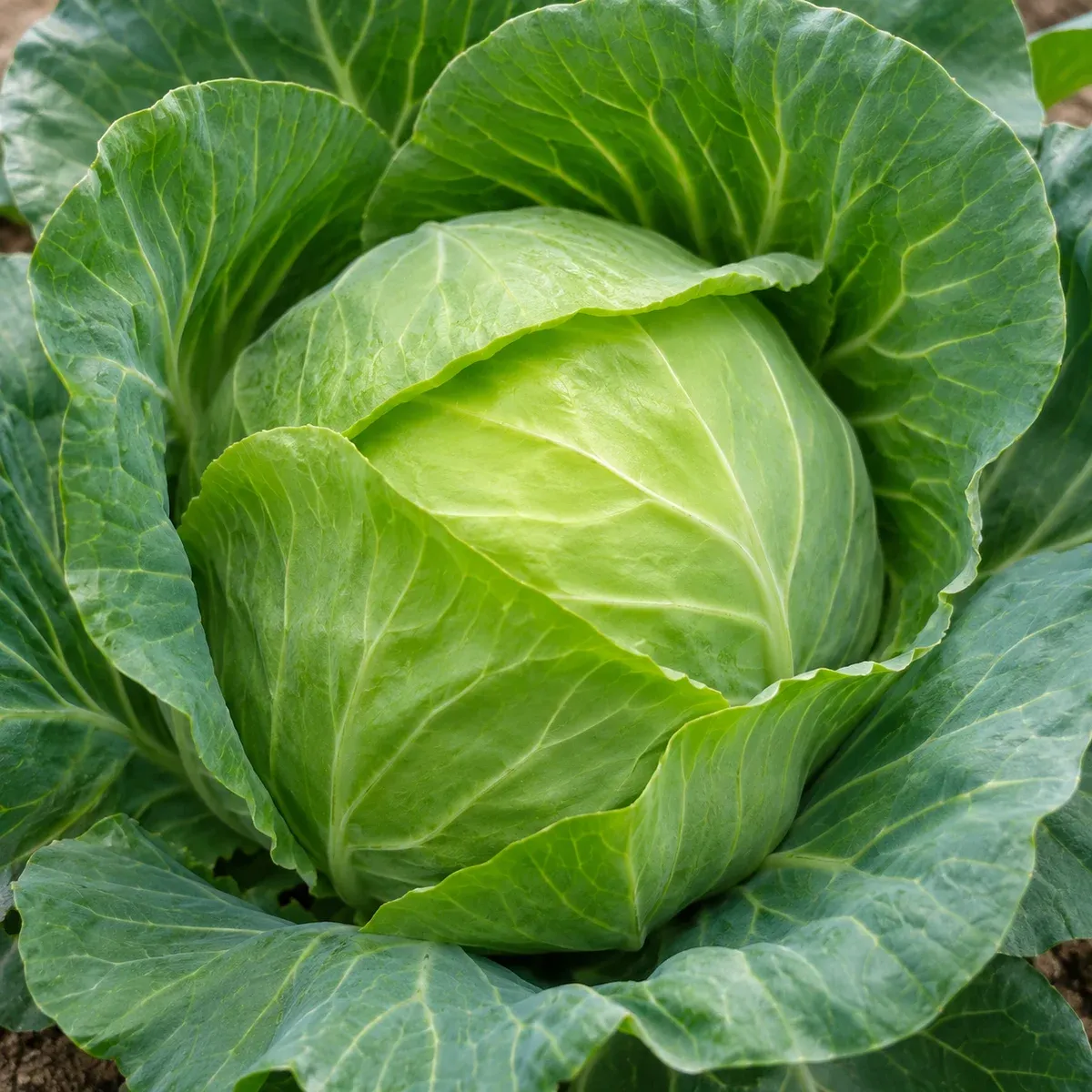
Headed cabbage forms a tight head of leaves. Smooth-leaved cabbage (Brassica oleracea var. capitata), known as cabus in French, has smooth leaves; Savoy cabbage has crinkled leaves. Brussels sprouts produce small heads along a stem and constitute a different crop. Select a precise variety and harvest season. SNHF · RHS
When to sow and plant headed cabbages?
For smooth-leaved cabbage in France, the SNHF provides three reference points:
- Sowing March–April, then planting out May–June.
- Winter cabbages: sowing May–June, transplanting July.
- Spring cabbages: sowing between mid-August and late September depending on the region, then planting in autumn or the following spring.
These periods do not apply indiscriminately to all varieties. An October sowing does not replace the spring preparation of a cabbage to be harvested that winter. SNHF
How to sow and transplant?
To start in modules, the RHS recommends 1 cm depth, then one vigorous plant per cell. Plant out young plants after acclimatisation outdoors, when they have a good root system and five or six true leaves. Water at planting, firm down, and position the lowest leaves at soil level. RHS
Spacing varies with size: the SNHF specifies 50 cm between rows for medium varieties, 65 cm for larger ones; the RHS distinguishes compact plants from large cabbages. Follow the spacing indicated on the seed packet for your variety instead of crowding a winter cabbage like a small lettuce. SNHF · RHS
Note the target harvest season on your label and keep the space allocated on your vegetable plot plan.
How to water and feed a headed cabbage?
Prepare deep, well-drained soil rich in humus. Choose a sunny site and keep the soil moist; some shade may be useful when the sun becomes too strong. SNHF
Monitor watering closely after planting and during head formation. An established plant requires less daily attention than a recent transplant but must not endure prolonged drought. Mulching can help retain moisture. Additional fertiliser depends on soil fertility, not a universal schedule. RHS
How to protect cabbages from caterpillars?
The RHS recommends fine insect-proof netting, supported on frames, to reduce damage from brassica pests. Also inspect plants: caterpillars, aphids, slugs and root problems require different responses. Holes in leaves do not allow for a precise diagnosis. RHS
To distinguish leaf damage, root-feeding larvae and clubroot, follow the guide Pests and diseases of cabbages. It indicates what to observe at the heart, collar and roots before choosing protection.
Why is the head absent, loose or split?
First, recheck the label: is this definitely a headed cabbage, and has its harvest season arrived? Some varieties naturally form a less tight head. A small head still forming should not be judged like a mature smooth-leaved cabbage. Also compare spacing to the stated size, available light and soil moisture; crowded plants or those that suffered drought cannot be corrected by routine fertiliser application. RHS
- No head and a plant with stunted growth: examine the heart and base of the stem. If the cabbage wilts or declines, look for root damage. The University of Minnesota describes a missing head in plants with roots swollen by clubroot, or with cutworm damage. These are avenues to investigate, not a diagnosis based solely on delay. Minnesota
- Loose head: first verify the varietal type and its stage. If the centre continues to tighten and the plant remains healthy, continue monitoring; expected firmness depends on the variety. RHS
- Firm head then split: heavy rain can cause splitting through water absorption. Harvest split heads quickly, as the exposed interior deteriorates rapidly, and monitor other mature heads. This differs from caterpillar holes. Illinois
Record the variety, sowing and planting dates, head development and periods of drought or rain. If lesions or wilting are present, revisit the cabbage health guide.
What does a stem that starts to flower mean?
A central stem elongating and bearing flower buds indicates bolting, distinct from a head simply slow to close. The University of Illinois explains that prolonged cold can trigger flowering in sufficiently developed plants, particularly after premature planting. For the next crop, respect the variety’s timeframe and choose vigorous plants, without stress or excessive time in modules. Illinois · Maryland
Bolting compromises head harvest. Do not rely solely on cutting the flower stalk to restore a normal head: plan a new batch suited to its season. Photograph the buds and note previous conditions to distinguish this development from heart damage. Maryland
When to harvest a headed cabbage?
Check for a firm head of the desired size, then cut the stem near the ground. Winter cabbages of suitable varieties can remain in place for some time, but inspect them: their condition depends on the variety and circumstances. No fixed period after planting replaces this check. RHS
Can you grow cabbage in a pot?
Yes, with a compact variety and a deep, well-drained container. The RHS describes a plant in a 30 cm pot, with light, space and consistent watering. Large winter varieties require more room; pots are not a solution for every cabbage. RHS
Key points for this crop
Practical guidance
- Type
- Cabbage grown for its head of leaves, including smooth-leaved types
- Soil
- Deep, fertile, moist and well-drained
- Schedule
- Depends on the variety and its harvest season
- Harvest
- Head formed and firm
Sources and references
- Smooth-leaved cabbageFrench National Horticultural Society Accessed on 17 October 2026.
- How to grow cabbagesRoyal Horticultural Society, in English Accessed on 17 October 2026.
- Cabbage — Harvesting; Questions & AnswersUniversity of Illinois Extension, in English Accessed on 18 October 2026.
- Cabbage > Head > No head developsUniversity of Minnesota Extension, in English Accessed on 18 October 2026.
- Flower Stalks Form or Bolting of VegetablesUniversity of Maryland Extension, in English, updated 20 February 2023 Accessed on 18 October 2026.