
The vegetable garden notebook / Crops
Growing shelling peas: sowing, supports, and fresh harvest
First, choose a shelling pea variety, considering its height and sowing period. Early round-seeded varieties, wrinkled-seeded types, and mangetout are not all managed in the same way.
Adapt this guidance to your garden’s climate and conditions.
When to sow peas: spring or autumn?
The SNHF distinguishes Mediterranean regions, where round-seeded peas can be sown from November to February, from the rest of mainland France, where it recommends February to June, starting with round seeds followed by wrinkled ones. These are not automatic dates: variety, soil, and weather must be suitable. SNHF
For autumn sowing, explicitly verify varietal suitability and protection requirements. Sainte Marthe lists adapted varieties and suggests starting under a cold frame or polytunnel. This option does not apply to all peas or all French winters. Sainte Marthe
Very cold soil slows seedling emergence; waterlogged ground can cause seeds to rot. The RHS recommends waiting for suitable conditions or starting in modules under cover. RHS
Shelling peas and mangetout: what’s the difference?
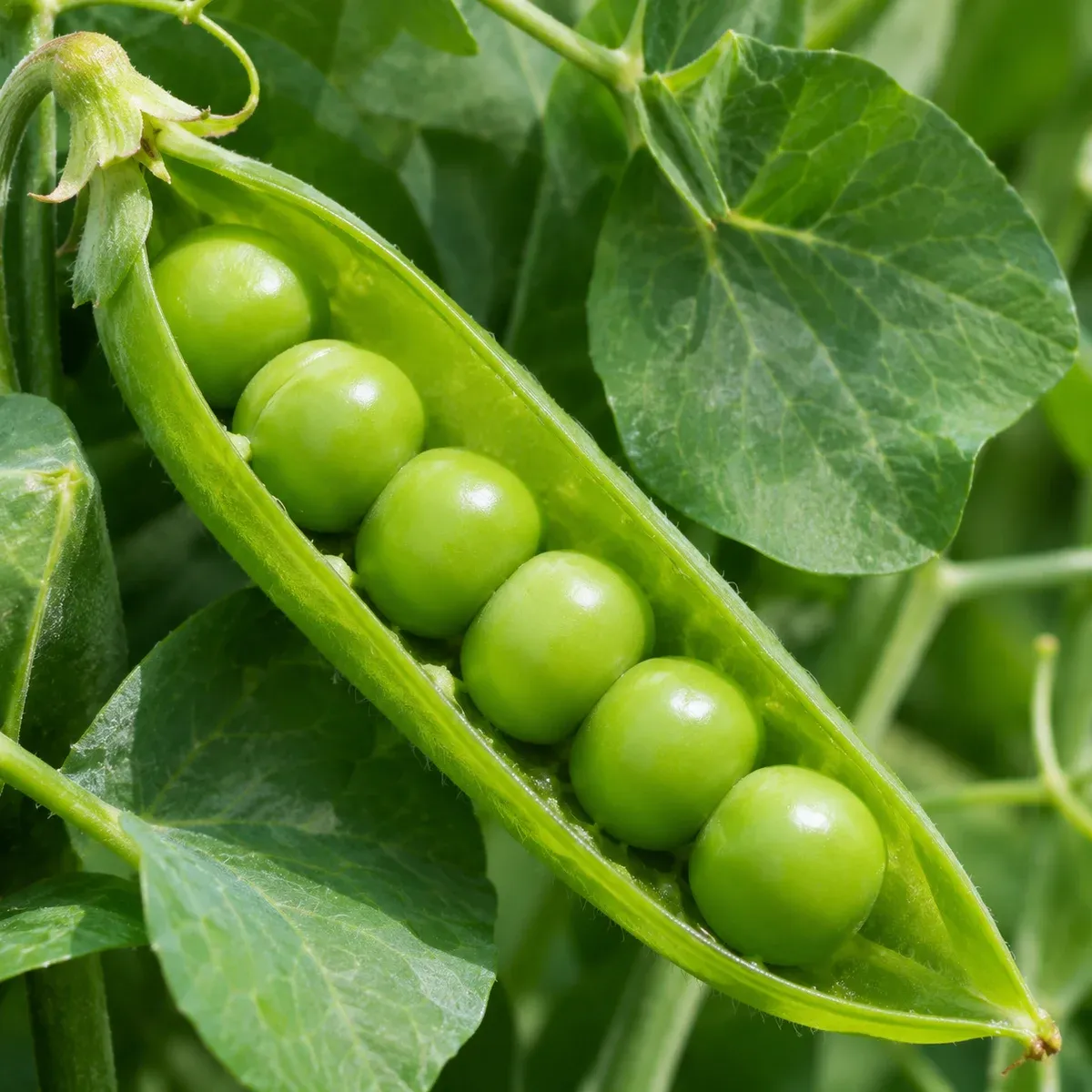
This guide focuses on fresh shelling peas, harvested when the green pod is well-filled. Mangetout are picked before the seeds develop, with a different harvest stage: do not confuse them with fresh shelling peas in the catalogue. SNHF
Can you grow peas in pots?
Opt for a dwarf variety and a large, well-drained container. The RHS suggests at least 45 cm in width, a support, and regular water monitoring; with few plants, the harvest remains modest. RHS
How to sow and install supports?
For sowing shelling peas in rows, here is the SNHF method: moist, well-aerated, and loosened soil, rows spaced 30 to 40 cm apart, seeds at 1 cm depth and 2 to 3 cm apart, then lightly firming with the back of a rake. Consider this approach as a whole, to be compared with your variety’s instructions. SNHF
The RHS describes a different setup for low-growing varieties: a flat-bottomed drill and sowing in multiple lines, with a different depth. This is not an additional covering layer to add to the SNHF drill. If your seed packet prescribes a different method, follow that batch’s protocol rather than combining depth, spacing, and drill widths from different sources. None of the references explain these differences solely by soil type.
Plan supports from the outset: a few branches for low-growing varieties, a well-secured net for tall ones. Check the stated mature height before constructing the support. The sowing guide covers common practices. RHS
How to water and fertilise peas?
Monitor water during flowering and pod filling. Check soil at root level before watering, directing water to the ground. Once established, outdoor peas mainly require attention during dry periods. RHS
The RHS states they generally grow without fertiliser in most soils. Adjust inputs based on soil needs and the following crop. RHS
When to harvest peas?
Pick when pods are still green and seeds well-formed, starting from the bottom. Harvest regularly during the season. The SNHF’s three-to-four-month guideline should not be treated as a guaranteed timeline for overwintered sowings. SNHF · RHS
Why do flowers fail to produce pods?
Compare flowers, very young pods, and recent weather. University of Minnesota Extension notes that hot days and nights can cause flower abortion and disrupt pollination. Conversely, young plants’ tolerance of light frost does not apply to forming flowers and pods, which cold can damage.
Also check soil moisture, particularly at the two stages already described: flowering and pod filling. Correcting dry soil helps sustain the crop. Peas are self-pollinating: the absence of bees alone is not enough to explain a lack of pods, as the RHS notes. Note the affected stage to choose a more suitable sowing period for the next attempt, rather than routinely adding fertiliser.
Missing seeds or nibbled leaves: what to check?
Birds, small rodents, slugs, and snails may cause damage at different stages. Inspect sowings and plants to identify the issue before protecting the row; a single damaged leaf does not indicate disease. RHS
White deposit or nibbled seeds: two different checks
A powdery white deposit spreading on leaves or stems may suggest powdery mildew. The RHS describes these signs and lists peas among hosts; University of Minnesota Extension notes its development in hot, dry weather. Observe the extent and progression, maintain soil moisture monitoring, and avoid overcrowding stems on supports. An isolated white mark does not alone identify this disease.
Carefully open pods with damaged seeds: the pea moth leaves cream-coloured caterpillars, sometimes with dark spots, and frass near eaten seeds. This internal damage differs from leaves with holes. If the problem has occurred before, prepare prevention before egg-laying: a suitable insect-proof net can block moth access. It will not repair an already infested pod. The RHS clarifies that excluding pollinators does not compromise self-pollinating pea crops. RHS — pea moth
The protective netting guide details how to choose the system based on the target pest and checks under cover.
Key points for this crop
Practical guidance
- Species and harvest
- Pisum sativum, fresh shelling peas
- Season
- Cool; autumn reserved for suitable situations and varieties
- Support
- To be sized according to the variety’s height
- Harvest
- Green pods, well-formed seeds
Sources and references
- Garden peaFrench National Horticultural Society Accessed on 17 October 2026.
- How to grow peasRoyal Horticultural Society, in English Accessed on 17 October 2026.
- Growing peas successfullyLa Ferme de Sainte Marthe Accessed on 17 October 2026.
- Growing peas in home gardensUniversity of Minnesota Extension, in English Accessed on 18 October 2026.
- Pea mothRoyal Horticultural Society, in English Accessed on 18 October 2026.
- Powdery mildewsRoyal Horticultural Society, in English Accessed on 18 October 2026.