
The vegetable garden notebook / Crops
Growing spinach: sowing, bolting and harvest
Spinach yields its best leaf harvests when growth remains steady. The sowing period, variety and soil moisture matter more than a fixed harvest date.
Adapt this guidance to your garden’s climate and conditions.
When to sow spinach?
For metropolitan France, the SNHF provides March–April and August–September as guidelines. Adapt the choice to your climate, weather and especially the variety: a winter variety is not interchangeable with one intended for another season. The RHS advises delaying a late-summer sowing if heat persists, while allowing plants time to establish before winter.
The March calendar and August calendar place these sowings within vegetable garden tasks. Neither justifies sowing in frozen or waterlogged soil.
Two examples of seasonal choices
For a spring start, ‘America’ is a candidate: Sainte Marthe recommends March–April for this batch, then warns that heat can accelerate bolting. The goal is to harvest its leaves before this deterioration, not to maintain the same productive row throughout summer.
For a late-summer sowing intended for autumn and winter, ‘Géant d’Hiver’ is described as cold-resistant by the same seed supplier, with a possible start in August–September. This choice still requires establishment before cold weather and protection depending on your garden. The sowing windows for these two varieties overlap: always check the details for your seed lot and keep an eye on the weather, rather than relying on the names alone.
How to sow and thin?
Choose moist, humus-rich soil without fresh manure, in a mainly sunny position in spring and autumn; a shaded position may be suitable in summer. Sow directly in place: the SNHF suggests rows spaced 30 to 40 cm apart, then thinning to 8 cm when seedlings have four or five leaves. SNHF
For depth, the RHS recommends a 2.5 cm furrow. First follow the packet instructions, particularly according to the desired harvest stage. Its closer spacing for young leaves is not mandatory for mature plants. RHS
Label the variety and date. Keep a plan of the row to compare your sowing periods the following year; preparation steps are outlined in the sowing guide.
How to water and maintain spinach?
Weed early on and check soil moisture during dry periods. A lack of water halts growth and encourages premature flowering. Pots dry out particularly quickly: inspect them more often, without assuming one volume of water suits every situation. The RHS favours morning watering to avoid prolonged moisture overnight. RHS
Do not automatically add fresh manure: the SNHF recommends avoiding it. Before any application, consider the preparation and fertility already present. SNHF
Why do my spinach plants bolt?
Heat and drought encourage bolting; a flower stalk signals the end of the harvest of good-quality leaves. Sowing in cooler seasons and choosing a less sensitive variety reduce the risk without eliminating it. In pots, avoid scorching midday sun. RHS
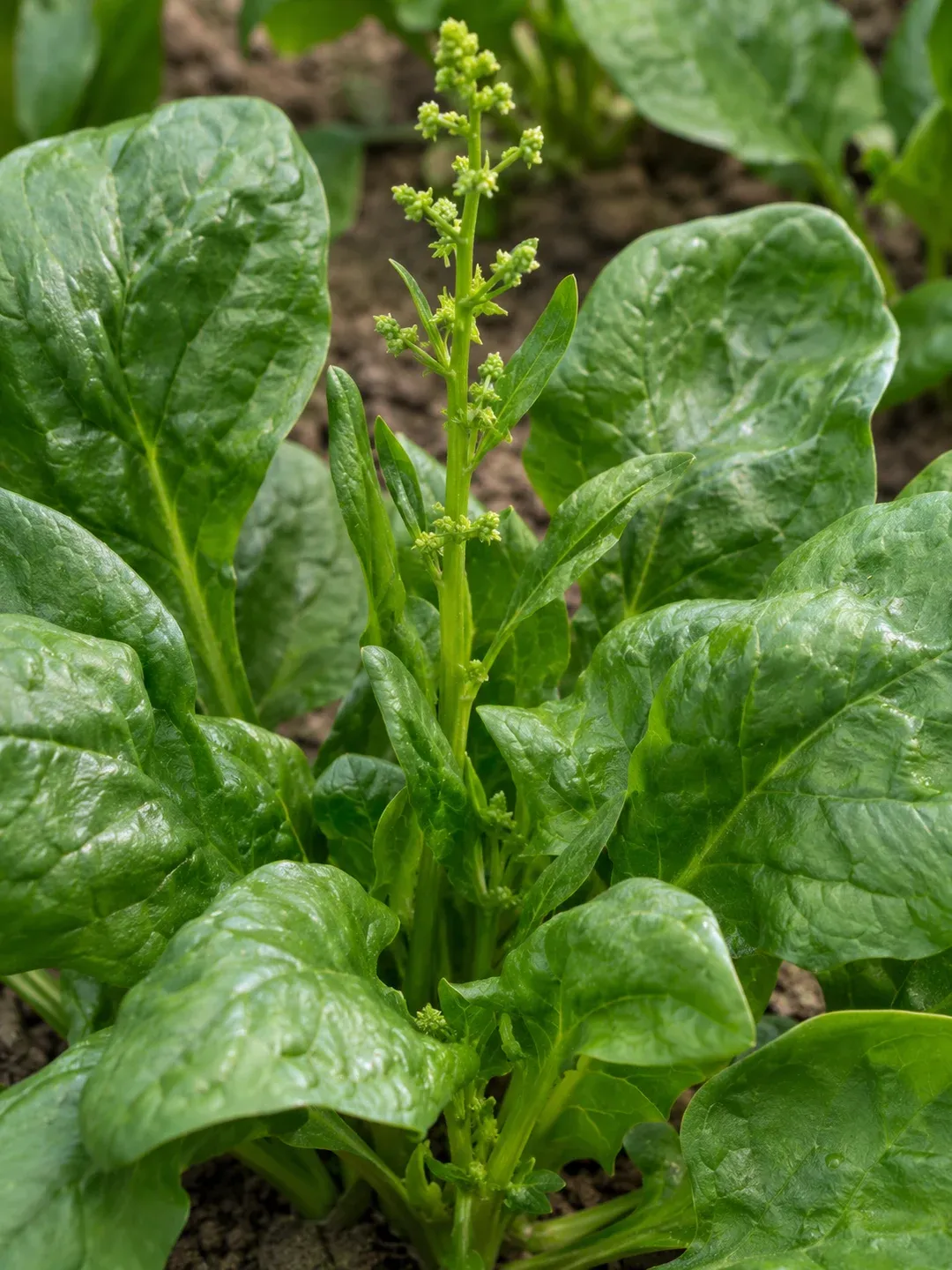
When to harvest without uprooting plants?
The SNHF indicates about two months for well-developed leaves: this is a rough estimate, depending on the season. Pick leaf by leaf, keeping the heart intact to allow further harvests. SNHF
Can spinach be grown in pots or in winter?
Yes. The RHS advises a container at least 30 cm wide and deep, well-drained, and careful water monitoring. For winter, the RHS suggests a cloche or horticultural fleece, or moving pots into an unheated greenhouse or cold frame before cold weather arrives. Install protection before the forecasted event, while maintaining access to the crop to check leaves, moisture and ventilation; the netting and fleece guide helps choose and secure cover. RHS
Spotted or nibbled leaves: what to check?
Inspect the undersides of leaves and young plants before intervening. Slugs, snails and downy mildew are among possible issues; humidity and overcrowded growth encourage the latter. One symptom on its own is not enough for a definite diagnosis. RHS
Distinguishing a mine from downy growth on the underside
The SNHF lists spinach among the hosts of the leaf-mining fly Pegomya betae: its larvae burrow between the two leaf surfaces, forming mines that may merge into dried patches. Look for the larva in the affected area and small clusters of white eggs on the underside. A translucent or browned section is therefore not automatically a fungal disease.
For downy mildew, examine instead a spot on the upper surface and corresponding downy growth underneath. Its colour and visibility vary; humidity and poor ventilation should be noted. The RHS lists spinach among affected plants, but these indicators are insufficient to confirm each case.
Photograph both sides before intervening. For physical protection against an identified insect, check the pest, installation and site history with the netting guide. Avoid adding cover blindly to damp, crowded foliage: when choosing a cover, you also need to monitor ventilation.
Key points for this crop
Practical guidance
- Species
- Spinacia oleracea
- Sowing guidelines
- March–April or August–September, to be adapted locally
- Soil
- Moist and humus-rich, without fresh manure
- Harvest
- Leaf by leaf, preserving the heart
Sources and references
- SpinachFrench National Horticultural Society Accessed on 17 October 2026.
- How to grow spinachRoyal Horticultural Society, in English Accessed on 17 October 2026.
- Downy mildewsRoyal Horticultural Society (RHS), in English Accessed on 18 October 2026.
- Beet – leaf-mining fly (Pegomya betae)Jardiner Autrement, French National Horticultural Society Accessed on 18 October 2026.
- Spinach ‘America’ ABLa Ferme de Sainte Marthe, seed supplier Accessed on 8 November 2026.
- Spinach ‘Géant d’Hiver’ ABLa Ferme de Sainte Marthe, seed supplier Accessed on 8 November 2026.