
The vegetable garden notebook / Seasons
Summer vegetable garden: organising watering, harvests and succession
In summer, organise tasks around existing crops and the time you have available. A round of checks helps decide what needs action and what can wait.
Adapt this guidance to your garden’s climate and conditions.
This guide uses French examples and seasonal references. Adjust them to your garden’s climate and local conditions.
- Observe before watering
Check the soil beneath the surface and distinguish between sowings, young plants and established crops.
- Organise harvests and absences
Identify ready vegetables and arrange for someone to monitor crops during your absence.
- Prepare the next steps in small areas
Choose sowings suited to the season, variety and the care you can actually provide.
Start with a walk-through of the vegetable garden
Each time you visit, first observe the existing crops. To organise your tasks, distinguish three things: the soil condition, vegetables approaching harvest stage and spaces that will soon be freed up. Also note recently sown rows and plants still establishing.
This assessment helps prepare a short list of interventions. At the start of the season, the June calendar details some possible sowings and plantings; here, the goal is to maintain monitoring throughout the summer.
Adjust watering for each crop
Check moisture beneath the surface layer, including under mulch. Jardiner Autrement recommends this step before watering, then verifying after application to ensure water has penetrated. A wet surface is not enough; already saturated soil does not need further watering.
Sowings and young plants require consistent moisture. The needs of established vegetables then depend on their stage: tomatoes, for example, benefit from regular watering during flowering and fruiting. The RHS distinguishes these situations; this does not mean watering still-damp soil. Also check pots separately, as recommended in its watering methods guide.
When watering is necessary, target the soil around the plants. The watering guide details infiltration checks. Check restrictions applicable to your address on VigiEau, the service presented by the Ministry of Ecological Transition.
Mulch reduces evaporation but does not eliminate monitoring. Apply it to damp soil and ensure water penetrates the cover to reach roots, according to the RHS. The mulching guide helps choose materials and protect young shoots.
Incorporate harvests into your routine
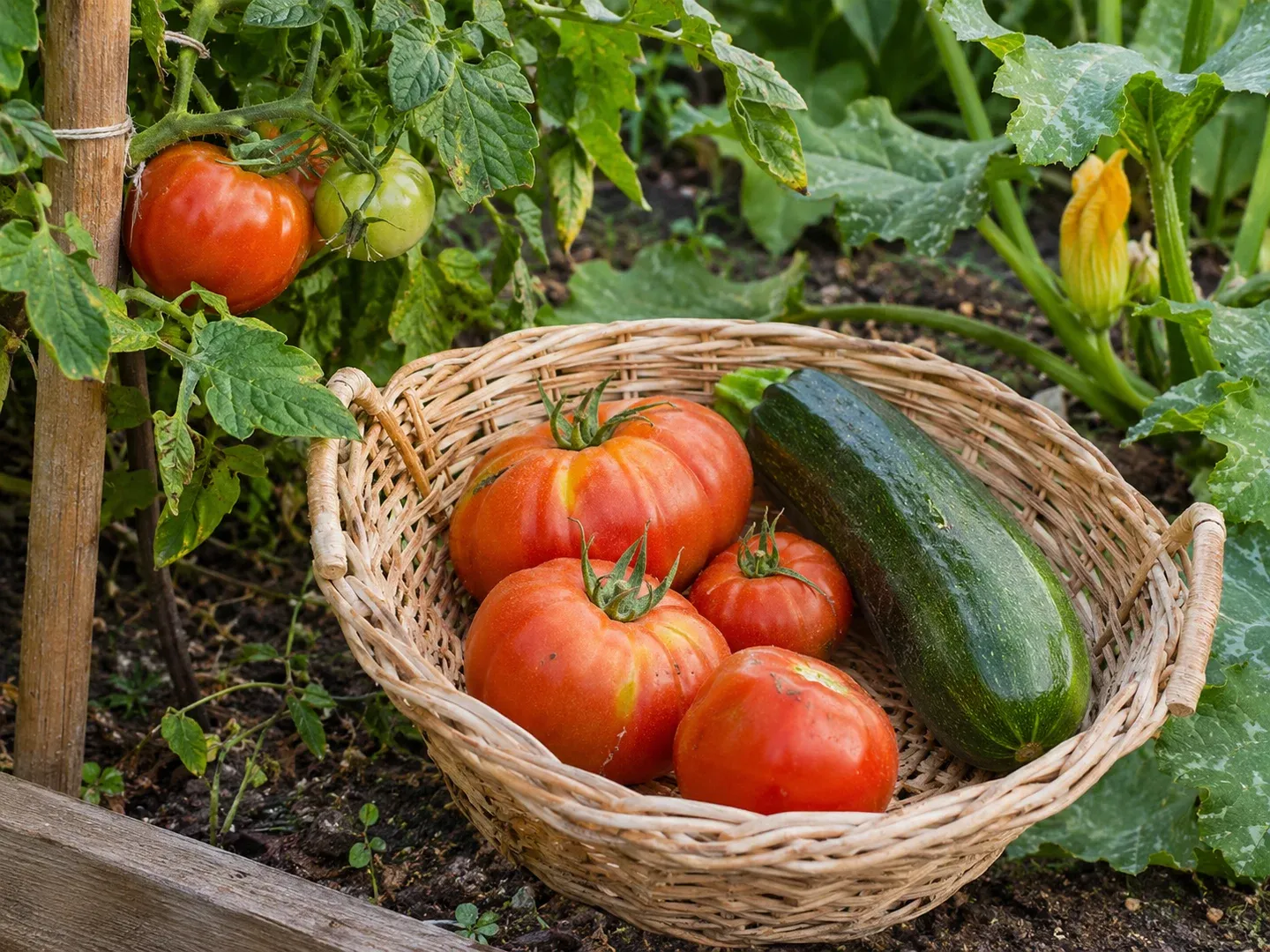
Identify what is ready before starting new tasks. The right stage depends on the vegetable: the SNHF advises harvesting courgettes young, as they grow, avoiding letting fruits become oversized. This advice does not apply to all fruiting vegetables.
Distinguish three stages during your walk-through:
- Fine-podded French beans (filet types) are harvested as young, slender pods; do not let them reach the dry seed stage. Stringless French bean varieties tolerate a longer delay in picking. SNHF
- Courgettes are picked young, without waiting for the maturity of a squash intended for storage. SNHF
- Tomatoes are harvested ripe, with the colour corresponding to their variety: not all turn red. The RHS distinguishes yellow, orange or green fruits at maturity. RHS
For each crop, note what you have actually harvested and what remains to monitor. These observations will help adjust the area sown next time, without turning a good one-off harvest into an expected yield.
Prepare for an absence with clear instructions
Arrange for someone to visit and observe the crops. In its advice for school or office gardens, the RHS suggests arranging someone to look after plants left in place. The frequency should match your garden and current conditions.
Before leaving, conduct a walk-through together and complete a handover sheet, on paper or in a shared document. Keep one line per pot or zone with the same instructions:
| To complete | Instruction to leave |
|---|---|
| Location and crop | Name on the plan or label, pot or open ground, sowing or established plant. |
| Soil check | Spot shown during the walk-through, beneath the surface or under mulch; if soil is still damp, wait before watering. |
| Watering if necessary | Equipment to use and method already tried together; then verify water has penetrated, without saturating the area. |
| Harvest | Vegetables to pick, stage demonstrated on site, plants to leave and destination of the harvest. |
| Leak or unusual drainage | Locate the shut-off valve for the relevant circuit together; in case of a leak, turn off this circuit and report the leak before turning it back on. |
| Garden care and contact | Agreed visits based on needs, person to contact and backup if unavailable. |
This sheet translates the garden care arrangements suggested by the RHS and soil checks from Jardiner Autrement into instructions tailored to your setup. The shut-off procedure should be demonstrated on your own equipment. It does not specify how long the garden can be left unattended: if no one can provide the necessary monitoring, reduce the crops requiring attention or arrange alternative care before leaving.
If you already use automatic watering, run it before leaving and check the soil in the areas served. The RHS states that settings must meet plant needs and that root zone moisture remains to be verified. Ensure water reaches the soil at the base of each crop.
Prepare the next sowings without filling all the space
When a row becomes free, choose the next crop based on the variety’s sowing window and your availability to monitor seedling emergence. If monitoring will be lacking during your absence, reduce the new area or postpone sowing to a compatible period.
For suitable crops, small successive batches can help stagger harvests. The RHS advises observing the development of the previous batch to decide on the next. It also notes that weather changes can cause staggered sowings to mature simultaneously.
Keep a note for each location: previous crop, harvest date, planned next sowing and person available to monitor it. You can plan the changeover to late-summer crops based on the vegetable garden’s actual condition.
Two possible approaches, to verify with the seed packet:
- A row freed up at the start of summer: if your radish type and weather suit, prepare a small batch of radishes rather than sowing the entire space. The SNHF distinguishes salad radishes (sold as “radis de tous les mois”) from summer and winter types; the windows are not interchangeable. If it is hot and dry and you cannot keep up with watering, postpone. The July calendar supports this choice. SNHF
- A space freed up towards the end of summer: consider corn salad planned for autumn, only if you can keep the area damp during establishment. The SNHF places its window from mid-July to autumn and emphasises moist conditions during seedling emergence. The August calendar helps plan this follow-on crop. If space or the necessary care is lacking, do not feel obliged to sow a follow-on crop. SNHF
Wicks and bottles: test the system before holidays
A wick channels water from a reservoir to the growing medium. The RHS for school gardens describes cords between a bucket and soil, noting that needs vary with container and plant. In its houseplant advice, it also highlights possible failures: empty reservoir, wick dislodged from the pot or overly damp soil. RHS — wicks
An inverted bottle is not necessarily a drip system. The RHS educational activity describes a bottle with the base cut off, used to manually pour water near roots. This setup provides a point for applying water; it does not establish a regulated flow rate or how long a filled, pierced bottle could keep plants watered while you are away.
Test the system under the planned conditions before leaving, with the same pots, plants and exposure. Compare the reservoir level and moisture at the core of the root ball; check that the device does not leak, shift or saturate the container. These trials apply the water checks described earlier to failures noted by the RHS. Arrange for someone to check the pots and settings if conditions change. RHS — wicks, watering methods
Sources and references
- Water-efficient wateringJardiner Autrement, a programme run by the SNHF Accessed on 16 October 2026.
- Watering vegetables and fruitRoyal Horticultural Society (RHS), in English Accessed on 16 October 2026.
- Mulches and mulchingRHS, in English Accessed on 16 October 2026.
- CourgetteSociété nationale d’horticulture de France (SNHF), Jean-Marc Muller Accessed on 16 October 2026.
- How to care for school and office gardens during holidaysRHS, in English Accessed on 16 October 2026.
- Garden watering methodsRHS, in English Accessed on 16 October 2026.
- Successional sowingRHS, in English Accessed on 16 October 2026.
- Launch of the VigiEau platform to inform about drought restrictionsMinistère de la Transition écologique Accessed on 16 October 2026.
- Houseplants: holiday careRoyal Horticultural Society, in English Accessed on 18 October 2026.
- Teach pupils how to water plants correctlyRoyal Horticultural Society, in English Accessed on 18 October 2026.
- French beansFrench National Horticultural Society Accessed on 8 November 2026.
- How to grow tomatoesRoyal Horticultural Society, in English Accessed on 8 November 2026.
- RadishesFrench National Horticultural Society Accessed on 8 November 2026.
- Corn saladFrench National Horticultural Society Accessed on 8 November 2026.