
The vegetable garden notebook / Crops
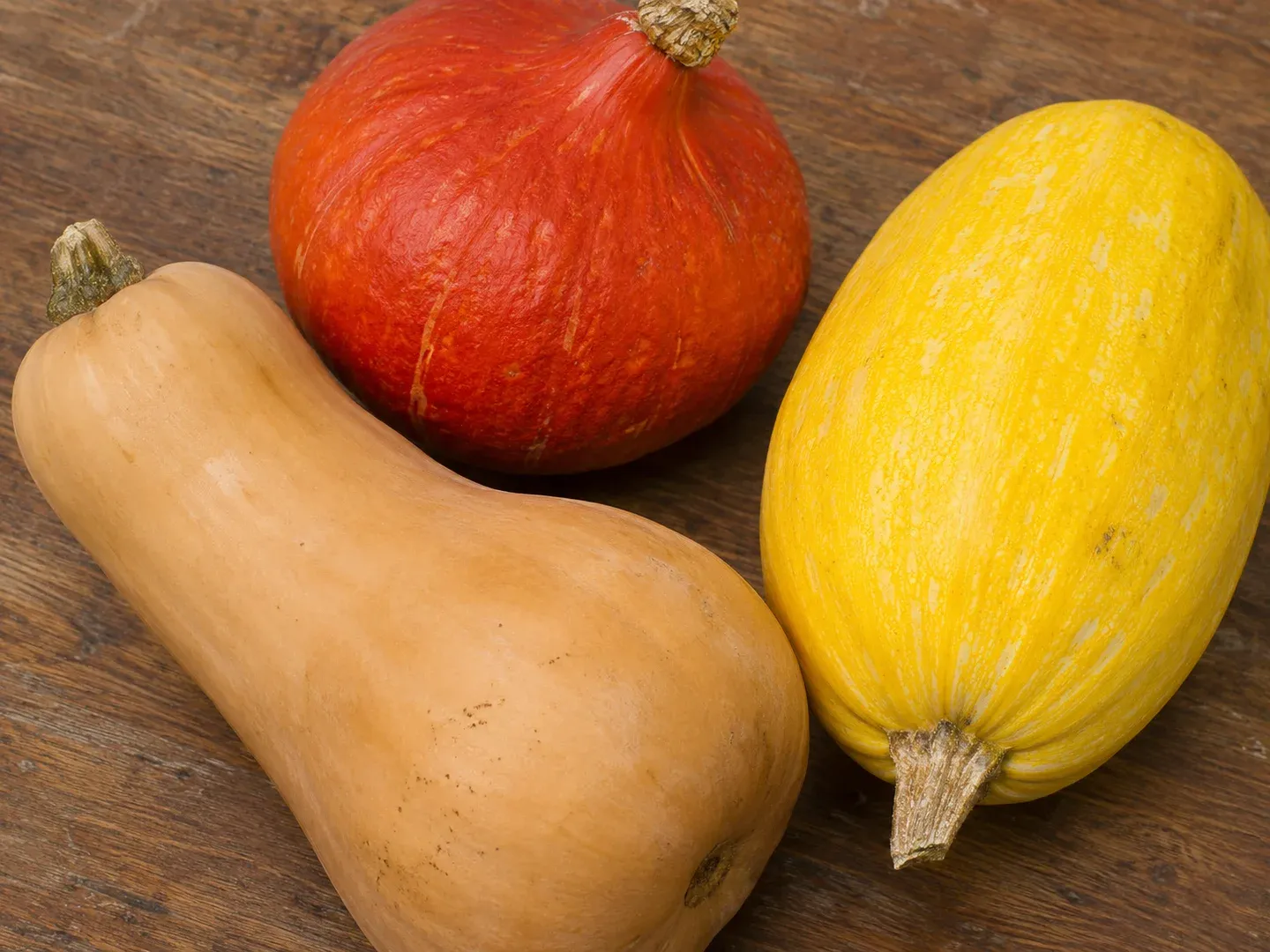
Which squashes to grow: choosing based on space and harvest
First decide between young fruits to pick regularly and squashes to leave to mature for storage. Next, check the variety’s growth habit and the space its stems require: the fruit’s name alone is not enough to predict its spread.
Adapt this guidance to your garden’s climate and conditions.
Choose the harvest stage before the squash name
Summer squashes, such as courgettes, are picked young and consumed quickly. Winter squashes, such as butternuts, mature on the plant before being stored: their name does not mean they grow during winter. This distinction is provided by the RHS.
| Crop | Species | Harvest objective |
|---|---|---|
| Courgette | Cucurbita pepo | Young fruits, picked frequently. |
| Pattypan | Cucurbita pepo | Young for its tender skin; mature for other uses, particularly stuffed. |
| Butternut | Cucurbita moschata | Mature fruit; sort before storage. |
| Red kuri and pumpkin | Cucurbita maxima | Mature fruit; sort before storage. |
| Spaghetti squash | Cucurbita pepo | Mature fruit; sort before storage. |
The species are confirmed by the University of Minnesota for summer squashes and butternuts and spaghetti squashes, and by the SNHF for red kuri and pumpkin. The same species can therefore encompass different uses: courgette and spaghetti squash are both Cucurbita pepo.
The CTEM describes the two stages of pattypan: its tender skin can be eaten with the flesh when young; it hardens at maturity. This possibility of mature harvest does not confer the same storage qualities as a butternut.
Compare varieties based on the space actually available
Look for the mention trailing, semi-trailing, or non-trailing. The SNHF distinguishes, among red kuris, ‘Uchiki Kuri’ (trailing) and ‘Amoro’ or ‘Zora’ (semi-trailing). Do not deduce the spread from the name “red kuri” alone.
For squashes, the RHS provides benchmarks of 90 cm between non-trailing plants and 1.5 metres between trailing plants. These are planting distances: trailing stems can occupy several metres. Follow the variety’s instructions and sketch their location on your vegetable garden plan.
A support allows some small-fruited varieties to be trained vertically. It must be sturdy, with fruit support if necessary, according to the RHS. For large fruits, the University of Minnesota advises ground culture. Do not plan a simple stake as a universal solution for lack of space.
To contain a trailing variety, the RHS suggests guiding the stems in a large circle, secured with small stakes, or cutting those that exceed the reserved area. This action helps manage space; it does not constitute mandatory pruning for all squashes.
Check the growing time and your availability
Squashes need warmth: wait until after frosts and for the soil to warm before planting outdoors. The University of Minnesota notes that cold soil also hinders plants started indoors. The fact sheets in the table specify sowing practices for each crop; no national date replaces the conditions in your garden.
For squashes to be harvested ripe, check the variety’s stated earliness. The University of Minnesota indicates that long-season varieties may not have enough time to mature in regions with a short warm season. This observation helps compare varieties; its local calendar does not apply to France.
Monitor watering, mulching, and nutrition
Water at the base, particularly during fruit enlargement, and keep the stem base clear of mulch: the RHS advises maintaining moisture without creating a damp zone around the collar. Our guides on watering and mulching detail this monitoring.
In prepared and fertile soil, the RHS generally does not expect additional fertilisation. In containers, it recommends regular feeding, with a potassium-rich fertiliser once the first fruits start to swell. Follow the instructions for a product suited to this use. This context mainly concerns compact forms of summer squashes; it does not make every winter squash suitable for pots. A lack of fruit is not sufficient to decide on fertiliser.
Flowers without fruit: observe before intervening
For winter squashes, the University of Minnesota describes early flowers often being male, followed by female flowers with a swelling at their base. Their succession alone does not signal failure. Cold and rain can also reduce pollination.
For the three species in the table, the RHS advises distinguishing between lack of female flowers, poor pollination, and a plant too young to bear fruit. With both types of flowers open, pollen from a male flower, stripped of its petals, can be placed in the centre of a female. Under cover, allow insect access in favourable weather. This action does not correct cold or poor growing conditions.
Organise the harvest and storage
For young courgettes or pattypans, plan to harvest often. The University of Minnesota recommends frequent harvests, before the seeds grow large, the skin hardens and the texture deteriorates. Choose this method if you want to use the fruits as you pick them.
Harvest before frost, according to the RHS. For storage, select only healthy fruits, without rot or unhealed wounds. Handle them gently and provide a dry, ventilated space: the University of Massachusetts links storage duration to fruit condition and storage conditions.
Leaves, collar, or young fruits: what checks to perform?
These guidelines apply to Cucurbita pepo, C. maxima, and C. moschata, the scope of the RHS fact sheet, and do not provide a definitive diagnosis.
- Small fruit that shrivels: first examine the flowers and conditions for fruit set described above; this is not the same as rot spreading on a developed fruit.
- White powder, yellow mosaics, or new deformed leaves: the RHS and University of Minnesota cite powdery mildew and viruses among possible causes. Photograph the progression; colour alone does not identify them.
- Wilting with dark or rotting stem base: the RHS indicates collar and root rots; also check moisture and drainage before adding water.
- Young plant nibbled or shoots colonised: look for slugs and snails, then aphids on the tips, as cited by the RHS. Observe the animals present before intervening.
The RHS also notes that accidental exposure to herbicide can yellow and deform leaves. Record nearby interventions and recent manure applications: these symptoms do not prove infection.
If damage progresses or the plant collapses, gather photos of the whole plant, leaves, and collar, along with weather and recent interventions, to seek advice. The University of Minnesota points out that climate, diseases, and animals can alter a squash’s appearance: identify the cause before acting.
Edible and decorative squashes: verify the use
Choose seeds or plants whose label specifies the variety and edible use. Shape and colour can be misleading, according to ANSES. A decorative squash does not become edible because it resembles a pattypan or comes from the garden.
ANSES advises not to consume ornamental squashes or self-sown squashes. For a squash already identified as edible, it recommends tasting a small raw piece before preparation: if it is bitter, spit it out and discard the entire squash, even if you intended to cook it. This check does not serve to identify an unknown squash.
In case of poisoning symptoms, contact a poison control centre; for a medical emergency in France, call 15 or 112, in accordance with ANSES guidelines.
Key points for this crop
Practical guidance
- First choice
- Young harvest or mature harvest
- Space
- Depending on whether the variety is trailing or non-trailing
- Planting
- After frosts, in warmed soil
- Food use
- Identified edible variety; discard bitter squashes
Sources and references
- How to grow squashesRoyal Horticultural Society (RHS), in English Accessed on 18 October 2026.
- Courgette, marrow, pumpkin and squash problemsRoyal Horticultural Society (RHS), in English Accessed on 18 October 2026.
- Growing summer squash and zucchini in home gardensUniversity of Minnesota Extension, in English Accessed on 16 October 2026.
- Growing pumpkins and winter squash in home gardensUniversity of Minnesota Extension, in English Accessed on 18 October 2026.
- Red kuri squashFrench National Horticultural Society (SNHF), Michel d’Argentré Accessed on 16 October 2026.
- Pattypan squash 2021 — CTEM technical bookletVegetable Growing Technical Experimentation Centre (CTEM), New Caledonia Technopole Accessed on 16 October 2026.
- Pumpkin and Winter Squash Harvest and StorageUniversity of Massachusetts Amherst, R. Hazzard, in English Accessed on 16 October 2026.
- Not all squashes are edible — Vigil’Anses No. 3French Agency for Food, Environmental and Occupational Health & Safety (ANSES), October 2017 Accessed on 16 October 2026.
- Bitter squashes: beware of poisoningFrench Agency for Food, Environmental and Occupational Health & Safety (ANSES), 2021 infographic Accessed on 16 October 2026.