
The vegetable garden notebook / Crops
Growing pattypan squash: sowing, planting and harvest choices
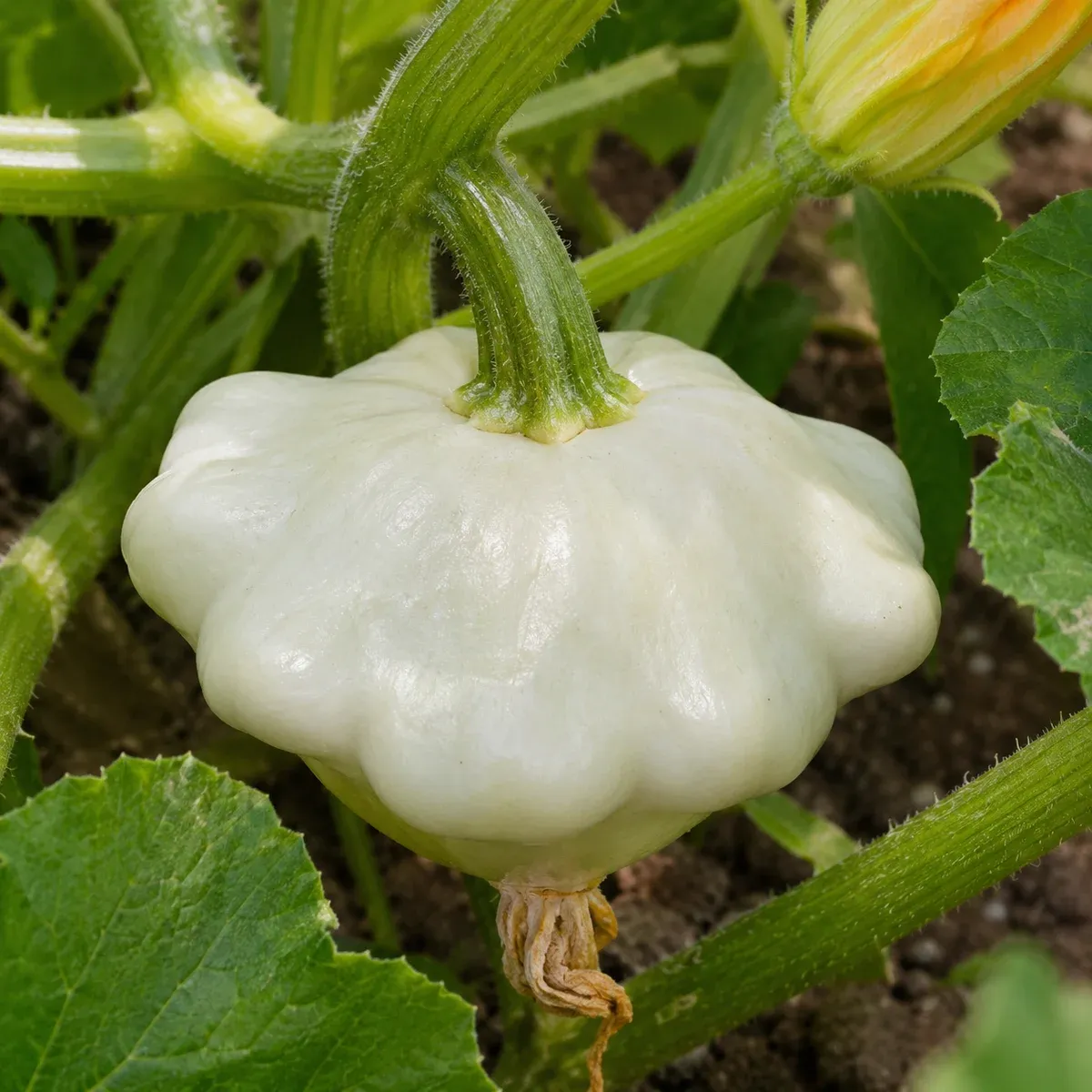
Pattypan squash can be harvested young for tenderness or mature for other uses, such as stuffing. Select your variety and harvest method before allocating a sunny spot in the vegetable garden.
Adapt this guidance to your garden’s climate and conditions.
Choosing an edible pattypan squash and its use
Pattypan squash belongs to Cucurbita pepo, like courgette: this identity is confirmed by CTEM and the University of Minnesota. Purchase seeds or a plant with a label specifying the variety and its edible use. The shape or colour of a squash does not prove its edibility, as ANSES points out.
The RHS notably classifies pattypan squashes ‘Sunburst’ and ‘Sunbeam’ among summer squashes, harvested young and not well suited to long storage. A butternut squash serves a different purpose: harvesting at maturity for storage. Pattypan squash can nevertheless be eaten mature; decide primarily whether you seek tender fruits or fruits for stuffing.
When to sow or plant pattypan squash?
Wait until the risk of frost has passed and the soil has warmed before planting outdoors or sowing directly. The University of Minnesota emphasises that cold soil also hinders the establishment of indoor-raised plants: a calendar date is not sufficient.
To start indoors, the RHS recommends one seed per pot, at 18–21 °C, followed by light and regular watering. Follow the sowing depth indicated on the seed packet for your variety. Before planting out, gradually harden off the plants outdoors; preserve the root ball, firm gently and water. A purchased plant allows you to begin at this stage. Our sowing guide details container preparation.
What space should be allocated?
Choose a sunny location and soil enriched with organic matter that retains moisture without becoming waterlogged. For non-vining squashes, the RHS recommends at least 90 cm between plants; verify the growth habit and spacing for your variety before applying this guideline. Ensure access for watering and reaching the fruits. Before planting, also compare ways to manage stems and supports for different growth habits and fruit types.
Which pattypan squash to choose for a large pot?
Oregon State University identifies ‘Sunburst’ as one of the pattypan squashes suitable for growing in large containers. Look for a variety whose cultivation in pots is specified; a small fruit does not indicate that the plant will occupy little space.
For summer squashes in containers, the RHS recommends one plant in a container at least 45 cm wide, filled with potting compost suitable for containers. This width guideline is not a volume in litres and does not apply to all winter squashes. Allow space around the pot for foliage and check for water drainage holes, also noted by Oregon State University.
Continue to monitor moisture levels. The RHS advises regular feeding in containers once the first fruits begin to swell; adjust this based on the potting compost and the instructions for the product you use. Also, keep flowers accessible to insects when pollination depends on them, as explained below.
Monitoring water and keeping flowers accessible
Check soil moisture before watering, taking into account rainfall and drying conditions. Direct water to the soil: the University of Minnesota recommends wetting the root zone while keeping leaves dry. The watering guide helps adapt watering practices, without a uniform quota for all gardens.
Mulching limits evaporation; keep a clear space around the stem, as advised by the RHS.
The female flower has a small swelling at its base; the male flower is borne on a slender stem. Insects transfer pollen between them. Remove any cover that prevents their access from flowering onwards, following the University of Minnesota.
If small fruits stop growing, do not immediately assume disease. The RHS cites a still-young plant, insufficient pollination due to poor weather, or unfavourable growing conditions. When both flower types are present, you can transfer pollen from a male flower to the centre of a female flower. This action does not correct water shortages or other plant difficulties.
Harvesting young or allowing to mature?
For a tender texture, harvest before full maturity: the skin can then be eaten with the flesh, according to CTEM. The University of Minnesota advises against letting these squashes become too large, with large seeds and fibrous or watery flesh. Harvest regularly for this use and plan to eat them quickly; no single diameter suits all varieties.
For stuffing at maturity, CTEM describes a fruit whose skin becomes hard. Check the instructions for your variety and the fruit’s condition, without applying the number of days observed in their New Caledonian trials. This stage change does not guarantee storage comparable to that of a winter squash: do not plan to store the fruit for winter based solely on its size.
Do not consume bitter pattypan squash. ANSES documents poisonings involving squashes from both shops and vegetable gardens. Appearance alone is not enough to eliminate this risk.
Note the variety and the stage at which you enjoyed the harvest: this will serve as a practical reference for your next sowing.
Management, flowers and leaves: continuing monitoring
The general squash guide allows you to examine flowers without fruits. For damaged leaves, a rotting stem base or shrivelling young fruits, follow the checks before deciding that a disease is responsible. These shared guidelines specify observations and their limitations.
Key points for this crop
Practical guidance
- Identity
- A type of Cucurbita pepo, like courgette
- Planting
- After frosts, in warmed soil
- Space
- According to the growth habit and variety instructions
- Harvest
- Young with tender skin, or mature depending on use
Sources and references
- Pattypan squash 2021 — CTEM technical bookletVegetable Growing Technical Experimentation Centre (CTEM), New Caledonia Technopole Accessed on 16 October 2026.
- How to grow squashesRoyal Horticultural Society (RHS), in English Accessed on 18 October 2026.
- Growing summer squash and zucchini in home gardensUniversity of Minnesota Extension, in English Accessed on 16 October 2026.
- Courgette, marrow, pumpkin and squash problemsRoyal Horticultural Society (RHS), in English Accessed on 16 October 2026.
- Not all squashes are edible — Vigil’Anses No. 3, October 2017French Agency for Food, Environmental and Occupational Health & Safety (ANSES) Accessed on 16 October 2026.
- Squash (Summer)Oregon State University Extension, in English Accessed on 18 October 2026.