
The vegetable garden notebook / Crops
Growing butternut squash: sowing, harvesting ripe fruit and storage
Butternut squash is grown during the warm season and harvested when mature. Before sowing, check the available space, the variety’s earliness and the conditions planned for storing the fruits.
Adapt this guidance to your garden’s climate and conditions.
Which variety and how much space to allow?
Butternut squash belongs to Cucurbita moschata, among winter squashes: this name refers to their use after harvest, not cultivation during winter. The University of Minnesota distinguishes several types and varieties of squash, each with different growth habits. Keep the exact name of your variety.
Compare its stated earliness and space requirements. In regions with a short warm season, look for an early variety: the University of Minnesota notes that long-season varieties may struggle to mature in its climate. This observation encourages comparing varieties without converting its calendar to French dates.
Choose a warm, sunny location. For trailing squashes, the RHS recommends 1.5 metres between plants, with space for the stems. Check the spacing specific to your variety; a small fruit does not necessarily mean a small plant.
Can butternut squash be grown to harvest in a pot?
Variety selection matters: the RHS describes ‘Butterbush’ as a compact butternut squash suited to pots and containers. This applies to an identified cultivar; the term “butternut squash” alone does not indicate that the plant will thrive in a small container.
Ensure sunlight, a substrate that drains excess water, and sufficient space for the stems. Before choosing your container, check the growing instructions for the variety and make sure you can keep up with watering and feeding as the fruits develop. The general squash guide details this monitoring in containers. If container growing does not suit your space, consider planting in the ground with room for the variety’s growth habit; this also requires monitoring moisture and watering as the soil dries.
When to sow and plant butternut squash?
In a pot, the RHS advises one seed per container, placed on its edge, at about 1.3 cm deep, at 18–21 °C. Keep seedlings in good light and water regularly. The sowing guide helps prepare this step.
Gradually acclimatise seedlings outdoors, then plant after the last frosts, without disturbing the roots; water after planting. Take the same precautions with a purchased plant. These steps are from the RHS.
The soil must also be warmed: the University of Minnesota recommends around 18 °C for direct sowing and transplanting. Wait for these conditions rather than relying on a single national date.
Supporting stems and fruits
Prepare soil that retains moisture while draining well. The University of Minnesota suggests well-rotted garden compost or manure. Keep soil disturbance shallow when weeding to avoid damaging roots near the surface.
Water the soil, avoiding the foliage, adjusting the amount based on soil moisture, rainfall and drying. Our watering guide details this observation. The University of Minnesota also notes that poor pollination can limit fruit formation, especially in cold, wet weather: the absence of fruit does not prove a lack of fertiliser.
How to recognise a ripe butternut squash?
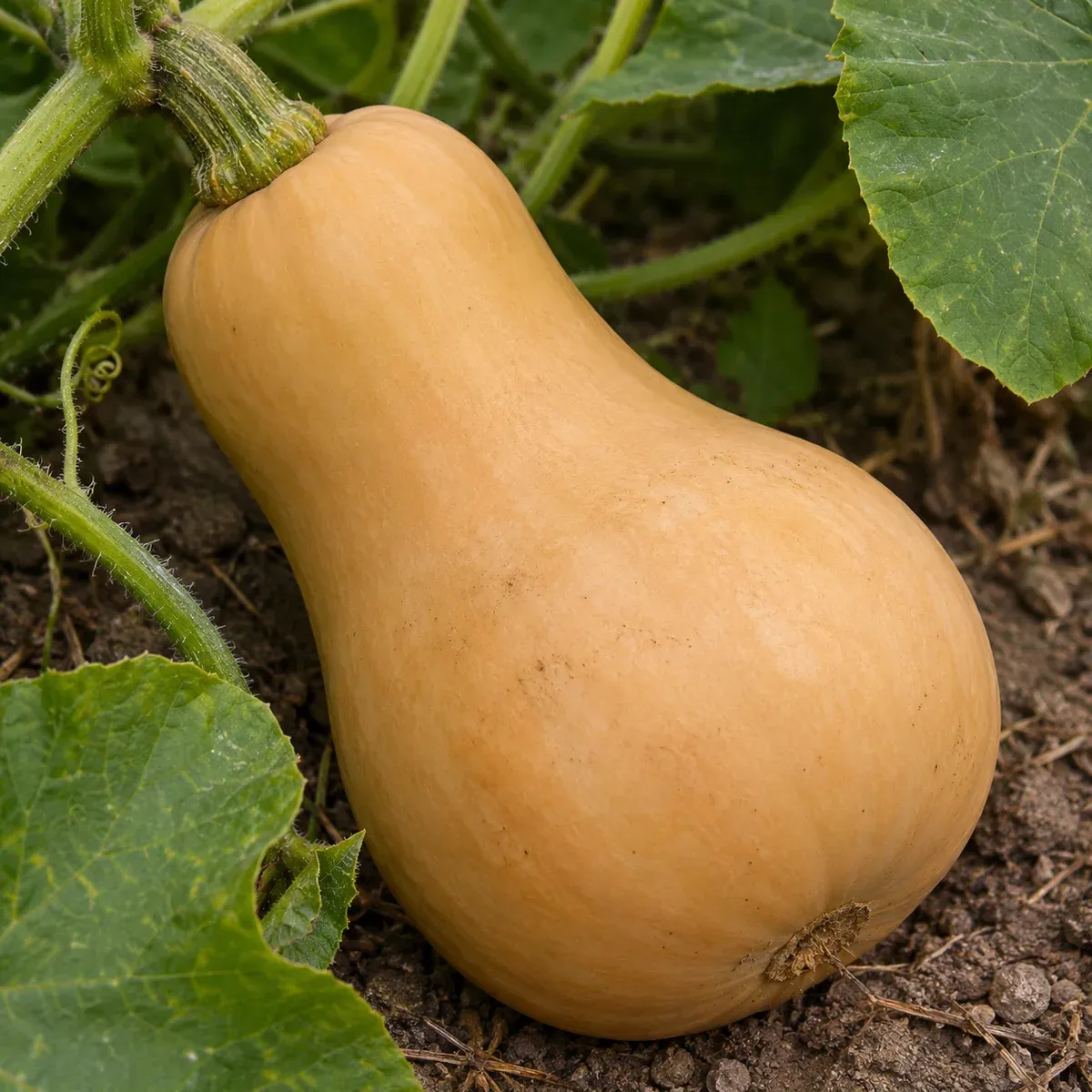
Iowa State University identifies two key signs: a uniform beige colour and a hard skin that resists pressure from a fingernail. Colour alone is not sufficient. Avoid damaging the skin during this check.
Harvest before frost, as recommended by the RHS. Cut the stem, leaving a portion attached to the fruit, and handle each squash gently to avoid bruising. Record the harvest date with the variety name to compare future attempts.
Sorting before storage
These guidelines apply to whole squashes. The University of Massachusetts reserves storage for fruits without disease, rot, insects or unhealed wounds. Set aside damaged fruits; a hard skin does not compensate for injury. Cold exposure in the garden can also reduce their storage potential.
This university describes a post-harvest preparation in a warm, dry, ventilated environment for up to two weeks to encourage skin hardening and healing of minor cuts. This step does not make a rotten fruit healthy.
Then store butternut squashes in a dry, airy place at around 10 to 13 °C, according to Iowa State University. Keep them away from apples, pears and other ripening fruits: their ethylene reduces squash storage life.
Avoid stacking and check their condition regularly. Actual storage duration depends on the fruit’s condition at storage and the room’s conditions, as noted by the University of Massachusetts. Remove fruits that begin to rot, following the University of Minnesota, without waiting until the end of a storage period stated on the seed packet.
Managing growth, flowers and leaves: ongoing monitoring
The general squash guide explains how to manage stems and supports for different growth habits and fruit types, and inspect flowers without fruit. For damaged leaves, a rotting stem base or shrivelling young fruits, follow the checks before assuming disease is the cause. These shared guidelines clarify observations and their limitations.
Organising neighbours and keeping records
To compare space, light, water and access for crops, use the layout method for a single bed. Also keep a record of planting locations before planning next steps. These two methods do not guarantee a protective effect from pairing plants.
For a maize–French bean–squash combination, read the conditions and limitations of the “Three Sisters” before allocating space.
Key points for this crop
Practical guidance
- Species
- Cucurbita moschata
- Planting
- After the last frosts, in warmed soil
- Space
- According to the variety’s growth habit
- Storage
- Ripe, healthy fruits handled gently to avoid bruising
Sources and references
- Growing pumpkins and winter squash in home gardensUniversity of Minnesota Extension, in English Accessed on 16 October 2026.
- How to grow squashesRoyal Horticultural Society (RHS), in English Accessed on 16 October 2026.
- When should I harvest butternut squash?Iowa State University Extension and Outreach, in English Accessed on 16 October 2026.
- Pumpkin and Winter Squash Harvest and StorageUniversity of Massachusetts Amherst, R. Hazzard, in English Accessed on 16 October 2026.
- Cucurbita ‘Butterbush’Royal Horticultural Society (RHS), in English Accessed on 18 October 2026.