
The vegetable garden notebook / Crops
Growing spaghetti squash: sowing, spacing and harvesting at maturity
Spaghetti squash is a winter squash: its fruits are left to mature, and their cooked flesh separates into strands. Ensure adequate space for the chosen variety and a sufficiently warm season before starting to sow.
Adapt this guidance to your garden’s climate and conditions.
Choosing a spaghetti squash for consumption
Spaghetti types belong to Cucurbita pepo, according to the University of Minnesota. Keep the cultivar name: “spaghetti squash” alone is not enough to specify its vigour or final colour. The RHS describes ‘Vegetable Spaghetti’, for example, as a trailing variety whose cooked flesh separates into strands.
Choose seeds or plants clearly identified as edible. The shape of the fruit does not prove its edibility: ANSES warns of confusion with ornamental squashes.
What space should be allocated?
Plant in full sun. For trailing squashes, the RHS recommends 1.5 metres between planting points as a general guideline. Check the details for your variety and also reserve the area where its vines can spread: this spacing is not the final diameter of the plant.
Prepare soil that retains moisture while draining excess water. Well-decomposed garden compost can improve the soil; the University of Minnesota notes that additional fertiliser is not always necessary after organic amendment.
Can a spaghetti squash be grown in a container?
Yes, provided the variety and its cultivation method are verified. All-America Selections presents ‘Sugaretti F1’, a spaghetti squash, as suitable for containers with support. This reference provides a specific example; it does not describe a pot suitable for all spaghetti squashes.
Reserve space for the vines and install the support from the start. Choose a container large enough for the mature plant, rather than keeping it in the nursery pot it was sold in. Check the cultivar’s instructions and follow the watering and nutrition guidelines detailed in the general squash guide.
Sowing indoors, then planting at the right time
For ‘Vegetable Spaghetti’, the RHS recommends sowing each seed on its side, at 1 cm depth, and keeping it at 18–21 °C. Follow the packet instructions for another cultivar. Sow in individual pots and keep seedlings in good light, following the RHS general guide.
The University of Minnesota suggests allowing about four weeks between sowing and planting when planning to transplant winter squashes. Avoid sowing too early without knowing when you can plant.
Wait until the risk of frost has passed and the soil has warmed. Gradually acclimatise the plants to outdoor conditions, then plant without disturbing the roots and water. Direct sowing is possible in warm soil. RHS, Minnesota.
Supporting vines and fruits
Water the soil at the base during dry periods, avoiding unnecessary wetting of the foliage. Adjust applications based on soil and rainfall; guidance from the University of Minnesota makes a distinction for sandy soils, which require more frequent but smaller waterings. The watering guide helps observe the soil before intervening.
Allow the vines to occupy the planned space. The ‘Vegetable Spaghetti’ factsheet does not require pruning. The RHS suggests placing large fruits on a board or tile to isolate them from damp soil.
When to harvest spaghetti squash?
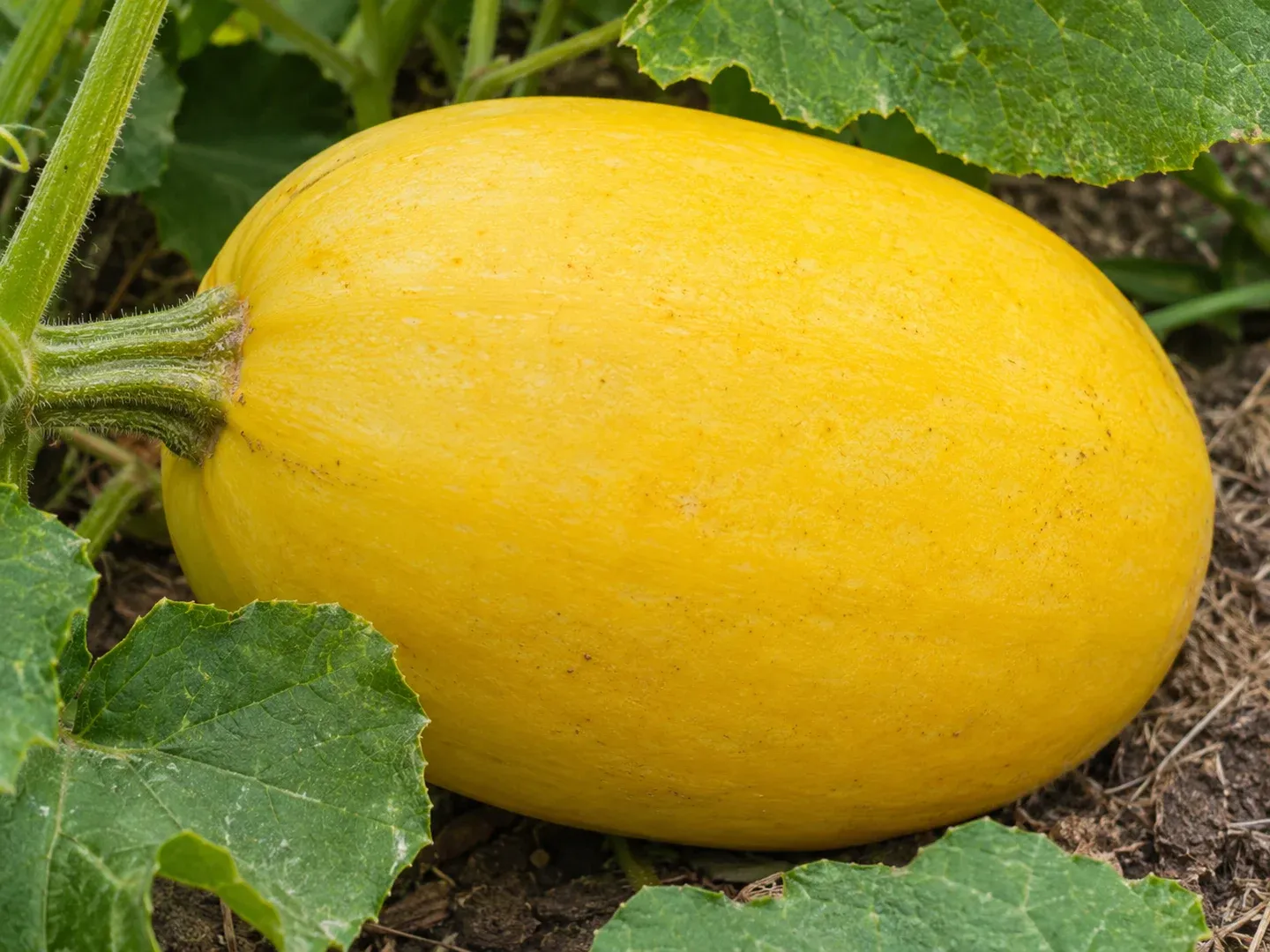
Wait for the fruit to mature. The University of Illinois distinguishes winter squashes from courgettes, which are harvested immature: repeated early harvesting is not the model to follow here.
Combine two observations:
- The expected colour. Iowa State University describes the transition from ivory white to golden yellow for spaghetti squash. The RHS mentions a pale orange skin for ‘Vegetable Spaghetti’: also consult the description of your cultivar.
- A hardened rind. The University of Illinois describes a dull, dry skin resistant to fingernail pressure in mature winter squashes. Check gently, without cutting into the fruit.
Harvest before forecast frosts, according to the RHS. Cut the stem; for spaghetti squash, Iowa State University advises leaving about 2.5 cm on the fruit. Then carry the squash from underneath: the stem may break if used as a handle, warns the University of Illinois.
An immature fruit when frost approaches
Forecast frost requires harvesting, even if not all fruits have met the above criteria. Separate pale or soft-rinded fruits from mature ones intended for storage; note those harvested too early. The storage recommendation from Iowa State University applies to mature spaghetti squashes, and the RHS states that winter squashes store better the riper they are when cut.
Do not rely on a change in colour after harvest to guarantee that a spaghetti squash picked too early is mature, will develop spaghetti-like strands when cooked or will keep well. Rind drying does not replace maturity criteria for fruit on the plant. A cracked or soft-spotted fruit should not be stored. This separation prevents immature fruits from being treated the same as those harvested ripe. Iowa, Illinois
Store only fruits in good condition
Place mature fruits in a cool, dry place, following Iowa State University, with good air circulation and without stacking, as advised by the University of Illinois. Examine the rind before storage: cracks and soft spots are defects to identify.
A bitter squash must not be eaten. The RHS reminds us of this for this cultivar, and the ANSES documents poisonings linked to bitter squashes, including those from home gardens. Neither origin nor appearance should be considered a guarantee.
Management, flowers and leaves: ongoing monitoring
The general squash guide explains how to manage vines and supports according to habit and fruits, then examine flowers without fruit. For damaged leaves, a rotting stem base or shrivelling young fruits, follow the checks before assuming disease is the cause. This shared guidance explains what to look for and the limits of those observations.
Key points for this crop
Practical guidance
- Species
- Cucurbita pepo
- Planting
- In full sun, after frosts, in warmed soil
- Spacing
- To be planned for the vines of a trailing variety
- Harvest
- At maturity, before frost
Sources and references
- Cucurbita pepo ‘Vegetable Spaghetti’Royal Horticultural Society (RHS), in English Accessed on 16 October 2026.
- How to grow squashesRoyal Horticultural Society (RHS), in English Accessed on 18 October 2026.
- Growing pumpkins and winter squash in home gardensUniversity of Minnesota Extension, in English Accessed on 16 October 2026.
- When should I harvest spaghetti squash?Iowa State University Extension and Outreach, in English Accessed on 16 October 2026.
- Harvest abundant squash for food, decorationUniversity of Illinois Extension, Jennifer Fishburn, in English Accessed on 16 October 2026.
- Not all squashes are edible — Vigil’Anses No. 3French Agency for Food, Environmental and Occupational Health & Safety (ANSES), October 2017 Accessed on 16 October 2026.
- Squash Sugaretti F1 — 2017 AAS Edible-Vegetable WinnerAll-America Selections (AAS), in English Accessed on 18 October 2026.