
The vegetable garden notebook / Crops
Growing Sweet Peppers: From Sowing in Warmth to Harvest
Sweet peppers require a sufficiently warm season to form and ripen their fruits. First, choose your variety and its location, then raise the young plants under cover. A green fruit may already be harvestable: its final colour depends on the variety.
Adapt this guidance to your garden’s climate and conditions.
Sweet Pepper and Chilli: Which to Choose?
This guide covers sweet peppers. Iowa State University classifies them under Capsicum annuum, a species that also includes some hot chillies; other chillies belong to different species. An elongated shape does not automatically indicate a hot fruit. Verify the name and the “sweet” label on the tag.
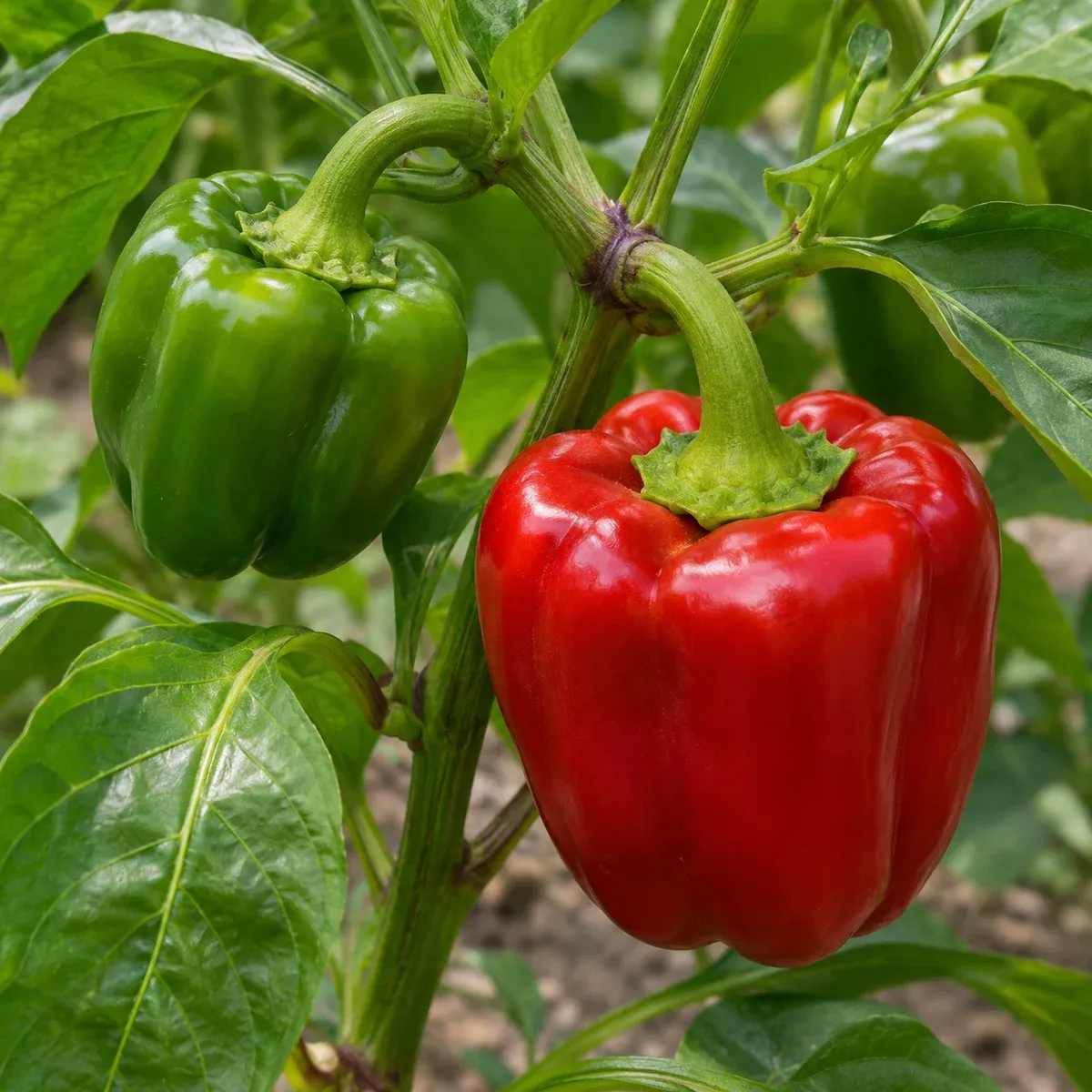
Also keep a note of the colour the variety is expected to reach when ripe. A pepper intended to turn yellow does not necessarily need to redden: Iowa State University Extension describes different final colours depending on the cultivars.
How to Sow Sweet Peppers?
The University of Minnesota suggests starting indoor sowing approximately eight weeks before outdoor planting. This is an indicative preparation period, to be compared with your variety and the time when your garden will be warm enough.
Prepare containers and seed compost, then follow these guidelines from University of Minnesota Extension:
- Cover the seeds with about 6 mm of seed compost.
- Keep the sown containers warm and monitor the compost’s moisture, especially with a heat mat.
- After the seedlings emerge, provide them with abundant light; insufficient light causes them to stretch.
- Prick out or space the young plants when true leaves appear.
The RHS indicates 18 to 21 °C for germination. This guideline does not describe the outdoor temperature required for planting. Our sowing guide helps prepare containers and labels.
When to Plant Outdoors or Under Cover?
Wait until the risk of frost has passed and the soil has warmed: University of Maryland Extension highlights the sweet pepper’s sensitivity to cold. The RHS recommends, for outdoor planting, a warm and sheltered location with nights consistently above 12 °C. Check local forecasts and the temperature of your chosen site.
If the warm season is short, the RHS advises choosing small-fruited varieties, whose fruits develop and ripen faster than large ones. A greenhouse or polytunnel provides shelter but requires monitoring: above 30 °C, fruit set may decrease. Ventilate and provide shading if necessary.
Before final planting out, gradually harden off the plants over one to two weeks. University of Minnesota Extension then advises planting at the same depth as in the pot, without burying the stem any deeper, and watering afterwards.
Preparing the Site and Planting Out
Choose a location receiving at least six hours of direct sunlight per day. Iowa State University Extension suggests spacing plants about 45 cm apart and 60 to 75 cm between rows. Adjust according to the expected growth of your variety.
The University of Georgia recommends well-draining soil and, if necessary, adding garden compost or other organic matter. A soil test can guide fertility adjustments: routinely adding fertiliser or lime does not replace this information.
Plan support before the fruits weigh down the branches. University of Maryland Extension notes that stems can become brittle and suggests a cage or small trellis.
Planting Sweet Peppers in Pots
The RHS recommends one plant per pot at least 30 cm wide, using peat-free multipurpose potting compost and providing support. Place it in full sun, sheltered from wind; the heat conditions described above remain necessary.
Check drainage holes: the RHS on containers considers them essential. Use potting compost designed for containers, distinct from garden compost.
Watering and Maintenance Without a Rigid Schedule
Aim for consistent moisture. According to University of Maryland Extension, drought can cause flower drop and limit fruit size. Before watering, examine the soil near the plants; our watering guide details this observation.
The University of Georgia prefers drip irrigation or a soaker hose to maintain moisture in the root zone. It also advises mulching, for example with straw or garden compost, keeping the stems clear. Monitor moisture under the mulch: its presence does not eliminate the need for checks.
For pots, the RHS recommends a high-potassium liquid fertiliser from flowering onwards. Before starting, check how long the nutrients already in the potting compost are expected to last, as stated on the bag; follow the dilution and frequency of the chosen fertiliser and apply it to moist substrate, as per its container maintenance guide. This approach does not automatically apply to open ground already enriched.
Record your observations with dates: dry soil, dropped flowers, first fruits. To compare two trials, also note the variety name and location. This prevents attributing a difference to a single action when multiple factors may be involved.
What Signs to Look for on Shoots and Leaves?
Inspect shoot tips and the undersides of leaves: the RHS recommends checking for aphids. Its specialised guide describes visible colonies, distorted leaves, and sticky honeydew. Also check for beneficial insects, such as ladybird larvae. A few insects do not justify routine treatment. After identification, the aphid management decision guide details the choice between observation and local intervention.
Soft rot with grey-brown mould may indicate botrytis, illustrated on sweet pepper by the RHS. Carefully remove affected parts and improve ventilation under cover; a single spot is insufficient to identify the disease.
If colonies increase and young shoots become deformed, or if the plant is declining without clearly identified pests, photograph the entire plant and affected areas, then seek identification before intervening. Distinguish these signs from simple flower drop after water stress.
When to Harvest a Green or Coloured Sweet Pepper?
Iowa State University Extension advises harvesting sweet peppers when they are well-developed and firm. They can be picked green or left on the plant until they reach their final colour. Fully ripe fruits are generally sweeter.
Colour should be interpreted with the label and expected size, not solely based on days since sowing. To detach the fruit, cut the stem rather than pulling: University of Maryland Extension recommends this method to avoid breaking a branch.
At the first harvest, note whether you picked green or fully ripe. Recording this detail will make your taste and timing comparisons more useful the following season.
What to Do with the Last Sweet Peppers Before Cold Weather?
The RHS suggests using temporary fleece on outdoor plants or bringing pots indoors to help the last fruits ripen. Monitor cold weather forecasts before extending the growing season. Harvest well-developed fruits if you wish to use them green.
Organising Neighbours and Keeping Records
To compare space, light, water, and access for crops, use the bed layout method. Also keep a record of planting locations before planning the next season. These two methods do not guarantee a protective effect from plant pairing.
Key points for this crop
Practical guidance
- Planting
- In full sun, after frosts and in warmed soil
- Sowing
- Indoors, with warmth followed by sufficient light
- Watering
- Regular moisture in the root zone
- Harvest
- At sufficient size, green or at the variety’s mature colour
Sources and references
- How to grow sweet peppersRoyal Horticultural Society (RHS), in English Accessed on 18 October 2026.
- Growing peppers in home gardensUniversity of Minnesota Extension, Marissa Schuh and Cindy Tong, in English Accessed on 16 October 2026.
- Growing Peppers in the Home GardenIowa State University Extension and Outreach, Aaron Steil, Cynthia Haynes and Ajay Nair, in English Accessed on 16 October 2026.
- Growing Peppers in a Home GardenUniversity of Maryland Extension, in English Accessed on 16 October 2026.
- Home Garden PeppersUniversity of Georgia Cooperative Extension, Bob Westerfield, in English Accessed on 16 October 2026.
- Growing plants in containersRoyal Horticultural Society (RHS), in English Accessed on 18 October 2026.
- Container maintenanceRoyal Horticultural Society (RHS), in English Accessed on 18 October 2026.
- AphidsRoyal Horticultural Society (RHS), in English Accessed on 18 October 2026.
- Grey mouldRoyal Horticultural Society (RHS), in English Accessed on 18 October 2026.