
The vegetable garden notebook / Crops
Growing aubergines: sowing in warmth, planting and harvesting
Aubergine requires warmth from sowing to harvest. Before selecting a variety or date, identify your sunniest spot and decide if protection will be needed to bring the fruit to harvest.
Adapt this guidance to your garden’s climate and conditions.
Choosing between outdoor and protected cultivation
Choose a sunny spot with loosened, humus-rich soil for aubergines. The SNHF highlights its sensitivity to frost and advises keeping protection in place for longer north of the Loire. An available spot is not enough: also consider the warmth it receives.
The RHS, in its British context, prioritises greenhouse cultivation; it reserves outdoor growing for very mild conditions or long, hot summers. For your own garden, take account of this need for warmth without treating the RHS preference as a rule for the whole of France. An outdoor location must also be sheltered.
Next, choose the variety. The SNHF mentions ‘Baluroi F1’ for its early cropping in the northern half of France. Compare how early the variety crops, its mature size and its stated fruit size before deciding based solely on fruit colour. Keep the label: it will also be useful at harvest time.
Sowing in warmth or starting with a young plant
The SNHF recommends sowing from March to April, in individual pots filled with seed compost kept at 20–25 °C, in good light and evenly moist but not waterlogged. It recommends three or four seeds per pot, then keeping the strongest seedling. This guideline assumes access to warmth; it does not describe outdoor sowing in cold soil.
For sowing depth, the University of Minnesota indicates a quarter of an inch, approximately 6 mm. Also check the seed packet. Once seedlings emerge, give them plenty of light: warmth alone is not sufficient. Our sowing guide helps you prepare your equipment and plan how to check the seedlings.
Buying a plant avoids this sowing stage. The University of Minnesota advises selecting a sturdy plant with closely spaced leaves on the stem and no leaf spots. Compare several plants rather than automatically choosing the tallest.
When and how to plant aubergine?
Wait until the risk of frost has passed and the soil is well warmed. The University of Maryland links these two conditions and notes that cold can halt root and foliage growth. A calendar date alone is not sufficient to decide.
Before planting out, gradually harden off the plants. The University of Minnesota describes increasing exposure to sunlight over one to two weeks, initially sheltered from wind, with plants brought indoors if nights turn cold. Hardening off does not make aubergines frost-resistant.
The RHS suggests 60 cm between plants, adjusting for the mature size stated for your variety. Plant at the same depth as in the pot and install the stake at this time. In pots, it recommends a container at least 30 cm in diameter, with a single plant: even with this minimum, keep checking the needs of a vigorous variety. The balcony cultivation guide details choosing the pot and substrate, then water drainage.
Managing water, growth, and flowers
Aim for consistent moisture. A soaker hose or drip irrigation can facilitate watering, according to the University of Maryland. Having either system does not determine how much water to give: observe the soil and adjust settings based on rainfall and drying. The watering guide explains how to check the soil before and after watering.
The University of Minnesota recommends watering at the base and advises against repeated shallow watering. It also warns that excess nitrogen promotes lush foliage and delays fruiting. Therefore, do not automatically respond to a lack of fruit with more fertiliser.
Support is important when fruit weighs down branches: the University of Maryland advises using a cage or trellis to prevent plants from collapsing. Check ties as the plant grows.
In a greenhouse, the RHS recommends opening doors and vents during hot days when plants are flowering to allow pollinating insects access. Retaining warmth does not mean keeping the greenhouse closed at all times.
Feeding in pots and pinching out: what are the guidelines?
The RHS distinguishes between a plant in enriched soil and one dependent on its container. For pots, it suggests applying a potassium-rich fertiliser once the first flowers appear; use an appropriate product, following its label and considering any fertilisation already present in the substrate, without copying a dose from another crop. Fertilisation does not correct waterlogged or overly cold conditions. RHS
To encourage a bushier plant, the RHS suggests pinching out the tip of the main stem when the plant is about 30 cm tall. This practice is not mandatory for all varieties: check the plant’s growth habit, its support and the instructions supplied with it before cutting. Staking remains necessary if branches bend under the weight of fruit; do not confuse supporting with pruning. RHS
Damaged leaves: what to check before treating?
Slow growth or damaged leaves alone do not show that a plant lacks water or fertiliser. The RHS also lists aphids, whiteflies, and spider mites among aubergine problems, particularly in protected cultivation. You need to look for these organisms; naming a symptom does not identify its cause.
Examine both sides of several leaves, as well as the young shoots. Note what you actually see, the extent of damage, and its progression: organisms present, discoloured areas, any sticky residue. The RHS links mites to mottled leaves and whiteflies to honeydew, but these isolated signs do not provide a certain diagnosis. RHS
Compare these observations with soil moisture, temperatures, and plant growth, as discussed above. If the plant remains wilted, revisit water and drainage checks before adding more water. If aphids are identified, the general aphid guide helps you choose an appropriate response. If you cannot identify the problem, the vegetable disease observation guide indicates the information to gather before seeking advice. Do not choose a product based solely on leaf colour.
Recognising harvest time
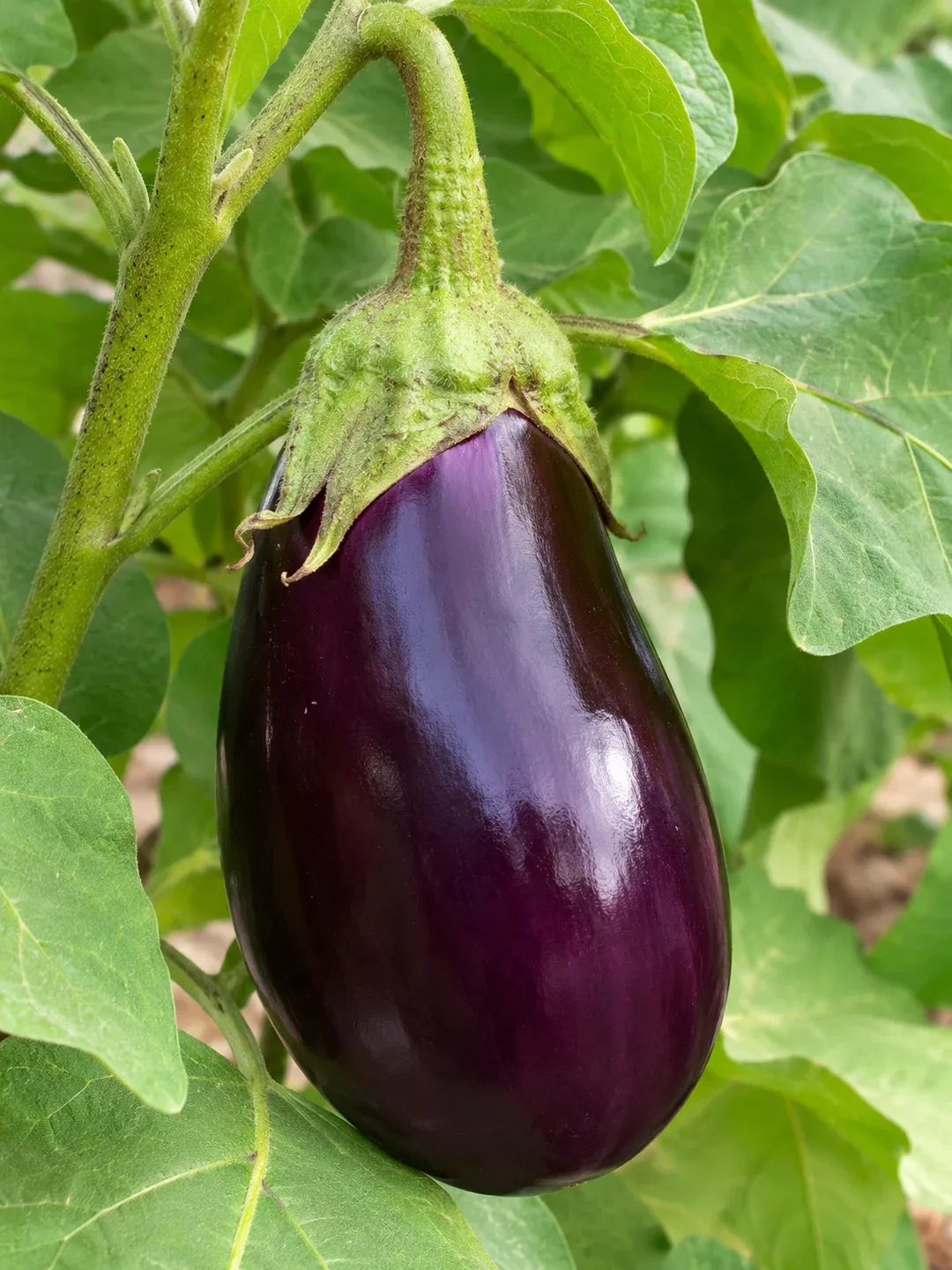
Do not wait for the fruit to reach full maturity. The University of Maryland recommends harvesting when the skin remains very shiny, before the fruit becomes dull and its seeds turn brown. Size depends on the variety: a small aubergine does not necessarily need to reach the size of a large purple variety.
Cut the stem with sharp secateurs or a knife. Harvest regularly as the fruit is ready: the University of Maryland notes that leaving overripe fruit on the plant reduces subsequent production. Record the date and appearance of your first harvest to prepare for the next sowing.
After harvest: short-term storage and monitoring
Harvest as needed when possible. The University of Minnesota describes short-term refrigeration but warns that prolonged cold can cause pitting on the skin. Store only healthy fruit and monitor their condition.
Organising neighbours and keeping records
To compare space, light, water, and access for crops, use the bed layout method. Also keep a record of locations before planning the next season. These two methods do not guarantee a protective effect from a plant pairing.
Key points for this crop
Practical guidance
- Location
- Full sun and warmth throughout the growing season
- Sowing
- In warmth; buying a young plant is also an option
- Planting
- After frosts, in warmed soil
- Harvest
- Shiny skin, before full maturity
Sources and references
- AubergineSociété nationale d’horticulture de France (SNHF), Jean-Marc Muller Accessed on 16 October 2026.
- How to grow auberginesRoyal Horticultural Society (RHS), in English Accessed on 18 October 2026.
- Growing eggplant in home gardensUniversity of Minnesota Extension, Marissa Schuh and Cindy Tong, in English Accessed on 18 October 2026.
- Growing Eggplant in a Home GardenUniversity of Maryland Extension, in English Accessed on 16 October 2026.