
The vegetable garden notebook / Techniques
Vegetable Garden on Chalky Soil: Selecting Plants Without Blindly Acidifying
Chalky soil can be light and dry or heavier and moist. Before amending it, assess its actual constraints: cultivable depth, water, pH, and the needs of the plants you wish to grow.
Adapt this guidance to your garden’s climate and conditions.
Practical steps
- Observe
Separate texture, depth, moisture, and pH.
- Select
Compare crop requirements with your site conditions.
- Preserve
Monitor organic matter and soil cover.
- Verify
Examine symptoms before applying any amendments.
Chalk, pH, and Texture: Do Not Confuse Them
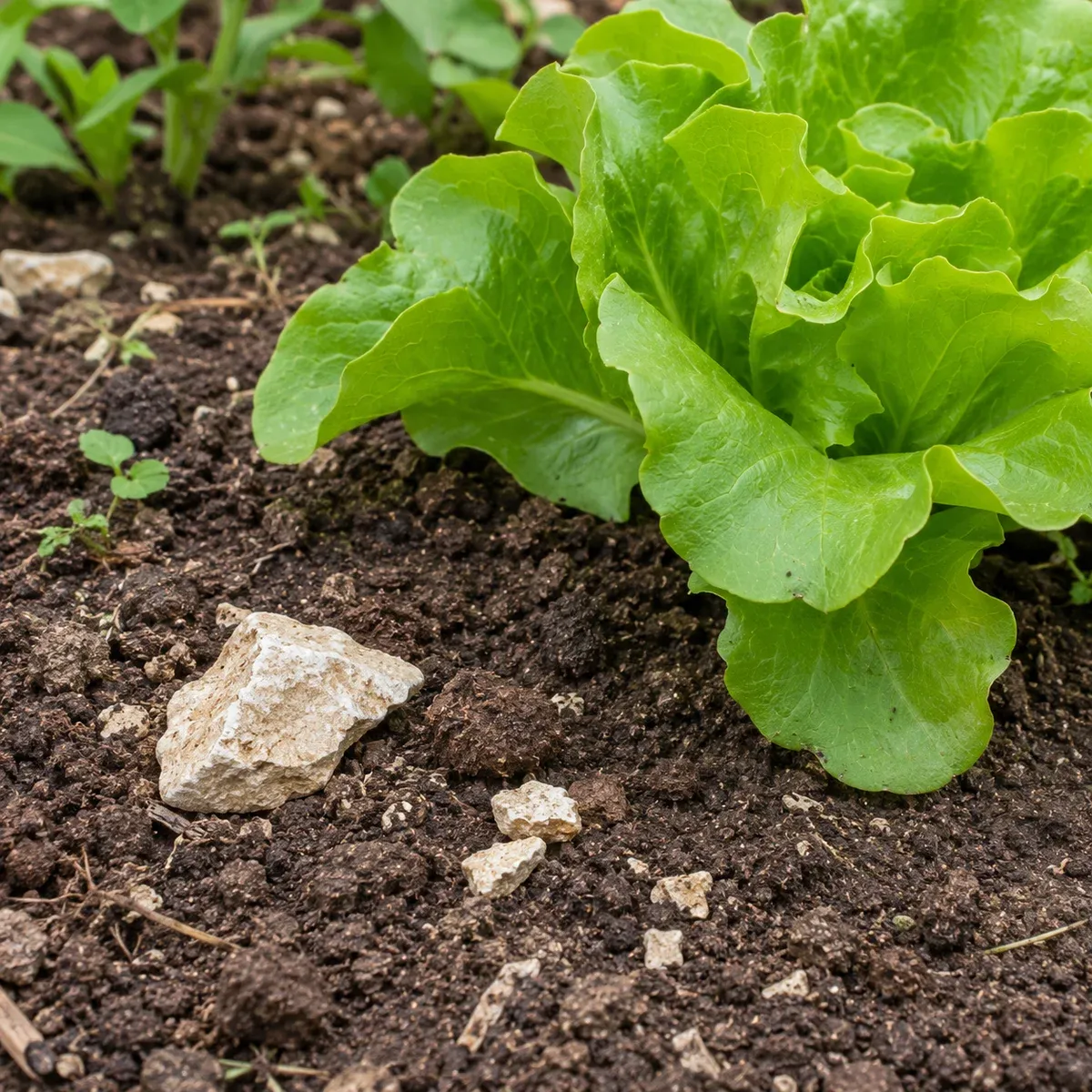
Soils rich in chalk contain calcium carbonate and are alkaline, but their texture can vary significantly. The RHS distinguishes notably between stony, light soils and those containing clay, which retain more water. Simply stating “chalky” is not enough to determine a watering schedule. RHS, chalk
Note the depth of soil actually available, the presence of stones, and whether water persists or is absent after rainfall. INRAE advises separating structure, compaction, moisture status, and pH in any diagnosis. A pH test alone does not describe these other properties.
Select Crops Before Amendments
Review the soil requirements for each plant profile and those specified for your variety. Start with a small area or a few plants; record growth observations rather than filling the entire garden based on a list of vegetables reputed to be “for chalky soil”.
The RHS recommends adapting plant selection to the site rather than attempting to acidify soil containing a high level of free calcium carbonate. The need for acidic soil is a real constraint: it cannot be resolved by adding a handful of potting compost around the roots. RHS, soil types
Two examples illustrate why a “for chalky soil” list is insufficient:
- Common thyme tolerates neutral to alkaline and chalky soils in full sun but requires well-drained ground. This choice does not eliminate the need to check the actual depth available for the root ball. RHS, thyme
- Blueberry plants, by contrast, require an acidic environment: the RHS indicates an ideal pH of 4.5 to 5.5. In alkaline soil, they recommend a large container with a substrate for acid-loving plants. Deep but chalky soil therefore does not meet their needs. RHS, blueberry
Two Soils, Two Decisions
Thin, stony soil that dries quickly: Measure the depth before preparing a sunny spot for thyme. If the root ball cannot be planted at its original depth, opt for a container rather than leaving it exposed. The RHS specifies a minimum of 15 cm in width and 10 cm in depth for one plant, with drainage holes; this minimum does not describe the final volume for every variety. RHS, planting
Deeper soil that retains water for longer: Do not select thyme based solely on pH results. The RHS advises using a pot or a raised bed when the ground remains moist, particularly in winter. Begin by observing water drainage: depth, alkalinity, and drainage are three separate criteria. RHS, planting
Containers present their own water and volume constraints; the container gardening guide helps assess these. Choose a substrate suited to the plant and monitor container moisture.
Organic Matter, Mulching, and Water: Managing the Bed
For light chalky soils, the RHS suggests using organic matter and mulching to improve water retention. Organic matter may also decompose rapidly in these soils: the effect should not be assumed to be permanent. Observe before renewing applications. RHS, chalk
Adjust watering based on actual moisture levels and the crop. A chalky soil containing clay does not follow the same schedule as a very thin, stony soil. The watering guide and mulching guide specify checks to perform before intervening.
Do Yellow Leaves Indicate Iron Deficiency?
The RHS explains that in chalky environments, iron and manganese may become less available, leading to yellowing, particularly between the veins. This possible mechanism does not identify the cause of all yellow leaves: also examine water, growth, stage, and the distribution of symptoms. RHS, chalk · INRAE
Before adding iron or an acidifying agent, clarify the cause and the soil’s properties. The RHS considers acidifying soil rich in free calcium carbonate impractical, as it would require very large quantities of amendment. The fertiliser guide distinguishes between observing and correcting inputs.
Sources and references
- Chalky soilsRoyal Horticultural Society, in English Accessed on 18 October 2026.
- Soil typesRoyal Horticultural Society, in English Accessed on 18 October 2026.
- Assessing soil characteristicsINRAE, Ephytia Vég-Di@g Accessed on 18 October 2026.
- Thymus vulgarisRoyal Horticultural Society, in English Accessed on 8 November 2026.
- How to grow thymeRoyal Horticultural Society, in English Accessed on 8 November 2026.
- How to grow blueberriesRoyal Horticultural Society, in English Accessed on 8 November 2026.