
The vegetable garden notebook / Crops
Planting Sweet Potato: Slips, Warmth, and Harvest
Sweet potato is grown from rooted slips and requires a long warm season. Success depends on the variety, sunlight, and water available until harvest.
Adapt this guidance to your garden’s climate and conditions.
Is Sweet Potato Planted Like Potato?
These are two different crops. Sweet potato belongs to the Convolvulaceae family. Tubers can be started in warmth to produce slips; the SNHF recommends around 25 °C, with light. SNHF
The RHS describes the cultivation of slips, later rooted in small pots, or already rooted plants. To avoid this preparation, start with a plant identified for food production. RHS
How to Root Slips?
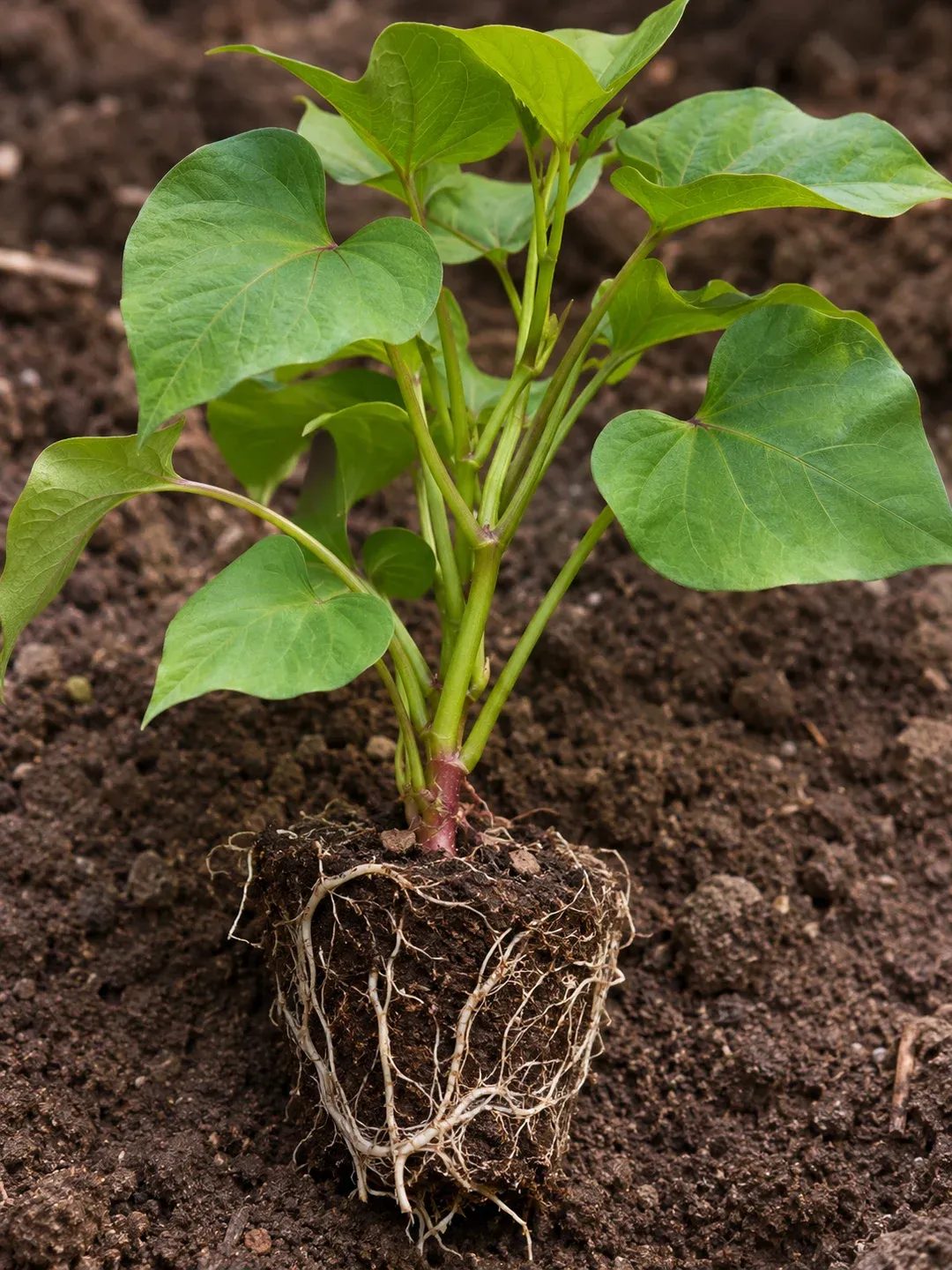
Upon receipt, place unrooted slips in small pots of potting compost. Keep them warm and in good light, with moist potting compost; a mini-greenhouse maintains humidity until they are growing vigorously. The RHS also suggests rooting in a glass of water, followed by potting. Grow the young plants on before hardening them off and planting them in their final position. RHS
To produce your own slips, start with a well-stored sweet potato, still healthy in spring. Start it into growth in moist sand in a warm place. The RHS takes leafy slips of 5 to 7.5 cm, cutting them at the base with a sharp knife, then places them in small pots. Maryland notes that slips separated from the mother root may lack roots: they need moisture to establish. Do not expose them directly to cold. RHS · Maryland
When to Plant Sweet Potato in France?
The SNHF recommends mid-May when frosts are no longer a risk. This condition takes precedence over the month: in cold areas, wait for suitable conditions. The plant is frost-sensitive, though cultivation is possible in the northern half with precautions. SNHF
Choose a variety compatible with your warm season. The RHS states that most require at least four to five months; young plants raised indoors must be hardened off before planting out. This period remains dependent on conditions. RHS
Where and at What Distance to Plant?
Choose a warm, sunny spot in deep, loosened soil. For open ground, the SNHF suggests at least 80 cm between plants. Also allow space for spreading stems. SNHF
In cool climates, the RHS favours protection under cover and very warm, sheltered spots. Their British advice emphasises warmth; it does not mandate a greenhouse for all of France. RHS
Should Stems Be Pruned or Trained?
Stems may spread or be guided on a trellis to clear pathways. Tie those trained upwards. Pruning is not essential; only shorten stems that exceed the reserved space. This controls overgrowth. RHS
How to Water and Can It Be Grown in Pots?
Water at planting to encourage establishment, then monitor during dry periods. Avoid routine nitrogen applications, which may encourage foliage growth at the expense of the crop. SNHF
The RHS recommends one plant in a container at least 30 cm wide, well-drained, at its previous depth. Keep the substrate consistently moist: in pots, drying may limit the swelling of the storage roots. Consult the watering guide to adjust for your soil. RHS
What Signs to Monitor Under Cover?
The RHS mentions mites and whiteflies. If leaves show fine pale speckling, examine the underside with a magnifying glass: mites and fine webs may be present. Small white insects that fly when disturbed, immature forms under leaves, and sticky honeydew suggest whiteflies. Photograph these signs and seek identification if damage progresses; yellowing alone is insufficient for treatment selection. RHS · RHS, mites · RHS, whiteflies
When to Harvest Sweet Potato?
In temperate regions, the SNHF cites foliage drying or temperatures dropping below 10 °C as harvest signals. SNHF
Harvest before frost and lift plants gently: the skin bruises easily. Use damaged specimens promptly and monitor stored ones. The size of the roots at harvest depends on the growing season they have had. RHS
Preparing and Monitoring a Harvest for Storage
If foliage has been touched by frost, harvest roots quickly: Maryland warns that stem degradation can spread to underground organs. Do not prolong cultivation to reach a theoretical size. Remove soil gently without rubbing the skin or washing roots intended for storage. Maryland
The RHS suggests a few days of warm sunshine to dry the skin. This remains a short preparation, dependent on weather. Curing, intended to heal minor wounds, requires heat and humidity conditions difficult to replicate at home. RHS · Maryland
At home, spread roots in a single layer sheltered from rain, with good airflow; avoid a garage that cools significantly. Then store healthy specimens in ventilated crates or baskets, in a cool but not cold room: Maryland recommends around 13 to 16 °C for storage. Inspect regularly and remove those that soften or rot. Domestic conditions do not guarantee months of storage; plan to consume fragile specimens first. Maryland · RHS
Organising Neighbours and Keeping Records
To compare space, light, water, and access for crops, use the bed arrangement method. Also keep a record of locations before planning next steps. These two methods do not guarantee a protective effect from plant pairing.
Key points for this crop
Practical guidance
- Species
- Ipomoea batatas, Convolvulaceae family
- Planting
- After frost risk, in a warm location
- Start
- Rooted slips or plants raised in warmth
- Harvest
- Before frost, according to the growth cycle and the foliage dying back
Sources and references
- Sweet potatoFrench National Horticultural Society Accessed on 18 October 2026.
- How to grow sweet potatoesRoyal Horticultural Society, in English Accessed on 18 October 2026.
- Growing Sweet Potatoes in a Home GardenUniversity of Maryland Extension, in English Accessed on 18 October 2026.
- Glasshouse red spider miteRoyal Horticultural Society, in English Accessed on 18 October 2026.
- Glasshouse whiteflyRoyal Horticultural Society, in English Accessed on 18 October 2026.