
The vegetable garden notebook / Crops
Growing melon: heat, watering and harvesting by variety
Melon requires a warm spot and a suitable variety. Keep its name and cultivation instructions: pruning and the right time to harvest are not the same for all melons.
Adapt this guidance to your garden’s climate and conditions.
Choosing the variety and its location
The SNHF recommends an early Charentais type. Above all, check that the variety suits your cultivation method, whether outdoors or under cover. Select a sunny spot, sheltered from draughts, in deep, well-drained soil enriched with garden compost. For ground cultivation, the SNHF suggests one metre between plants in both directions.
If your location consistently lacks warmth, start with a small trial under cover. The RHS notes that only certain varieties are suitable for outdoor growing in cool conditions.
Sowing in warmth, then planting without rushing
In pots, the RHS recommends sowing at a depth of about 1.5 cm, with 18 to 21 °C for germination. Keep one plant per pot, in warmth and light. Gradually harden it off before planting out.
Wait until the risk of frost has passed and the soil has warmed, as advised by Iowa State University. A date alone is not sufficient. The RHS waits for nights to remain above 12 to 15 °C before planting outdoors: this benchmark does not describe germination temperature.
Sowing yourself or waiting for a plant?
For ‘Anasta’ F1, HM.CLAUSE gives a guideline of 20 to 30 days to raise seedlings, depending on the season and root ball size. This is not a universal timeline for all melons: its protocol includes germination at 23–25 °C, followed by minimum temperatures for raising the seedlings of 14–15 °C at night and 16–20 °C during the day. It also includes gradual ventilation and hardening off before planting out. These conditions differ from the RHS germination benchmark mentioned above. HM.CLAUSE
Start from a feasible planting period for your location, then check if you can provide these conditions while raising and hardening off the seedlings. If warmth, light, or space is lacking, a plant purchased at the right time avoids starting sowing too early. At planting, the RHS considers the three- or four-leaf stage, in addition to outdoor conditions: even at this stage, you still need to wait for suitable night-time temperatures. RHS
Planting a melon in a container
The RHS recommends one plant per pot at least 40 cm wide and deep, filled with peat-free multipurpose potting compost. In a greenhouse or on a very hot, sunny terrace, also reserve space for the stems. For vertical training, provide a sturdy, well-anchored support: the weight of the fruit adds to that of the foliage.
The pot requires monitoring of water and nutrition. The melon watering guide explains how to check the growing medium and drain excess water from a standard pot with drainage holes.
Watering during growth, adjusting at maturity
Iowa State University recommends consistent moisture from germination to harvest, without waterlogging. Water shortage at flowering can compromise fruit formation; near harvest, it may limit fruit size and accelerate stem decline. Apply water to the soil to avoid wetting the foliage.
As maturity approaches, reduce watering based on existing moisture and rainfall. Excess can cause fruit splitting. Do not systematically stop all watering to achieve a sweeter melon: the same source also emphasises the damage from drying out. Our watering guide helps observe the soil before intervening.
Mulching and adjusting nutrient inputs
The RHS advises decomposed organic mulch, leaving the base of the stem clear. In prepared soil, additional nutrients may be unnecessary; slow growth requires reassessing conditions. In containers, it recommends a general liquid fertiliser during growth, then a high-potassium one when fruits reach walnut size. Follow the product instructions; stop feeding as the fruits ripen and the foliage reaches the end of its growth cycle.
Supporting flowers and stems
When growing under cover, open doors or vents during the day to let pollinating insects in. If their activity is insufficient, the RHS describes transferring pollen with a small brush from a male flower to the centre of a flower with a swelling at its base. On a vertical support, also support fruits in a suspended net.
For pruning, start with your variety’s guidelines. An example of a pruning regime described by the SNHF: on a plant with three or four true leaves, pinch above the second leaf to obtain two branches, then prune each above its third leaf. The guidelines then call for leaving one leaf beyond each fruit. This pattern applies only to varieties whose instructions include this method.
The SNHF cites the hybrid Charentais F1 ‘Anasta’ in its example of training without pruning. The breeder classifies it as mid-early, for high summer: the adjective “early” alone is not enough to plan its schedule. HM.CLAUSE Do not automatically apply the previous pinching to it, nor generalise this mention to all F1 hybrids. Note the variety and training method to compare your trials.
Identifying causes of damaged leaves
- Spreading white powder: INRAE describes powdery mildew as white patches, often first on older leaves, potentially affecting both sides. Some varieties show less typical signs: white alone is not conclusive.
- Yellow and green mosaic, reduced vigour: a viral infection is among the possibilities. For CMV on melon, INRAE highlights differences depending on variety, strain, and infection stage; a photograph does not always identify the virus.
- Small pale spots, especially under cover: inspect the underside with a magnifying glass for mites and possibly fine webs. The RHS describes these signs; they call for a check of which pests are actually present.
The SNHF also lists aphids among melon pests. Check shoots and the underside of leaves; if a young plant is nibbled, look for slugs and snails as noted by the RHS. Record damage before any treatment. If it spreads or the plant declines, seek advice with photos and your growing conditions, as recommended by the SNHF.
Recognising your melon’s maturity
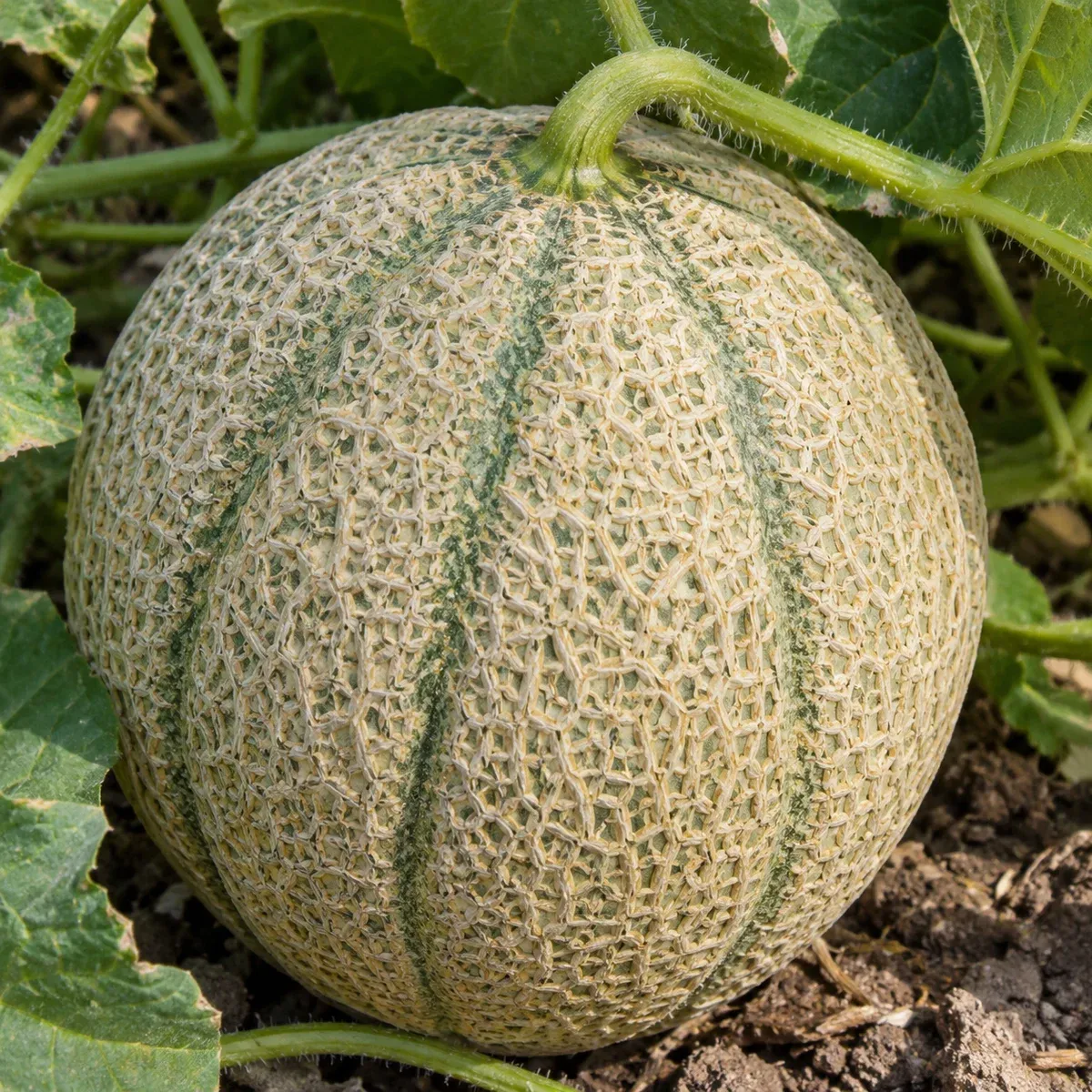
For a melon whose variety description includes these signs, the RHS suggests observing the characteristic fragrance and the first signs of cracking around the fruit stalk. Cross-reference these clues: the word “Charentais” alone does not guarantee the fruit will detach or yellow noticeably. INRAE describes green Charentais melons whose rind changes little and whose fruit stalk shows little or no tendency to detach at maturity. RHS · INRAE
‘Anasta’ is described as fragrant at maturity by its breeder, but the consulted datasheet does not provide a precise detachment test: do not invent one for this variety. Keep its harvest instructions with the label. HM.CLAUSE
The University of Minnesota distinguishes different ripening patterns:
- Cantaloupes that detach at maturity: the fruit separates easily from the stem. Verify that your variety uses this benchmark.
- Honeydew and other melons in the inodorus group: do not wait for this detachment. Colour and fragrance changes depend on the variety; follow its harvest description.
Some melons continue ripening after picking, others very little or not at all. Do not harvest all still-immature fruits hoping they will ripen indoors. Keep the variety name and note the signs observed at first harvest: they will be more useful than a universal date.
Planning neighbouring crops and keeping records
To compare location, light, water, and access for crops, use the method for planning crops that share a bed. Also keep the record of planting locations before preparing the next season. These two methods do not promise a protective effect from a plant pairing.
Key points for this crop
Practical guidance
- Location
- Sun, warmth and well-drained soil
- Water
- Consistent moisture, without saturation
- Training
- Pruning to be checked for the chosen variety
- Harvest
- Different signs depending on the type
Sources and references
- MelonSociété nationale d’horticulture de France (SNHF), Guy Tournellec Accessed on 18 October 2026.
- How to grow melonsRoyal Horticultural Society (RHS), in English Accessed on 18 October 2026.
- Growing Cantaloupe, Muskmelon, and Other Melons in the Home GardenIowa State University Extension and Outreach, in English Accessed on 16 October 2026.
- Harvesting and storing melons, squash and pumpkinsUniversity of Minnesota Extension, in English Accessed on 16 October 2026.
- Melon — Powdery mildew: main symptomsINRAE, Ephytia, D. Blancard and V. Mayet Accessed on 18 October 2026.
- Melon — Cucumber mosaic virus: main symptomsINRAE, Ephytia, H. Lecoq Accessed on 18 October 2026.
- Glasshouse red spider miteRoyal Horticultural Society (RHS), in English Accessed on 18 October 2026.
- Anasta F1 — growing instructionsHM.CLAUSE Home Garden, breeder Accessed on 8 November 2026.
- Melon — Fruit qualityINRAE, Ephytia, M. Pitrat Accessed on 8 November 2026.