
The vegetable garden notebook / Crops
Watering melons: adjusting the amount through to ripening
Melons require consistent moisture during growth. As the fruits ripen, watering should be adjusted based on the moisture still present in the soil: neither a fixed schedule nor a sudden stop can replace this observation.
Adapt this guidance to your garden’s climate and conditions.
When to water a melon plant?
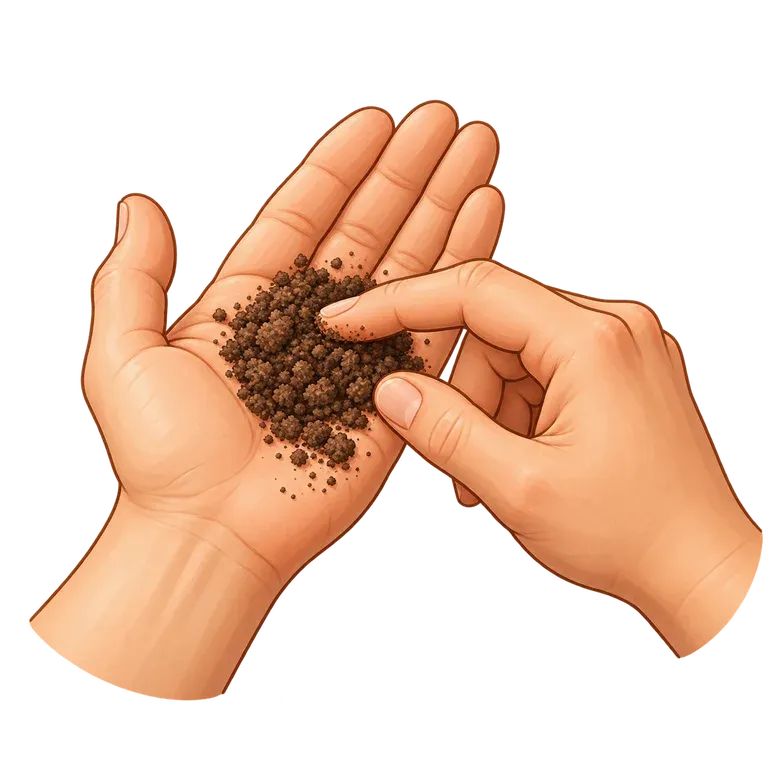
Move the mulch aside and examine the soil beneath the surface, next to the plant, without disturbing its roots. The RHS watering guide recommends checking moisture in the root zone: wetting only the surface is insufficient.
- The soil is drying near the roots: water to moisten this area.
- It remains damp: delay watering and check its condition again later.
- It is waterlogged: suspend watering and investigate what is preventing drainage.
The growth stage, soil type, and weather all influence water needs. There is therefore no fixed number of litres per plant or frequency to apply throughout the season. Our general watering guide provides further details on this observation.
From young plant to fruit enlargement
Young plants require consistent moisture, as noted by the RHS. After planting, monitor the condition of the root ball and the surrounding soil, without keeping them saturated.
At flowering, a lack of water can hinder melon formation, according to Iowa State University. Continue monitoring during fruit enlargement. Under cover, the RHS recommends particular attention when fruits begin to form: daily watering may become necessary in very hot conditions, but this is not a permanent rule.
In the ground: water at soil level and monitor under mulch
Direct water to the soil, using a watering can or drip irrigation, keeping the leaves dry. The RHS advises watering during the cooler hours, preferably in the morning. Afterwards, check that moisture has reached the roots.
In sandy soil, Iowa State University describes more frequent but smaller water applications. This does not justify copying the routine of another garden: observe how quickly your soil dries and take rainfall into account.
Mulch helps retain moisture. Apply it to already moistened soil, as advised by the RHS watering guide, leaving space around the stem as specified in the RHS melon factsheet. Continue to check beneath it. Our mulching guide explains how to choose and apply mulch.
In pots: do not rely on rain alone
A pot dries out faster than open ground. Heat and wind increase moisture loss; a brief shower may only wet the surface. Therefore, check the growing medium before each watering, even after rain, as recommended by the RHS.
In a standard pot with drainage holes, pour water slowly onto the growing medium and allow it to penetrate. Stop just before, or as soon as, the first drops appear at the drainage holes. Empty the saucer after a few hours if it still contains water. For a self-watering container, follow the manufacturer’s instructions.
Should watering be stopped when melons ripen?
Not automatically. Iowa State University recommends reducing watering as maturity approaches, while maintaining consistent moisture until harvest. Excess water can cause fruits to split; insufficient water near harvest may limit their size and accelerate stem decline.
At the end of fruit enlargement, do not stop watering solely because the fruit has reached a certain size or a set number of days has passed. Check the maturity signs specific to your variety, outlined in the melon growing guide, then adjust watering based on soil condition and rainfall. The RHS also suggests reducing water when fruits begin to ripen and the foliage reaches the end of its growth cycle.
If the soil remains damp, wait; if it dries out, provide the necessary water without saturating it. This approach aims to avoid both excess and insufficient water.
Key points for this crop
Practical guidance
- Reference point
- Moisture near the roots
- Application
- Onto the soil, without waterlogging it or wetting the leaves
- In pots
- Increased monitoring in heat and wind
- Maturity
- Reduce watering according to soil conditions; do not stop automatically
Sources and references
- Growing Cantaloupe, Muskmelon, and Other Melons in the Home GardenIowa State University Extension and Outreach, Aaron Steil, in English Accessed on 16 October 2026.
- How to grow melonsRoyal Horticultural Society (RHS), in English Accessed on 16 October 2026.
- Watering vegetables and fruitRoyal Horticultural Society (RHS), in English Accessed on 16 October 2026.
- How to water containersRoyal Horticultural Society (RHS), in English Accessed on 16 October 2026.