
The vegetable garden notebook / Crops
Growing Cucumber: Sowing, Planting, and Harvesting
Cucumber requires warmth and consistent moisture. Before sowing, select a variety suited to your location: pollination needs and space requirements vary by type.
Adapt this guidance to your garden’s climate and conditions.
Selecting the Cucumber Before Choosing the Date
The seed packet should specify the variety’s intended use: greenhouse, outdoors, or both. The RHS distinguishes these applications; fruit length alone is not sufficient to identify them. Also note the harvest size and pollination requirements. Keep this information with the plant label.
For a first attempt, prioritise the location you actually have available. A greenhouse-only variety will not adapt to a cool garden simply by being sown early.
When to Sow and Plant in France?
The SNHF provides two benchmarks: March–April for sowing in pots in a heated greenhouse, followed by May for planting or sowing outdoors once frosts are no longer a risk.
Soil warmth also matters: the University of Minnesota notes that cold soil compromises seedling emergence and plant growth. For your garden in France, verify local conditions before following the suggested month. A mild day is not enough to decide on planting.
In a greenhouse, the RHS waits for an indoor temperature consistently above 12 °C before planting. Monitor night-time minima in particular; do not treat an unheated shelter as a heated greenhouse.
Successful Sowing in Pots
The RHS method involves sowing one seed per pot, at a depth of 1 to 2 cm, in moist seed compost. It uses approximately 21 °C for germination, then keeps young plants warm, in full light, with regular watering.
Prepare pots, labels, and a well-lit space before opening the seed packet. If sowing multiple varieties, separate them clearly: you will need to refer back to their instructions at flowering time. Our sowing guide details how to organise this step.
Preparing the Site and Planting
Choose well-worked, well-draining soil enriched with garden compost, in full sun. The SNHF recommends a general spacing of one metre in all directions. Use this as a guide to prepare ample space; for specific training methods, check the variety’s instructions.
Handle plants gently, preserving the roots, as advised by the University of Maryland. This university also describes trellising: it lifts fruits off the ground and improves accessibility. Decide between ground culture and training before planting, to allocate space for supports and harvesting access.
Should Cucumbers Be Trellised and Pruned?
First, decide whether the plant will climb or trail on the ground. The RHS recommends installing supports at planting, then guiding and tying stems initially: tendrils can later attach themselves, but a stem laden with fruit may still need assistance. Check ties as the plant grows, without constricting the stems.
Pinching is not the same for all cucumbers. The RHS distinguishes between greenhouse and outdoor training: in a greenhouse, it pinches out the main stem when it reaches the top of the support and pinches out side shoots two leaves beyond a female flower. For outdoor training, it suggests pinching the main stem after seven leaves to encourage side shoots. These methods are horticultural options described by the source; verify your variety’s instructions before pruning and do not mix the two approaches. RHS
In containers, the RHS specifies one plant per pot of at least 30 cm in width and depth, with suitable potting compost and support. This is a minimum guideline from the source, not proof that a small pot will suffice for any variety throughout the summer. The cucumber watering guide details monitoring the root ball and drainage.
Watering and Mulching Without a Fixed Quota
Check soil moisture regularly. Water at the base, keeping foliage dry, following the University of Minnesota. Adjust watering based on observations and rainfall; our watering guide helps inform this decision.
Organic mulch reduces water loss and weed growth, but Utah State University advises waiting until the soil is thoroughly warmed before applying it. Consult the mulching guide to choose materials and prepare the surface.
Should Potted Cucumbers Be Fed?
The RHS distinguishes between containers and pre-enriched soil: it recommends regular feeding for the former, while prepared open ground does not automatically require the same supplements. At flowering, its container method switches to a potassium-rich fertiliser. Choose an appropriate product, follow its label, and take account of any fertiliser stated on the potting compost label; neither frequency nor dosage is fixed here for all pots. RHS
Should Male Flowers Be Removed?
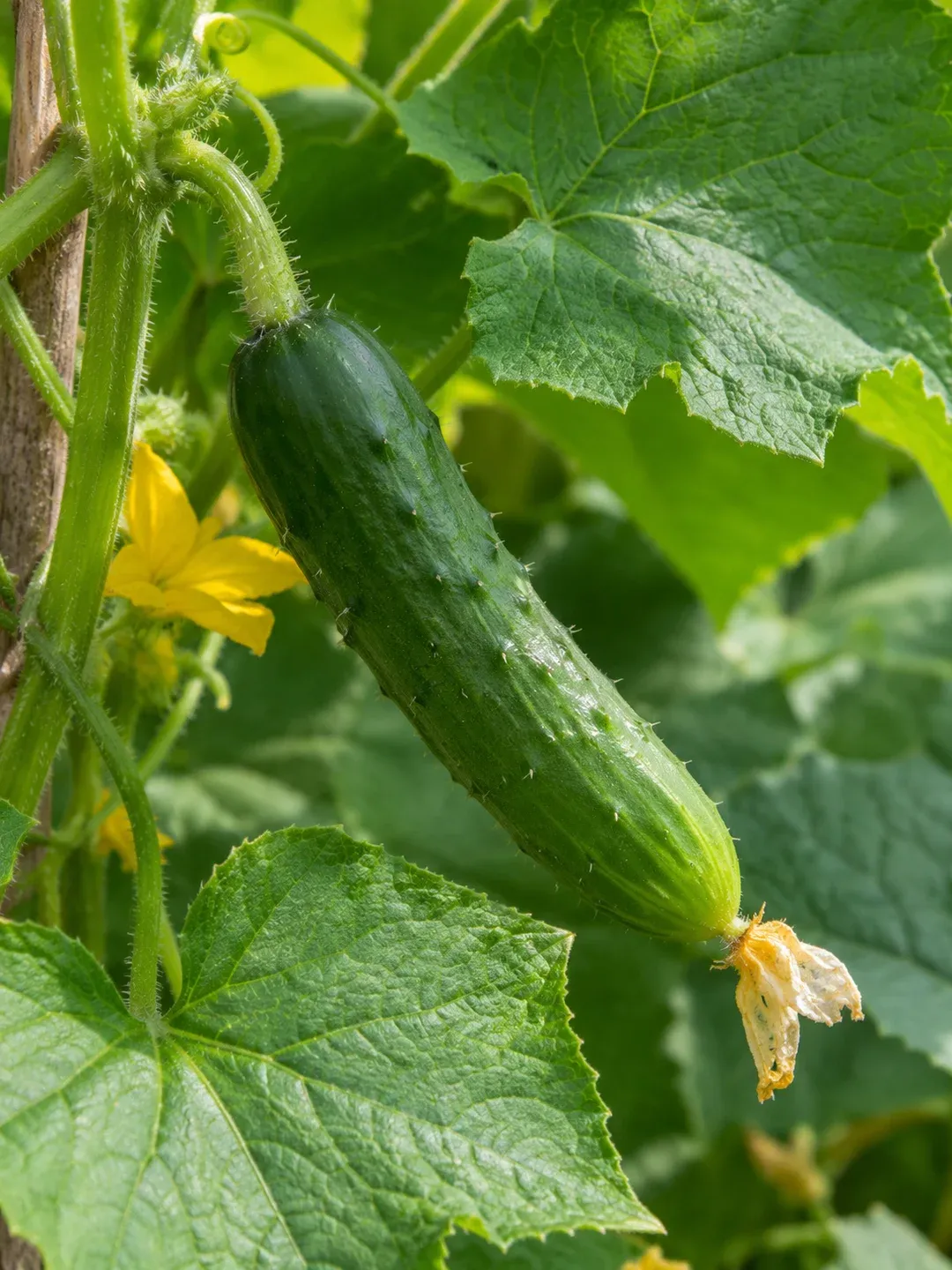
To identify a female flower, look for the small fruit visible behind the bloom. This feature helps you interpret the seed packet’s pollination instructions; by itself, it does not tell you how to prune the stems. RHS
Not without knowing the variety. The University of Maryland distinguishes between ordinary cucumbers, which require pollination, types with mostly or exclusively female flowers that may need another plant to provide pollen, and parthenocarpic types, which produce fruit without pollination. “Female flowers” does not automatically mean “no pollination required.”
Follow the seed packet’s instructions and keep any supplied seed mixture intact if it includes pollen-donor seeds. For a variety requiring insects, remove protective covers when flowering begins, as per the University of Minnesota.
Harvest Young and Watch for Problems
Harvest at the size specified for your variety, without aiming for the largest possible fruit. Utah State University recommends regular harvesting: as fruits age, they develop seeds and tougher skin. Handle cucumbers delicately to avoid bruising.
If growth slows, note what you observe: fruits not enlarging, dry soil, spotted or deformed leaves. The University of Minnesota reminds us that issues can have multiple causes. A single leaf photo does not justify treatment. Also record the variety, dates, and observed conditions for comparison in your next attempt.
White, Speckled, or Deformed Leaves: Observe Before Concluding
The RHS lists powdery mildew, mites, and mosaic virus among potential cucumber problems. White powder, speckles, or mottling guide observations but are not sufficient to identify a cause. Examine multiple leaves, both sides, the stem base, and fruits; note affected plants and progression, along with soil moisture and temperatures. RHS
The vegetable disease observation sheet helps you gather observations before seeking advice if damage progresses. Advice for powdery mildew on courgette does not automatically diagnose cucumber; do not apply treatment based solely on leaf colour or a disease name.
Can a Very Bitter Cucumber Be Eaten?
Iowa links cucumber bitterness to cucurbitacins and cultivation stress, citing local examples of hot, dry weather. This does not allow judging a fruit’s safety by peeling or masking its taste. Iowa
The German Federal Centre for Nutrition explicitly includes cucumbers in its recommendations on bitter cucurbits: if a piece tastes bitter, spit it out and discard the vegetable. It specifies that cooking does not destroy the bitter compounds. Do not attempt to salvage a strongly bitter fruit through cooking, marinating, or repeated tasting. BZfE
Key points for this crop
Practical guidance
- Location
- Sun, warmth and well-drained soil
- Outdoor planting
- After frosts, in warmed soil
- Pollination
- Check for the chosen variety
- Harvest
- Young fruits, at the variety’s specified size
Sources and references
- CucumberSociété nationale d’horticulture de France (SNHF), Jean-Marc Muller Accessed on 16 October 2026.
- How to grow cucumbersRoyal Horticultural Society (RHS), in English Accessed on 18 October 2026.
- Growing Cucumbers in a Home GardenUniversity of Maryland Extension, in English Accessed on 16 October 2026.
- Growing cucumbers in home gardensUniversity of Minnesota Extension, in English Accessed on 16 October 2026.
- How to Grow Cucumber in Your GardenUtah State University Extension, Rick Heflebower and Dan Drost, in English Accessed on 16 October 2026.
- Why are some of my cucumbers bitter?Iowa State University Extension, Richard Jauron, in English Accessed on 18 October 2026.
- Do not eat bitter squash or courgettesFederal Centre for Nutrition (BZfE), Germany, article dated 15 October 2025 Accessed on 18 October 2026.