
The vegetable garden notebook / Crops
Watering cucumbers in pots and in the ground
Cucumbers require consistent moisture, particularly during fruit formation. To decide when to water, check the soil and your cultivation method: a pot and an in-ground bed do not dry out at the same rate.
Adapt this guidance to your garden’s climate and conditions.
When to water cucumbers?
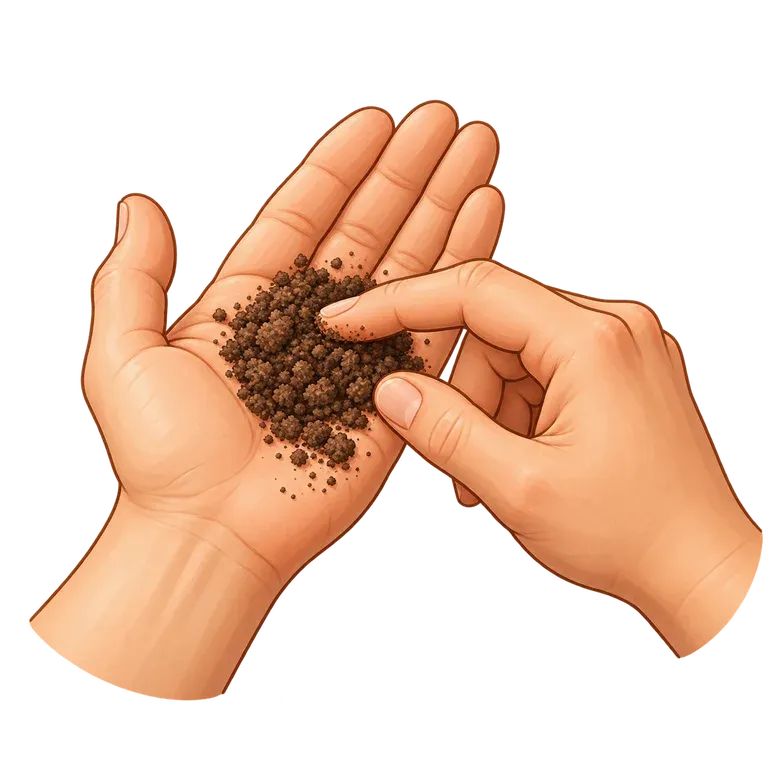
Move the mulch aside and check the moisture below the surface, near the plant. The RHS watering guide recommends examining the root zone: a dry surface does not reflect the entire water reserve.
- The soil is drying out: provide enough water to moisten the root zone.
- It remains moist: delay watering and check its condition again later.
- It is waterlogged: suspend watering and check the drainage.
The growth stage and soil type alter requirements. No specific volume in litres or interval suits all plants. Our general watering guide expands on this observation method.
The cucumber wilts despite moist soil
Do not add water based solely on the appearance of the leaves. First, check moisture near the roots, then note when wilting occurs. Heat or drying winds can cause temporary wilting even if the water reserve is sufficient; Maryland describes a recovery of turgidity in the evening under these conditions. Conversely, saturated soil can deprive roots of oxygen. Maryland
Observe again when the temperature drops. Note whether the symptom disappears, persists, or returns and spreads. Evening recovery does not rule out disease: INRAE states that wilting can be reversible or irreversible and advises examining the stem, collar, and roots as well. Inspect the visible base, any lesions, and the distribution among plants, without systematically uprooting a plant for this initial check. INRAE
If the soil is already moist and the plant remains wilted, shows damage at the stem base, or declines, broaden the examination using the cucumber cultivation sheet and seek advice with photos. Watering more does not help distinguish these causes.
From young plant to first cucumbers
At planting, the RHS advises watering the root ball before removing it from the pot, then watering after planting. Young plants then require consistent moisture, according to its watering guide.
Increase monitoring when fruits begin to form, especially in greenhouses or containers. The RHS cucumber cultivation sheet notes that a pot may require daily watering in hot weather. This is a possibility due to drying, not a frequency to apply throughout the season.
In the ground: adjust watering to soil and trellising
The University of Minnesota recommends soil that retains moisture while draining excess. In sandy soil, watering may need to be more frequent but with smaller amounts each time. A trellised cucumber may also require closer monitoring.
Water the soil at the base, using a watering can directed at the ground, a porous hose, or drip irrigation. Keep the foliage dry. Ensure moisture reaches the roots rather than just wetting the surface. When checking, work gently: the University of Minnesota notes that roots are shallow and can be damaged by working too deeply or too close to the plant.
In pots: check the substrate after rain as well
Check below the surface of each pot: a brief shower may have only moistened the top layer. The RHS points out that heat and wind accelerate water loss, and a deep container retains moisture longer than a small, shallow pot.
In an ordinary pot with drainage holes, pour water slowly onto the substrate to allow absorption. Stop just before, or as soon as, the first drops appear at the drainage holes. Empty any water remaining in the saucer after a few hours, as recommended by this source. For a self-watering container, follow the manufacturer’s instructions.
Mulch at the right time and continue checks
Organic mulch helps retain water, but wait until the soil is thoroughly warmed: Utah State University sets this condition for cucumbers. Apply it to soil already moistened by rain or watering, following the RHS, and keep the base of the stem clear, as specified in its cucumber cultivation sheet.
Subsequently, check the soil under the mulch. The mulching guide helps prepare this step. If the soil remains waterlogged, adding water is unnecessary: excess can encourage root and stem base rot, as the RHS notes.
For variety selection, planting, and harvesting, consult the cucumber cultivation sheet.
Key points for this crop
Practical guidance
- Decision
- Check moisture below the surface
- Fruiting
- Monitor watering more closely
- In pots
- Moisten the substrate without waterlogging
- Mulching
- Wait until the soil is thoroughly warmed
Sources and references
- How to grow cucumbersRoyal Horticultural Society (RHS), in English Accessed on 16 October 2026.
- Watering vegetables and fruitRoyal Horticultural Society (RHS), in English Accessed on 16 October 2026.
- Growing cucumbers in home gardensUniversity of Minnesota Extension, in English Accessed on 16 October 2026.
- How to water containersRoyal Horticultural Society (RHS), in English Accessed on 16 October 2026.
- How to Grow Cucumber in Your GardenUtah State University Extension, Rick Heflebower and Dan Drost, in English Accessed on 16 October 2026.
- Wilting of Vegetable PlantsUniversity of Maryland Extension, in English Accessed on 8 November 2026.
- Di@gno-Lég — WiltingINRAE, Ephytia, D. Blancard Accessed on 8 November 2026.