
The vegetable garden notebook / Crops
Growing dill: sowing for leaves or seeds
Dill is an annual: a single plant does not produce leaves indefinitely. Sow several small batches for harvesting leaves and set aside a few plants for flowering if you wish to harvest seeds.
Adapt this guidance to your garden’s climate and conditions.
Choosing what to harvest and how much space to allow
Purchase labelled Anethum graveolens. For pots, Illinois cites the compact varieties ‘Ella’ and ‘Monia’ in particular; ‘Fernleaf’ is also compact and bolts to seed more slowly. “More slowly” does not mean it will remain in the leafy stage indefinitely. Illinois
Distinguish plants intended for leaves from those you will allow to form their umbels and then seeds. A “seeds” label reminds you to leave their flower stalks during routine harvesting.
When and how should you sow?
The French SNHF booklet gives April to June as a guide for sowing in open ground. Wait until the soil has drained after rain and warmed up; in cold gardens or at altitude, the calendar alone is not sufficient. Choose a sunny spot sheltered from the wind, with loose soil that drains excess water. SNHF, booklet
Direct sowing avoids moving the taproot. Draw a furrow about 1 cm deep, sow thinly and cover. The RHS indicates 30 cm between rows; thin later to 20 cm between plants, a distance also given by the SNHF. Keep the seedbed moist without waterlogging. RHS, SNHF
For leaves, plan a succession while the first batch is still growing. The SNHF suggests one to two months between sowings; Illinois suggests two weeks. These are different schedules for supplying a harvest: start with small quantities and sow more frequently if harvesting leaves quickly exhausts the plants. No interval prevents flowering. SNHF, Illinois
In pots: sow in the final container
Provide a pot with drainage holes at least 30 cm wide and deep, filled with potting compost. Sow directly into it and thin; the pot does not eliminate the need to leave space for the plants. Watch for the compost drying out, especially on hot days. RHS
Plant a purchased pot-grown seedling with its root ball intact, without untangling the roots; avoid plants that have been cramped for too long. As dill does not transplant well, sowing in the final pot remains the simplest start. RHS
Water, maintenance and bolting
Weed around young plants. Keep the soil moist enough while seedlings emerge, then water during dry periods. Well-drained soil should not become constantly dry. If you only want leaves, remove flower stalks as they appear. SNHF
Heat and drought encourage early flowering. Therefore, check the moisture before adding fertiliser to a plant producing fewer leaves; flowering is also part of its cycle. Removing a flower stalk does not keep this annual young indefinitely. RHS, Illinois
What should you watch for on young plants?
Slugs and snails can damage young shoots; look for the animals and signs of feeding before attributing a disappearance to poor germination. Aphids are also possible. Once you have identified aphids, the aphid guide helps you decide whether to keep watching or take action where they are present. A single yellow leaf does not identify any of these problems: check the foliage, the base and whether the soil is wet or dry. RHS
If slugs repeatedly cause damage, the checks around mulch can help you continue preventive measures without assuming that slugs caused every hole.
The SNHF also mentions the swallowtail caterpillar and advises preserving it. Seeing a caterpillar does not mean you should remove every insect on the dill. If losses recur, record the growth stage and damage, then have the cause confirmed before taking action. SNHF
Harvesting, storing and planning ahead
Cut tender leaves as needed, leaving foliage to continue growth. Use them quickly; you can freeze any surplus. RHS, SNHF
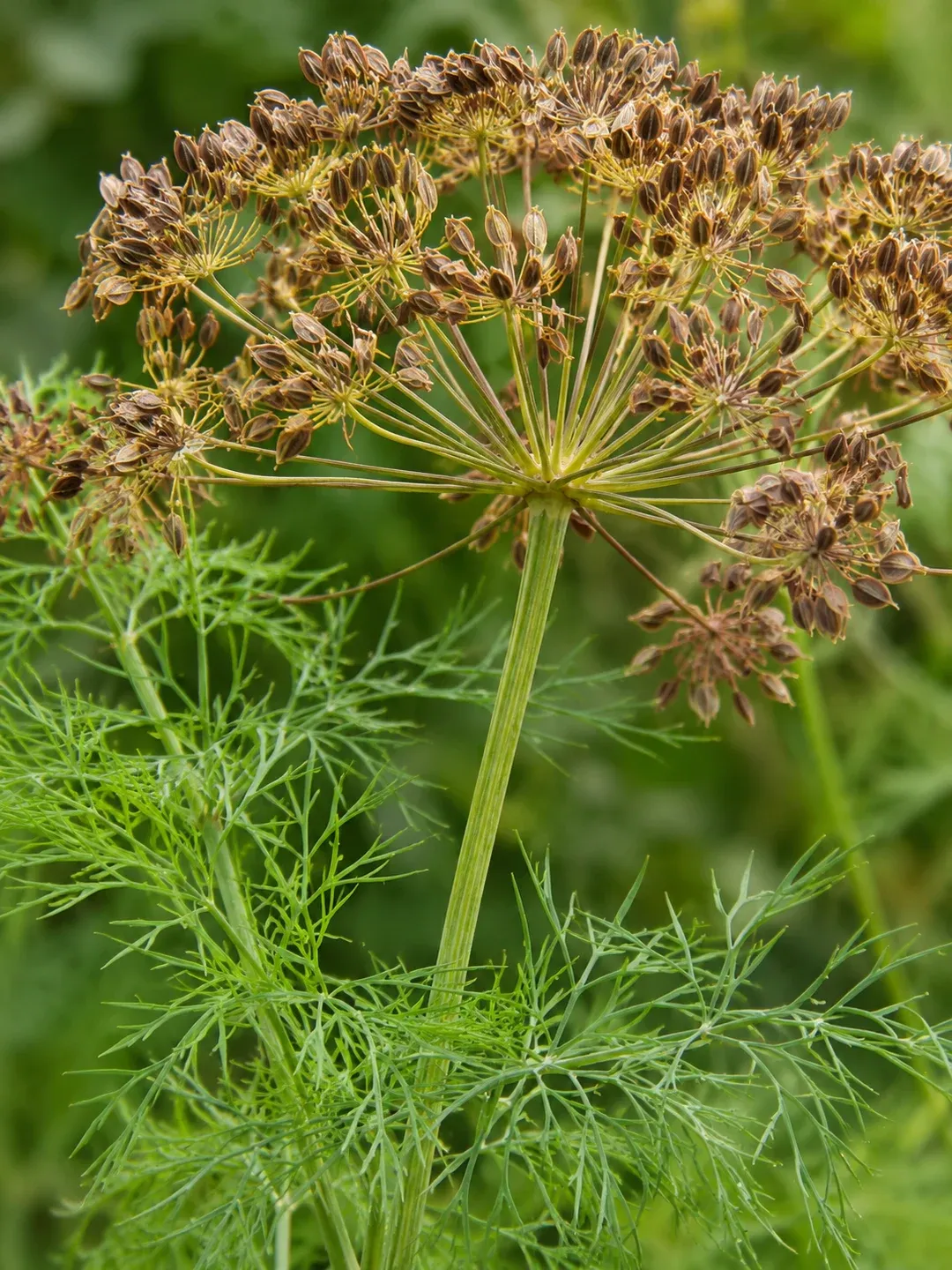
For seeds, keep the umbels until they turn brown. Cut the stems and place the heads in a paper bag, hung in a dry, airy place; wait for complete drying before airtight storage. Judge by the stage of the seed heads, rather than a fixed date in September. RHS, Illinois
Fallen seeds may produce self-sown seedlings; this does not mean the same plant has overwintered. Set aside ripe seeds if you want to resow and remove the heads before dispersal if you want to control where dill grows. Illinois
When planning, allow access for harvesting leaves and space for plants left to set seed. To plan crop successions and where to grow other members of the Apiaceae family, use the crop rotation guide. A general rule of “carrot–dill incompatibility” is not established by the sources in this fact sheet; consider neighbours based on their location and needs with the companion planting guide.
Key points for this crop
Practical guidance
- Species
- Anethum graveolens, annual in the Apiaceae family
- Start
- Direct sowing in the final location
- Spacing
- Guide: 20 cm between plants, 30 cm between rows
- Location
- Sun, shelter from wind and well-drained soil
Sources and references
- Herbs: a world of flavours at your fingertipsSNHF, vegetable and fruit section, April 2023 Accessed on 18 October 2026.
- DillJean-Daniel Arnaud, Société nationale d’horticulture de France Accessed on 18 October 2026.
- How to grow dillRoyal Horticultural Society, in English Accessed on 18 October 2026.
- DillUniversity of Illinois Extension, in English Accessed on 18 October 2026.