
The vegetable garden notebook / Crops
Sowing beetroot: seed clusters, depth and thinning
A single beetroot ‘seed’ can produce several seedlings. Before sowing, decide whether you want individual roots or small beetroots harvested in clusters: this choice affects the space required and thinning.
Adapt this guidance to your garden’s climate and conditions.
Understanding What You Are Sowing
This guide covers beetroot grown for its roots. Check the seed packet for the variety, its sowing window and whether it is labelled monogerm.
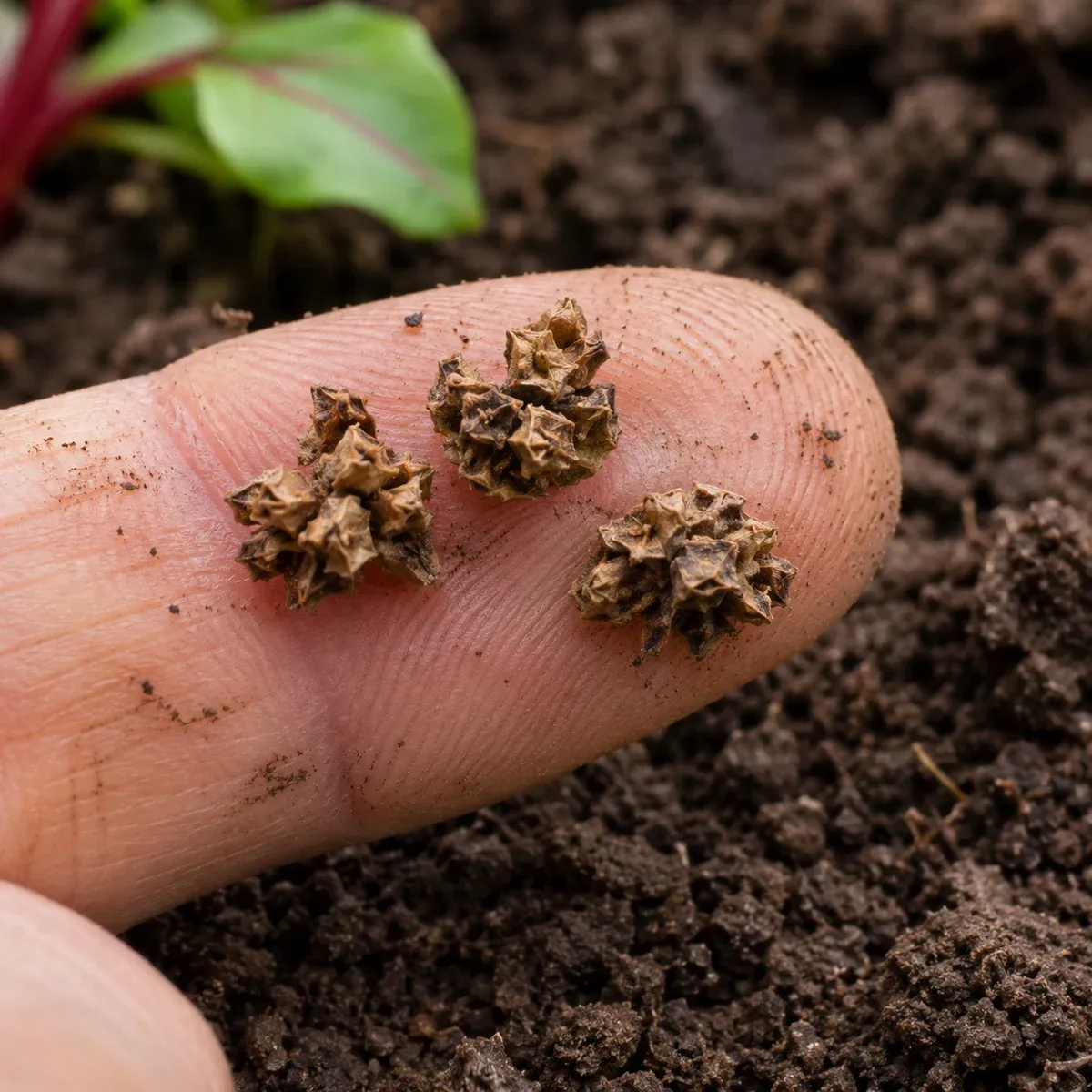
The standard seed is a multigerm seed cluster, a small ball containing several embryos. Several seedlings can therefore emerge at the same spot, explains the University of Maryland Extension. A monogerm seed contains only one embryo per fruit: it avoids several seedlings emerging from a single seed, but does not make up for sowing too densely.
Count the plants after emergence, not just the seeds sown. The Utah State University Extension notes that competition between plants can limit root development.
Choosing the Right Time and Preparing the Site
The Société nationale d’horticulture de France (SNHF) describes direct sowing and sowing in a nursery bed. It recommends moist, deep, loose soil. For variety selection and further cultivation advice, consult the beetroot fact sheet.
The Société nationale d’horticulture de France (SNHF) gives March to June as a guide and advises against sowing too early, which may expose seedlings to frost. Use this window to plan the season; not every day in March will be suitable for sowing. Do not choose a sowing date from a national guideline alone. Sowing too early in cold conditions can encourage bolting (premature flowering); high temperatures also reduce germination, according to the Utah State University Extension. Cross-reference the packet’s window with local conditions and your ability to monitor moisture.
Before sowing, loosen the soil and level the surface with a rake, as recommended by the University of Maryland Extension. Prepare a label and keep the packet: you will need the variety details and spacing instructions when thinning.
Direct sowing for the harvest you want
For individual roots, the Royal Horticultural Society (RHS) recommends sowing 2.5 cm deep, 10 cm between seed clusters, and 30 cm between rows. Moisten the drill, sow, cover, and water if the soil is dry.
In this method, keep one plant per spot by thinning as soon as seedlings reach 2.5 cm tall. First identify the strongest seedling to retain, then remove the weaker ones at soil level by pinching, as described by the Royal Horticultural Society (RHS) for seedlings. This avoids pulling up nearby seedlings from the same seed cluster. Simply flattening a seedling while leaving it rooted does not count as thinning. For small roots harvested young, the RHS offers another option: two or three seed clusters together, with 15 cm between groups, without routine thinning. Here, you deliberately keep a group to harvest while young, rather than aiming for ‘one root per spot’. Royal Horticultural Society (RHS)
These distances describe two precise methods. Follow the instructions specific to your variety; do not choose the density for small beetroots if you plan to let each root grow for a longer period. The sowing guide provides further preparation techniques.
Can Beetroot Be Started in Modules?
Yes. The Royal Horticultural Society (RHS) describes starting under cover in modules filled with seed compost. Place one seed cluster in the centre, at 2.5 cm depth, then retain the strongest seedling.
Plant out well-rooted seedlings at least 5 cm tall after gradually hardening them off. Preserve the root ball and space individual plants 10 cm apart.
This option therefore requires planning for planting out as well as sowing. Note the method chosen to compare your trials with the same variety and harvest goal.
Monitoring the Surface Until Emergence
Utah State University Extension recommends keeping the surface consistently moist and warns that a soil crust can hinder seedling emergence. Check the row before watering and adjust the amount based on drying and rainfall. A moisture requirement does not translate into a fixed number of daily waterings.
Remove young weeds by hand near the sown row. The University of Maryland Extension emphasises that young beetroot seedlings tolerate competition poorly and that deep cultivation can damage roots. Once emergence is visible, return to your chosen goal: one plant per spot or groups of plants intended for harvesting young.
Key points for this crop
Practical guidance
- Seed
- Several seedlings possible per multigerm seed cluster
- Method
- Direct sowing or in modules before planting out
- Density
- To be chosen according to the desired root size
- Emergence
- Monitor moisture and surface crusting
Sources and references
- Growing Beets in a Home GardenUniversity of Maryland Extension, in English Accessed on 16 October 2026.
- How to Grow BeetrootRoyal Horticultural Society (RHS), in English Accessed on 16 October 2026.
- How to Grow Beets in Your GardenUtah State University Extension, Dan Drost, in English Accessed on 16 October 2026.
- Red beetrootSociété nationale d’horticulture de France (SNHF), Jean-Daniel Arnaud Accessed on 16 October 2026.
- Sowing vegetable seedsRoyal Horticultural Society, in English Accessed on 8 November 2026.