
The vegetable garden notebook / Crops
Growing beetroot: sowing, thinning and harvesting
To grow beetroot, first select the variety and desired root size. Then monitor the space between plants and soil moisture: an advertised harvest date does not replace observing the roots.
Adapt this guidance to your garden’s climate and conditions.
Choosing an Edible Beetroot and Its Season
This guide covers edible beetroot grown for its root. Verify this purpose on the seed packet. The roots need not be red: the SNHF also describes white, yellow, or pink roots, and round, flattened, or long shapes such as ‘Crapaudine’. For even slices, cylindrical types such as ‘Cylindra’ are an option described by Maryland.
The SNHF sets the sowing period from March to June, avoiding starting too early due to frost. This general window must be cross-referenced with your climate and the variety’s instructions. For early sowing, choose a variety advertised as bolt-resistant; the RHS notes the risk of bolting in very cold conditions.
Preparing the Soil and Sowing
Select deep, well-draining soil and a sunny location. The Utah State University Extension advises basing fertiliser applications on a soil analysis: do not choose a fertiliser dose from the crop name alone.
For individual plants, the RHS suggests the following benchmark:
- Draw lines spaced 30 cm apart.
- Sow at a depth of 2.5 cm, placing clusters 10 cm apart.
- Cover and water if the soil is dry.
Follow the instructions specific to your seed packet. Keep the sown area moist: a soil crust can hinder seedling emergence, as noted by Utah. The sowing guide provides additional details on row preparation and monitoring.
Growing in Containers
Choose a beetroot with a round root for container growing; long-rooted varieties need a greater usable depth of compost. The RHS recommends a pot at least 40 cm in width and depth to accommodate plants. This guideline also applies to preparing a sowing container: place it in full sun, use potting compost, and ensure drainage holes.
Sow directly with 10 cm between clusters, under approximately 2.5 cm of potting compost, then thin to obtain individual roots. Growing in small groups targets smaller roots. RHS
Monitor moisture more frequently than in open ground: the limited substrate dries out faster. Adjust watering based on its condition. Growing in a pot does not change the growing season. Under cover, you can start in modules, then harden off the plants and transplant each root ball without damaging the roots. RHS
Why Thin After Seedlings Emerge?
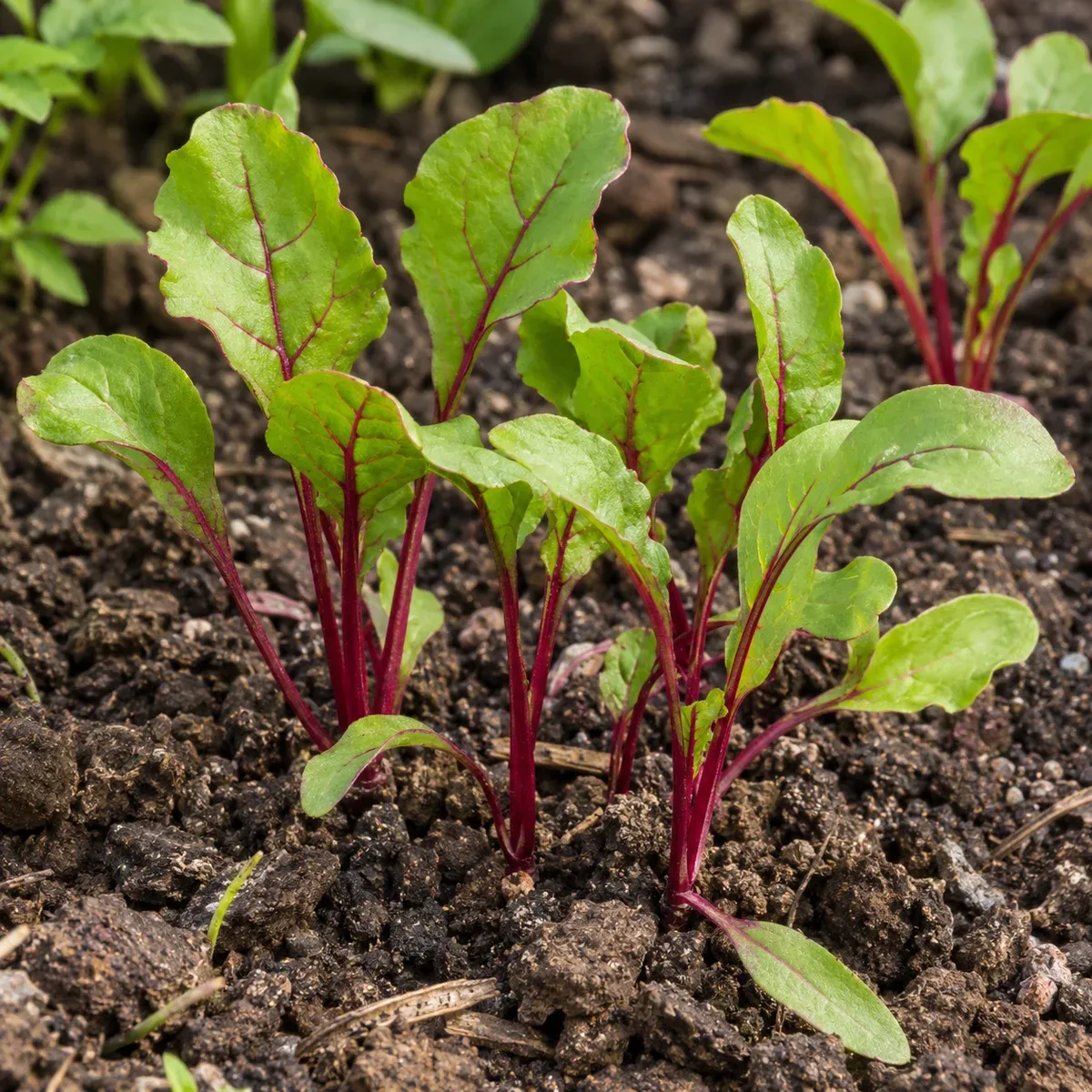
What appears to be a seed is often a seed cluster containing several embryos. Multiple seedlings may therefore emerge in the same spot. Seeds labelled monogerm contain only one embryo per fruit, explains Maryland; they reduce clustering, but overly dense sowing may still require thinning.
For individual roots, the RHS suggests thinning to 10 cm between plants, once they reach 2.5 cm in height. Growing in groups targets a harvest of small roots.
Remove young weeds by hand near the plants. Deep cultivation risks damaging the roots, notes Maryland.
Monitoring Water Without a Fixed Schedule
Requirements depend on the soil. Utah recommends consistent moisture and warns that fluctuations can crack roots; mulching helps reduce water loss. Adjust watering based on rainfall and observed soil moisture, using our watering guide.
Observing Leaves and Roots
Distinguish a mark within the leaf’s thickness from a spot where the tissue dies. Note which leaves are affected first, how the symptoms develop and the recent conditions; also check the undersides before removing anything.
- Pale patches or mines inside a leaf: look for larvae in the mined area and small pale eggs on the underside. The leafminers described by Maryland affect beetroot, chard and spinach. If only a few leaves are affected, the guide suggests removing leaves that contain mines or crushing the larvae inside them; avoid stripping the plant for old marks without visible larvae.
- Small light brown spots with a reddish-purple border: These may indicate cercospora leaf spot, particularly in warm, humid conditions; the centre may later drop out, leaving a hole. These are symptoms described for beetroot and chard by Maryland, not a definitive diagnosis from an isolated hole. Water at the base, limit splashing, and remove diseased debris at the end of the crop. If the problem recurs, note the presence of nearby susceptible crops before selecting the next planting site.
If roots are not growing well, first review spacing and watering. Cracks may result from uneven moisture; a soft or rotten root calls for further checks, including drainage. These distinctions are supported by Utah. Photograph an affected root and the whole plant if the decline continues, then seek local horticultural advice before concluding that a disease or nutrient deficiency is responsible. A black spot alone is not a reason to apply boron or a treatment.
Harvesting by Size and Use
The RHS suggests 4 to 7 cm in diameter as a quality benchmark. This diameter does not describe the length of a ‘Crapaudine’ root. Lift a few roots to assess their size and texture.
Large roots may become fibrous. Loosening the soil with a fork before lifting and harvesting before hard frosts are two tips from Utah.
For storage, the SNHF describes keeping roots in cool conditions, covered with sand in crates or buckets. The storage guide helps compare conditions for root vegetables and organise accessible batches for monitoring. Record the variety, sowing date, thinning, and harvested size: these observations will guide your next choice.
Key points for this crop
Practical guidance
- Selection
- Edible beetroot, shape and sowing window
- Emergence
- Several plants possible per cluster
- Water
- Check moisture and adjust watering to the soil and weather
- Harvest
- Judge by root size and intended use, rather than days alone
Sources and references
- Red beetrootSociété nationale d’horticulture de France (SNHF), Jean-Daniel Arnaud Accessed on 16 October 2026.
- How to Grow BeetrootRoyal Horticultural Society (RHS), in English Accessed on 16 October 2026.
- Growing Beets in a Home GardenUniversity of Maryland Extension, in English Accessed on 16 October 2026.
- How to Grow Beets in Your GardenUtah State University Extension, Dan Drost, in English Accessed on 16 October 2026.
- Cercospora Leaf Spot of VegetablesUniversity of Maryland Extension, in English Accessed on 18 October 2026.
- Leafminers on VegetablesUniversity of Maryland Extension, in English Accessed on 18 October 2026.