
The vegetable garden notebook / Techniques
Vegetable garden in sandy soil: tracking water and preserving fertility
Sandy soil is easy to work but can quickly lose water and nutrients. Effective management combines observation below the surface, organic matter and selecting an area you can maintain.
Adapt this guidance to your garden’s climate and conditions.
Practical steps
- Distinguish
Observe the texture without inferring pH from touch.
- Compare
Identify areas and depths that dry out quickly.
- Improve
Try organic matter and mulch suited to the crops.
- Adjust
Monitor water and nutrition without applying a fixed amount by default.
Sandy soil is not just dry soil
The RHS describes a gritty texture that barely holds together in the hand and is difficult to roll into a small sausage. A sandy mix containing silt or clay may behave differently. This tactile test provides an indication but does not offer a complete analysis. RHS
Distinguish between texture, moisture, compaction and pH. The INRAE recommends recording these characteristics and their distribution across the plot. Do not assume that soil is acidic simply because it feels sandy, nor that all areas of the garden lose water at the same rate.
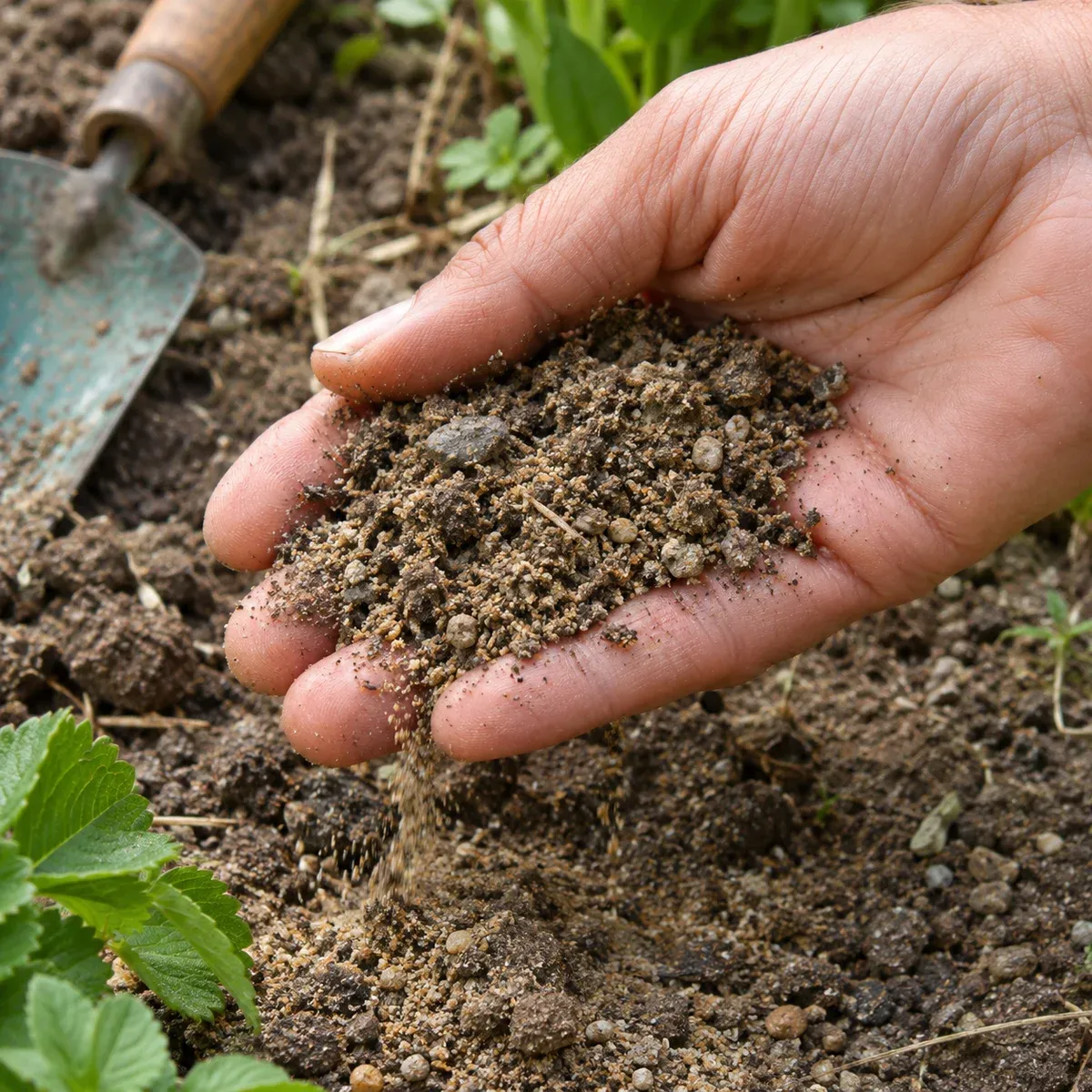
How does rapid drainage affect the soil?
According to the RHS, these soils warm up quickly and are easy to work, but retain water and nutrients less effectively. Recent rain or watering does not guarantee that roots will still have access to water on your next visit. RHS
On your plot record sheet, note the soil’s condition below the surface, the crop and its stage after a few waterings. Compare a mulched area with another part of the garden purely as practical observations, without inferring a universal percentage of water savings.
Gradually improving with organic matter
Jardiner Autrement explains that compost enhances cohesion in light soils and their water retention capacity. Start with a bed you can monitor, using well-decomposed compost and an application suited to the crop; record the material and the actual quantity used. SNHF
First application: selecting the material before distribution
On a cleared and workable sandy bed, where the record of previous applications and the next crop justify compost use, choose mature material: Jardiner Autrement describes it as dark, crumbly and without unpleasant odour. This indicates decomposition but does not alone guarantee the absence of contaminants. The source then describes incorporation by light cultivation or hoeing into the top 5 to 10 centimetres. This depth refers to mixing, not the thickness or quantity of compost to apply. SNHF, instructions for use
Mark out the small selected area, measure the quantity used, then note the planned crop and previous applications. Do not fill a bed with pure compost or infer a dosage from the term “sandy” alone. To select and prepare the material, refer to the compost instructions, then check moisture after watering as described below.
A single application does not automatically transform the entire texture. The goal is to improve bed management, not to create clay soil from a mixing recipe. The guide to potting compost, garden compost or fertiliser helps distinguish these uses.
Watering and mulching while monitoring newly sown crops
Jardiner Autrement advises checking moisture before watering and penetration after application. In well-draining sandy soil, smaller, more frequent applications may be suitable, provided the root zone is moistened. Frequency depends on observed need; do not replicate a fixed interval in days. SNHF, water
| Situation | Useful check |
|---|---|
| Recently sown row | Condition of the layer where seeds are placed; maintain a suitable sowing surface without burying seedlings under mulch. |
| Transplant establishing | Moisture of the root ball and adjacent soil, not just the surface colour. |
| Established crop | Moisture in the root zone before and after application; actual amount that penetrates. |
The irrigation guide details these practices, and the mulching guide covers application conditions. Reduce the area of new sowings if you cannot monitor their moisture.
Should more fertiliser be applied?
INRAE notes the potential leaching in sandy soils; this does not diagnose a deficiency in your garden. Check previous applications, plant growth and crop requirements before increasing fertilisation. A yellow leaf is not sufficient to determine a dosage. INRAE
Keep decisions distinct: improving retention, providing necessary water and feeding according to need. The fertiliser guide helps avoid substituting one for the other.
Sources and references
- Soil typesRoyal Horticultural Society, in English Accessed on 18 October 2026.
- Assessing soil characteristicsINRAE, Ephytia Vég-Di@g Accessed on 18 October 2026.
- Compost: instructions for useJardiner Autrement, SNHF Accessed on 18 October 2026.
- Water-efficient irrigationJardiner Autrement, SNHF Accessed on 18 October 2026.