
The vegetable garden notebook / Techniques
Vertical vegetable garden: choosing plants, containers and supports
Growing upwards can free up ground space. Start by choosing between training a plant rooted at the base of a support and installing several tiered containers: these two solutions do not have the same constraints.
Adapt this guidance to your garden’s climate and conditions.
Practical steps
- Observe
Identify light, wind and accessible locations for watering and harvesting.
- Choose
Match each plant to a substrate volume and support suited to its growth.
- Install
Check stability, fixings and water drainage before planting.
- Adjust
Monitor the moisture of each container and guide the stems as they grow.
Trellis or tiered containers: what do you want to grow?
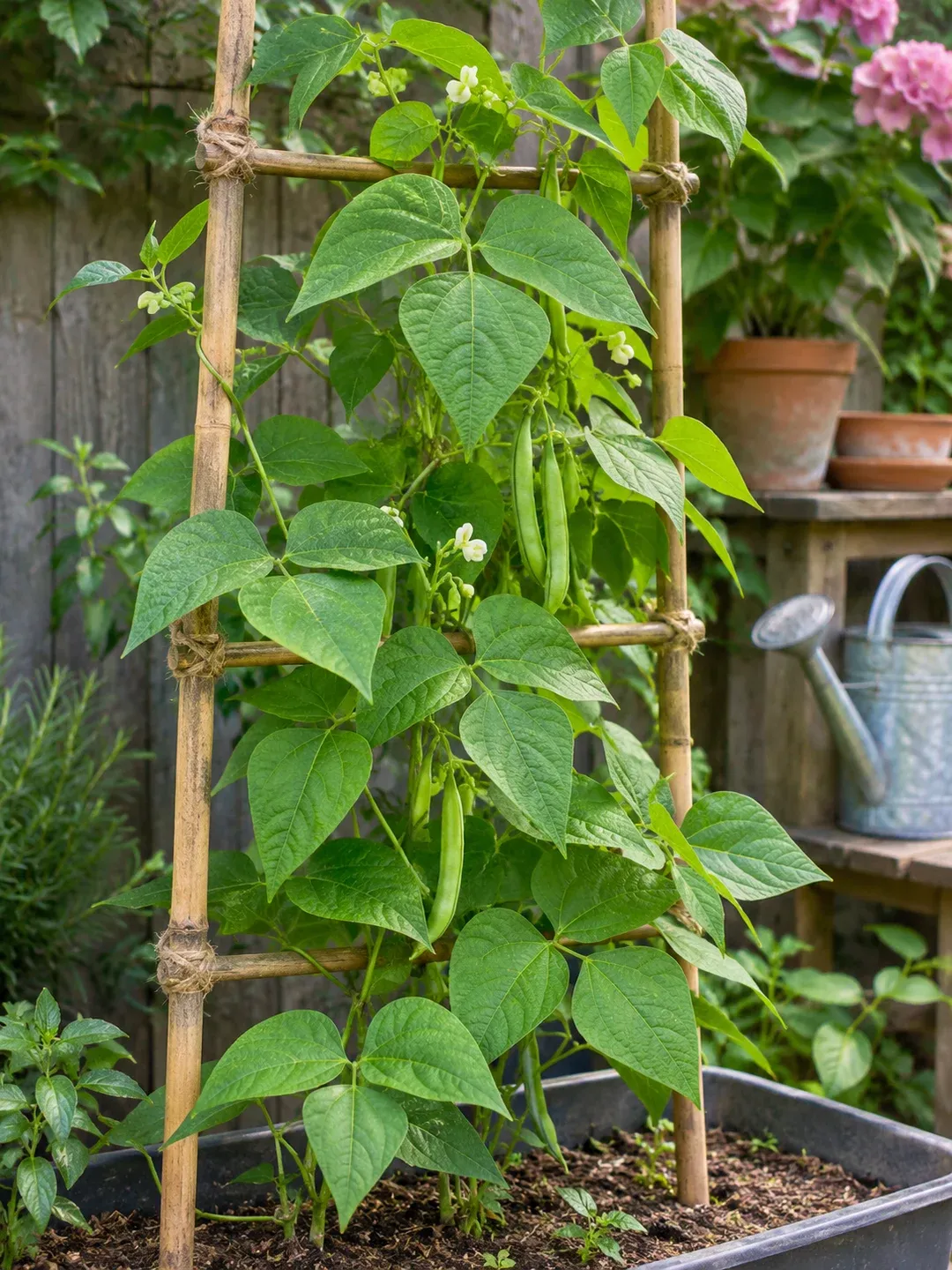
With a trellis, the roots remain in the soil or in a trough at the base of the structure. The stems grow upwards. Climbing French beans, climbing peas or a long-stemmed cucumber may be suitable. Check the growth habit of the variety: a dwarf French bean will not become climbing just because a net is provided. The University of Minnesota clearly distinguishes these growth habits and advises against large, heavy squash on trellises. The guides for French beans and cucumbers supplement the cultivation choices.
With tiered pots or pockets, each plant has its own root space at height. It does not need to climb. The RHS notably cites lettuce, parsley and chives among edible plants tolerating some shade in these systems. Their presence on this list does not mean they are suitable for any pocket, regardless of its size.
Observe the light at each level
Before purchasing, observe the location at several times of the day. A wall, an upper balcony and already installed plants can alter the exposure. Also sketch the space occupied by mature foliage: a row of climbing plants placed in front of other crops can shade them.
Choose plants according to the light actually available and group those with compatible moisture needs, as recommended by the RHS. Tolerance to shade does not mean cultivation is possible in darkness. Leave space between tiers to observe and reach the plants.
Ensure enough space for roots
The height of the setup does not replace the volume of the container. According to the University of Illinois, large plants generally require more space for their roots; with comparable plants, location and material, a large pot requires less frequent watering than a small one.
Therefore, choose the crop before the pocket or pot. If the container does not allow for its development, opt for another plant or a trough suited to the base of a trellis. Do not cut the roots to fit a plant into a tight space. An oversized container is not automatically a solution either: its substrate may remain damp for too long. There is no single volume suitable for all crops here.
A first trial with two containers
Instead of a wall of small pockets, consider two accessible pots of lettuce, on a support designed to carry them, one per level. For planted lettuces, the RHS requires a container at least 30 cm wide and deep; choose the type and variety for the season, then maintain the necessary spacing. The small nursery pot a plant is sold in is not its final growing container. RHS, lettuce
Before filling, place the empty pots and check the movement at each level: see the soil, insert a finger to check moisture, pour water and pick a leaf. Offset the levels if the upper pot blocks light or prevents access to the one below. This access trial is not a strength test: loads and fixings must be validated separately. Start with a single level if these conditions are not met.
Check the structure before filling it
A support must suit mature plants and exposure to wind. In the garden, the University of Minnesota emphasises that the strength of a trellis depends on the stakes, their anchoring and the vigour of the plants. Follow the instructions for the chosen system; this guide does not provide a universal anchoring depth.
For a shelf or wall module, have the compatibility of the fixings with the wall and the loaded setup checked, including the water contained in the substrate. On a balcony or roof, the building’s capacity must be known before adding troughs. The RHS recommends a structural assessment and stresses the need for secure fixings. No permissible load in kilograms per square metre can be deduced from this page for your home.
Before purchasing, ask for the following information about the specific system: permissible load per shelf and for the whole unit, anchoring requirements and compatible supporting surfaces, weight of filled and watered containers, intended wind exposure and water drainage route. Ask which requirements concern the unit and which concern the building. This information is used for the verification recommended by the RHS, without improvised structural calculations here.
Provide stable access to each container for watering, monitoring and harvesting. A tier that cannot be reached from a safe location should be removed from the project.
Water each container according to its condition
Wind and heat can quickly dry out pots; an overhang can also deprive them of rain, notes the RHS. Do not infer the moisture of one tier from that of its neighbour: check the substrate of each before watering. The University of Illinois recommends adjusting the supply to the plant, container and season, without a universal frequency.
When watering is necessary, moisten the root ball and allow excess to drain. Drainage holes must remain functional; do not leave ordinary pots soaking in a full saucer. A layer of gravel at the bottom does not correct a poorly drained pot, according to the University of Illinois. Plan the water’s path so it does not run down the facade or walkways.
Start with an installation you can manage
Install a first trellis or a few accessible containers. On a trellis, maintain the recommended spacing for ground cultivation and gently guide the stems as they grow, according to the University of Minnesota. Note shaded areas and pots that dry out too quickly before adding a tier. The watering guide helps organise this observation.
Vertical cultivation does not guarantee higher yields or freedom from watering. It does not alone constitute a permaculture garden: the Permaculture Association describes a design approach based on observation, available resources and ethical principles. Here, its value is judged by the actual use of space, necessary maintenance and harvests obtained.
Sources and references
- Green wallsRoyal Horticultural Society (RHS), in English Accessed on 16 October 2026.
- Trellises and cages to support garden vegetablesUniversity of Minnesota Extension, Jill MacKenzie, in English Accessed on 16 October 2026.
- Container SizeUniversity of Illinois Extension, in English Accessed on 16 October 2026.
- Roof gardens and balconiesRoyal Horticultural Society (RHS), in English Accessed on 16 October 2026.
- WateringUniversity of Illinois Extension, in English Accessed on 16 October 2026.
- Container Drainage OptionsUniversity of Illinois Extension, in English Accessed on 16 October 2026.
- What is Permaculture?Permaculture Association, in English Accessed on 16 October 2026.
- How to grow lettuces — PlantingRoyal Horticultural Society, in English Accessed on 8 November 2026.