
The vegetable garden notebook / Crops
Growing parsley: sowing, pots, harvest and winter care
Parsley is grown for its leaves both in pots and in the garden. Sowing requires patience and consistent moisture; harvest depends on actual growth, season, and plant renewal.
Adapt this guidance to your garden’s climate and conditions.
Which parsley to choose?
This guide covers flat-leaf or curly parsley grown for its leaves. Root parsley, also grown for its root, requires a different harvest objective. Parsley is biennial: it develops foliage and typically forms a flower stalk in the second year. SNHF
Keep the variety name and the packet instructions: a compact parsley and a vigorous type do not occupy the same space in a planter.
When to sow parsley in France, including in October?
The SNHF provides a broad window from February to September for direct sowing. This guideline must be adjusted to conditions: do not sow in frozen or waterlogged soil; under cover, also monitor available light.
October is therefore not a general outdoor sowing date. A trial in a sheltered container in a mild area remains weather-dependent and may develop too slowly for a harvest before winter. For a winter harvest, it is better to have already developed plants and protect them from severe cold. The possibility of continued growth under cover depends on sufficient light and warmth. SNHF, RHS
Why do parsley seedlings take so long to emerge?
Do not assume failure after a few days. The RHS states it often takes a month or more, sometimes up to six weeks, under the conditions in their guide. University of Minnesota Extension also emphasises the importance of fresh seeds. Mark the row to avoid hoeing it before the seedlings emerge.
Pre-soaking can speed up germination; sources suggest up to 24 hours. It remains optional and does not compensate for old seeds or a seedbed that dries out. Follow the packet instructions as a priority. SNHF, Minnesota
How to sow in the ground or in a pot?
Choose fertile soil that retains moisture, in full sun or partial shade. Direct sowing limits root disturbance. For a container, the RHS recommends at least 25 cm in width and depth, filled with suitable potting compost.
- Sow sparsely, at about 1 cm deep, unless the packet specifies otherwise.
- Water gently and keep the seedbed moist until the seedlings emerge.
- Thin according to the variety: the RHS suggests 15 to 30 cm between plants.
- If planting a specimen raised indoors, harden it off and maintain its previous planting level.
These steps are described by the RHS. The sowing guide provides additional container preparation details.
Watering and harvesting leaves
Parsley prefers moist soil, with watering during dry periods. In pots, check moisture more frequently, without letting the root ball become waterlogged. The SNHF recommends protecting plants in severe cold.
Cut a few outer stems near the base, allowing the centre to continue growing. University of Minnesota Extension advises against only picking the tops of leaves while leaving all petioles: this method reduces productivity.
When the flower stalk appears, the plant enters its reproductive phase. Sow fresh batches to provide young plants rather than waiting for sustained leaf production from the same plant. Leaves are best consumed fresh; part of the harvest can also be frozen. Minnesota
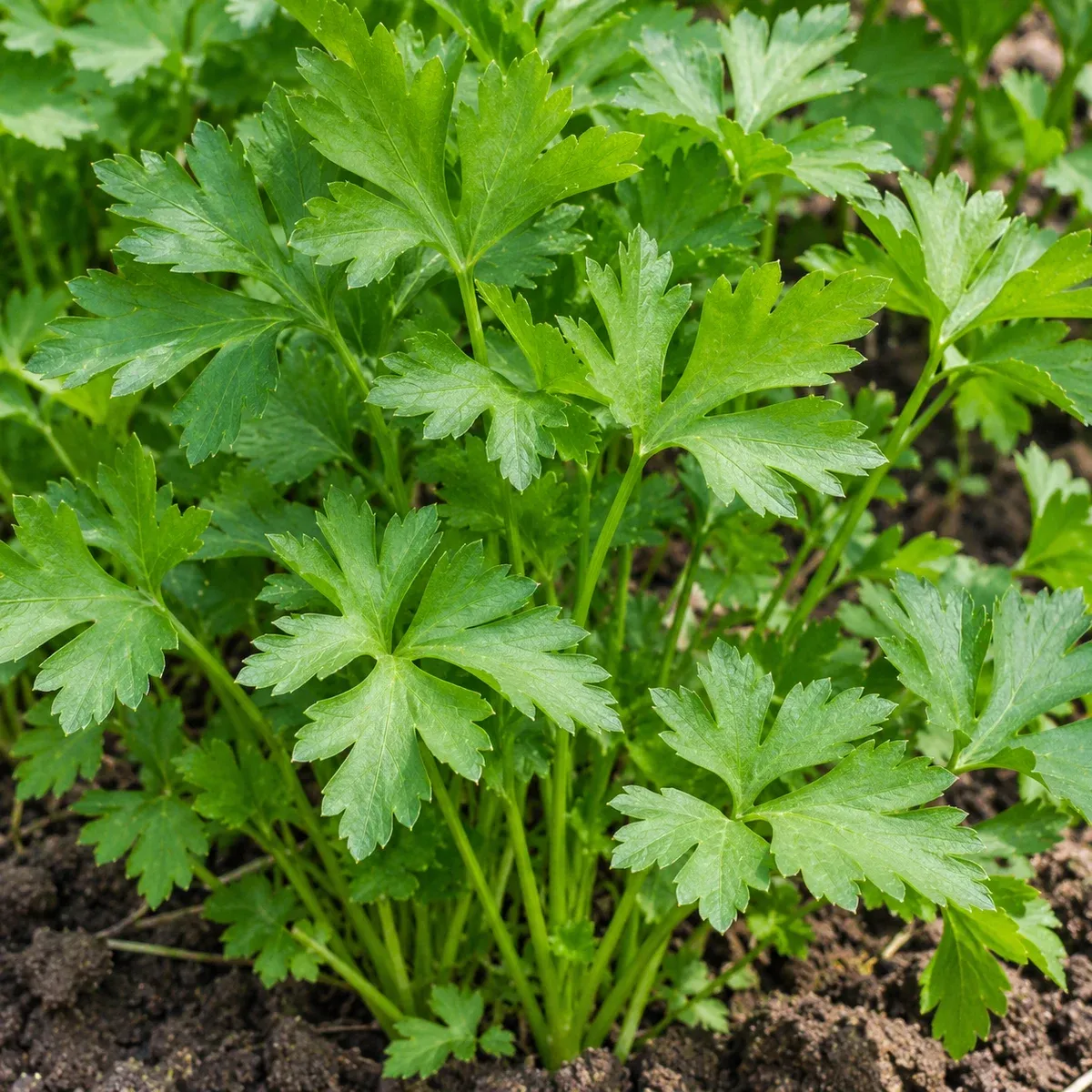
Why does established parsley turn yellow?
First, observe which leaves are changing and the condition of the root ball. A few yellowed lower leaves can be removed; the RHS describes this maintenance step. Widespread yellowing, or yellowing accompanied by decline, requires further checks: deeply dried soil, waterlogging, affected roots, and the condition of new leaves. Colour alone is not enough to diagnose a nutrient deficiency.
Keep the substrate moist without saturating it; check the pot’s drainage holes and empty water retained in the saucer. In hot, sunny periods, moving the container to shade can slow drying. The RHS states that outdoor parsley generally does not need fertiliser: do not add a dose to correct all yellowing. Also consider the plant’s age and the appearance of a flower stalk: the second year marks a lifecycle change, as described above. RHS
Eaten leaves or tunnels in roots: where to look?
The RHS highlights slugs and snails on parsley. Look for the animal and compare damage on young leaves before choosing protection.
Parsley may also host the carrot fly: its larvae feed on roots. If a plant is declining, examining an affected root may reveal rust-brown tunnels and fine cream-yellow larvae. This observation is more useful than diagnosing carrot fly based solely on yellow leaves. For a subsequent exposed crop, the RHS advises full coverage with suitable netting, combined with rotation: adults may emerge from the soil under netting placed in the same spot. RHS — carrot fly
If leaves show spots or degrade without an identified organism, photograph both sides, the stem base, and the entire plant; seek horticultural advice before choosing a treatment. The vegetable garden disease guide helps distinguish observations from diagnosis.
Key points for this crop
Practical guidance
- Crop covered
- Flat-leaf or curly parsley, Petroselinum crispum, for leaves
- Lifecycle
- Biennial: flowering typically in the second year
- Seedling emergence
- Slow: several weeks, sometimes over a month
- Location
- Full sun to partial shade, moist and well-draining soil
Sources and references
- ParsleyFrench National Horticultural Society Accessed on 18 October 2026.
- How to grow parsleyRoyal Horticultural Society, in English Accessed on 18 October 2026.
- Growing parsley in home gardensUniversity of Minnesota Extension, in English Accessed on 18 October 2026.
- Carrot flyRoyal Horticultural Society, in English Accessed on 18 October 2026.