
The vegetable garden notebook / Techniques
Vegetable garden ideas: three layouts and a small-scale start
A vegetable garden idea becomes useful when it addresses a specific challenge. First, decide what you want to make easier: reaching the plants, watering, keeping a path clear, or limiting the initial workload.
Adapt this guidance to your garden’s climate and conditions.
Practical steps
- Identify the constraint
Choose the priority issue: access, water, space, or time available.
- Select a layout
Compare a small bed, containers, or a support for climbing plants.
- Try the tasks
Try out the layout on site: check that you can move around, water, and reach the crops to harvest.
- Adjust the trial
Keep the area limited as long as its upkeep remains difficult to manage.
Which layout addresses your challenge?
Choose from these three layouts the one that suits your space and available time. In a permaculture approach, they help design a space you can maintain. You may select just one.
| Your constraint | Idea to try | Decisive condition |
|---|---|---|
| Reaching the plants without walking through the crops | A small bed along a path | Being able to reach the entire area from the paths |
| Cultivating in a courtyard with no available soil | A few containers near the water source | Having suitable light and being able to monitor moisture |
| Lacking ground space | Climbing French beans on a support | Installing a suitable support without obstructing access or light |
| Not knowing how much work you can manage | A single area before any expansion | Assessing actual upkeep before adding more crops |
A small bed along the path
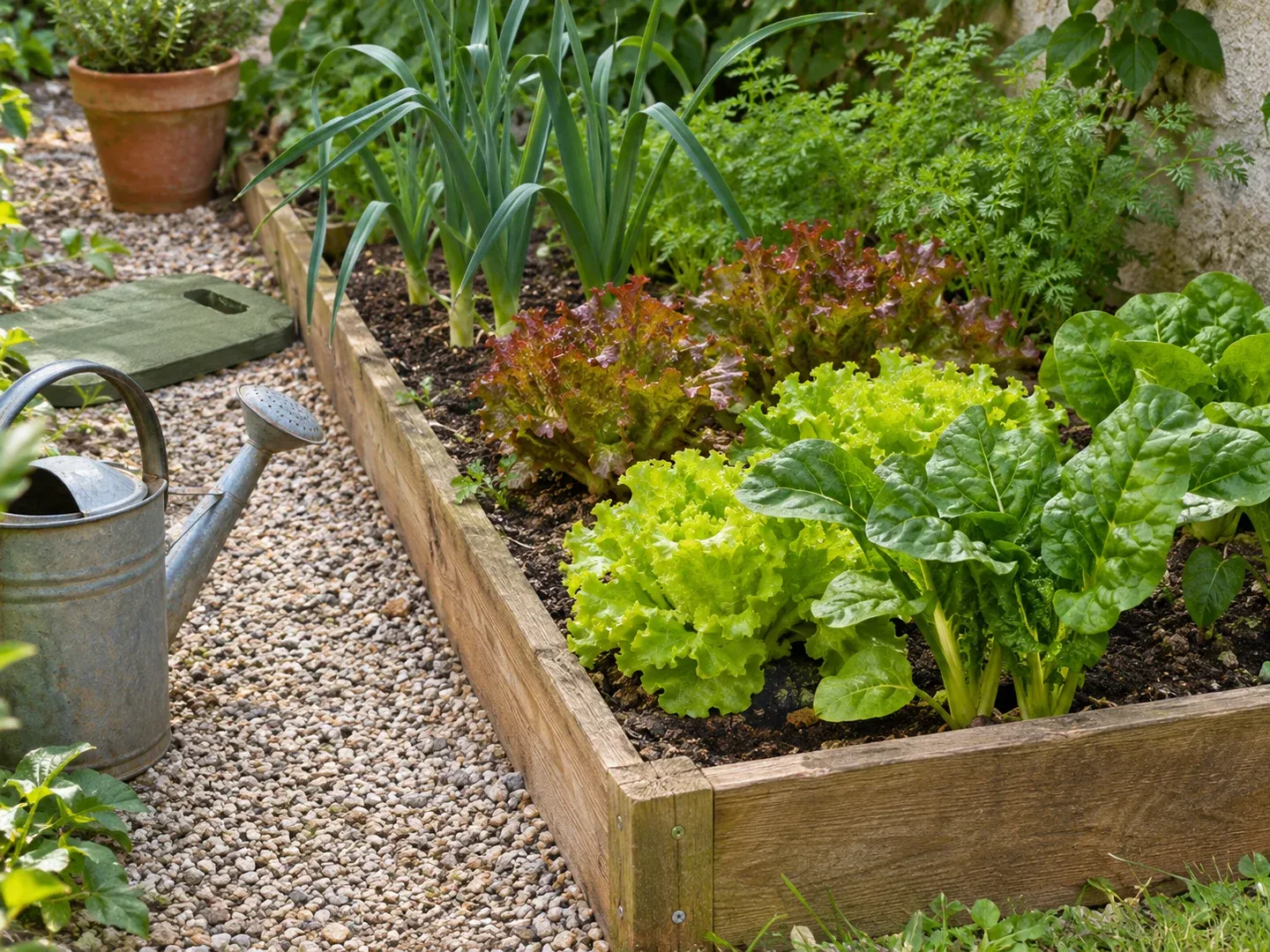
The idea: Transform a strip of already accessible ground into a cultivated area. Keep the existing path and temporarily mark the opposite boundary. Test access to the farthest point with the movements you will use for weeding or harvesting. If you can only work from one side, reduce the width accordingly.
Working from the paths avoids trampling the soil around the plants, explains the University of Maryland. Here, a bed refers to a cultivation area: you do not need to build a frame to mark its boundaries.
The limitation: Adding a raised frame changes the project. You must then plan for materials, maintenance, and water monitoring; the soil in raised beds can dry out faster, particularly in hot, dry weather. These constraints are described in the same fact sheet.
Containers grouped near the water source
The idea: In a courtyard or on a ground-level terrace, allocate one container to lettuces and another to radishes, according to the season and the volume suitable for the chosen varieties. These crops are among the possibilities listed by the University of Maryland. Arrange the pots so you can water each one without stepping over the others.
Proximity to the tap makes organisation easier, but it does not replace suitable exposure. The University of Maryland emphasises the importance of accessible water: some containers require daily watering in hot, dry weather. This is a possibility to anticipate, not a year-round frequency. Our watering frequency guide explains how to start from observed moisture levels.
The limitation: Using many small pots reduces the available reserve for each plant. The RHS highlights the risks of water, nutrient, and root space shortages. Choose a potting compost designed for containers and a volume suitable for the crop; also ensure excess water can drain without prolonged waterlogging.
A support for climbing vegetables
The idea: Reserve a space for climbing French beans, including their support, instead of relying solely on low-growing crops. The RHS describes climbing beans trained on poles, canes, or netting: they grow upwards and need less ground space.
Sketch the support and the space needed for fully grown plants. Maintain access for picking and check the shade cast on neighbouring crops. The University of Maryland recommends arranging tall crops so they do not deprive shorter ones of light.
The limitation: The support is part of the cultivation. Adapt its height, strength, and fixing to the location and chosen plants. A structure designed for beans is not automatically suitable for heavy fruits; the RHS requires a robust structure for squashes and pumpkins. This does not mean that any vegetable can be trained on whatever trellis is available.
Example layout, without a set plan
In a ground-level courtyard, you might choose the container option: a water source accessible at the entrance, a lettuce pot on one side of the path, a radish pot on the other, with access to each container for observation and watering. The choice of crops remains subject to their light, season, and container requirements; the fact sheets above provide the guidelines. This verbal sketch is an organisational suggestion, rather than evidence of how much you can harvest. Before filling the pots, walk the route with the watering can and check that doors and water drainage remain usable.
A trial area that remains small
The idea: Select just one of the previous layouts and leave expansion for later. The University of Maryland advises you to start small and expand when ready. This option is particularly useful when your availability is not yet known.
Choose a few vegetables you eat and quantities you can use: these are criteria from the RHS. On your vegetable garden plan, leave the expansion space as a possibility without equipping it immediately.
The assessment to make: Note watering tasks that are difficult to manage, obstructed paths, harvests actually used, and postponed tasks. Then decide what would make the next trial easier: widening a path, removing a pot, changing a crop, or expanding. An additional area becomes an option when the upkeep of the first one suits you; it is not a mandatory step.
Sources and references
- How to Start a Vegetable GardenUniversity of Maryland Extension, in English Accessed on 16 October 2026.
- Growing Vegetables in Raised BedsUniversity of Maryland Extension, in English Accessed on 16 October 2026.
- Growing Vegetables in ContainersUniversity of Maryland Extension, in English Accessed on 16 October 2026.
- Vegetables in containersRoyal Horticultural Society (RHS), in English Accessed on 16 October 2026.
- Vertical vegRoyal Horticultural Society (RHS), Chris Taylor, in English Accessed on 16 October 2026.
- Planning a vegetable gardenRoyal Horticultural Society (RHS), in English Accessed on 16 October 2026.