
The vegetable garden notebook / Techniques
Vegetable Garden Edges: Choosing Based on Access and Maintenance
Select an edge to address a specific need: separating a path from crops, simplifying mowing, or keeping mulch in place. Test the layout and access points before purchasing materials.
Adapt this guidance to your garden’s climate and conditions.
Practical steps
- Define the Need
Distinguish between a surface boundary and a retaining wall for soil.
- Test Pathways
Mark out the layout and verify access to crops with your tools.
- Choose the Material
Compare its origin, installation, and possible maintenance requirements.
- Monitor
Identify weeds crossing the boundary and any shifting elements.
Do You Need an Edge for Your Vegetable Garden?
An edge clearly marks the separation between crops, lawn, and pathways. It can also limit the movement of mulch or path materials, depending on its shape and installation. These are the functions described by K-State Extension.
Edging is optional: the University of Maryland also describes raised beds without walls, featuring sloped sides. If your pathways are clear and materials stay in place, you can start without construction. The permaculture approach helps in selecting a layout based on its utility in your garden.
Before deciding, define the problem: “grass is encroaching,” “mowing leaves an inaccessible strip,” or “mulch is spreading onto the path.” Retaining soil above the pathway is a different project, with structural constraints.
Verify Access Before Finalising the Layout
Lay a temporary rope on the ground. K-State Extension recommends generous curves, easy to mow, while allowing space for mature plants. Walk around with your watering can or wheelbarrow and check the turns.
Also test the action of weeding and harvesting from the path. The University of Maryland advises working from the pathways to avoid compacting the cultivated area. An edge that forces you to walk among the vegetables therefore calls for a layout adjustment.
On your vegetable garden plan, represent the actual thickness of the edge: it occupies space itself. Check the pathways at the narrowest point, not just between the centres of the beds.
Which Material Matches Your Maintenance Needs?
| Option | Advantage | Limitation to Consider |
|---|---|---|
| Edge cut into the lawn | No material to install. | Recut and trim encroaching blades after mowing. RHS |
| Flush bricks or paving stones | Can form a pathway strip for the mower wheel. | Check that the level and width suit your machine. K-State |
| Irregular stones | Create a visible boundary. | Grass may grow through the joints; the edges will need trimming by hand. K-State |
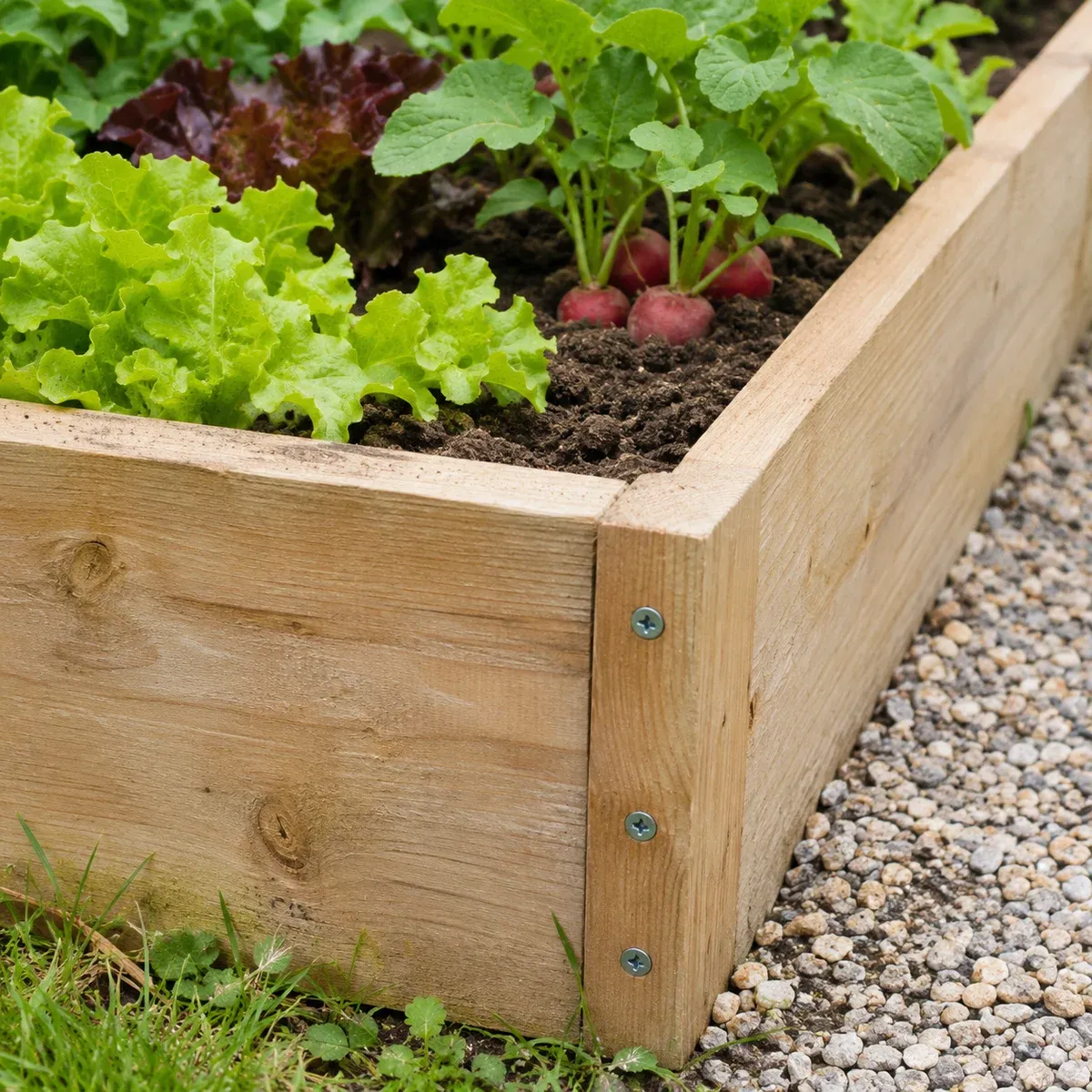
| Untreated wood of known origin | Allows for an edge with replaceable elements. | The wood decomposes and may require repairs. RHS |
| Metal or plastic strip | Creates a narrow boundary. | Check the fixing; grass may grow over the top. Some plastics may shift or crack in frost. K-State |
A high edge does not automatically aid mowing. The RHS notes that blades out of the mower’s reach require hand-trimming with shears. Before installation, identify where the wheel will pass and which areas will need manual cutting.
Selecting Reclaimed Materials Based on Their Origin
For reclaimed wood, ask about its source and any treatments it has undergone. Avoid old railway sleepers and demolition timber with an unknown history. The University of Maryland recommends steering clear of older wood treatments using CCA, creosote, and pentachlorophenol. Rejecting unknown wood is a precautionary choice: its appearance alone does not indicate its treatment.
If purchasing a product, keep its composition and usage instructions. The source distinguishes between older treatments and more recent products; it does not allow all treated wood to be deemed identical, nor does it certify any reclaimed piece. Untreated wood of known origin is an option if you accept its maintenance requirements.
Do not assume a universal lifespan for wood. The RHS describes its softening due to decomposition and the potential need for repairs. Inspect the actual condition of the pieces and their stability.
When Does an Edge Become a Raised Bed Wall?
As soon as the project involves containing soil at height, the stability of the structure becomes a construction issue. A decorative row placed on the ground is insufficient to demonstrate it can fulfil this role.
The RHS outlines requirements for bonding and foundations in masonry beds. Do not extrapolate an edge installation to a retaining wall: choose a design suited to the terrain, material, and desired height, with expert advice if necessary. This guide does not provide retaining wall plans. The square vegetable bed guide helps clarify the type of installation and its access; for a simple low wooden frame placed on the soil, the construction method covers that specific type of project. These guides do not provide structural dimensions for a high wall retaining a mass of soil.
Keeping an Edge Easy to Maintain
An edge does not stop all weeds. The University of Minnesota notes that the roots and underground stems of some plants can pass beneath shallow edges. Monitor regrowth on both sides and intervene before they establish or set seed. The weeding guide helps choose the appropriate action based on the weeds and crops present, before deciding to raise or replace the edge.
During your visits, also check for displaced pieces, loose fixings, and damaged edges. Restore anything that hinders access or maintenance. If the issue is only scattered mulch, first adjust its distribution using the mulching guide, then observe whether an edge remains necessary.
Sources and references
- All About EdgingJohnson County K-State Research and Extension, in English Accessed on 16 October 2026.
- Lawn care in spring & summerRoyal Horticultural Society (RHS), in English Accessed on 16 October 2026.
- Building Raised Beds for Vegetable GardeningUniversity of Maryland Extension, in English Accessed on 16 October 2026.
- The Safety of Materials Used for Building Raised BedsUniversity of Maryland Extension, in English Accessed on 16 October 2026.
- How to make a raised bedRoyal Horticultural Society (RHS), in English Accessed on 16 October 2026.
- Controlling weeds in home gardensUniversity of Minnesota Extension, in English Accessed on 16 October 2026.