
The vegetable garden notebook / Techniques
Weeding the vegetable garden while minimising root damage to crops
Effective weeding between crops depends on the plant to remove and the space left by the vegetables. Work on a small area at a time, keeping your movements controlled and clearly in view.
Adapt this guidance to your garden’s climate and conditions.
Practical steps
- Identify
Distinguish young annuals from perennials that regrow from underground organs.
- Wait
Work only when the soil is workable, avoiding frozen or waterlogged ground.
- Adapt
Hoe shallowly between rows and weed by hand near crops.
- Return
Monitor regrowth and remove it without dispersing perennial fragments.
Identify before choosing the tool
An annual completes its life cycle in one season, while a perennial can regrow for several years. This difference guides the approach: cutting a young annual just below the surface may suffice, whereas some underground fragments of perennials can produce new shoots. Identify unknown plants before intervening, taking care not to confuse a self-sown seedling with the row you sowed. RHS
First, locate the vegetables and their young seedlings. If you cannot yet distinguish the sown plants from other shoots, wait until you can identify them before hoeing that area. The sowing guide helps prepare recognisable rows.
The goal is to limit competition in the cultivated bed. Spontaneous vegetation left elsewhere in the garden does not necessarily require the same effort.
Wait for workable soil
Postpone work on frozen, waterlogged, or very sticky soil. The ground should not compact into a dense mass under your movements or footfall. Avoid deep digging around established crops: deep cultivation can damage their roots, and repeated tool use degrades soil structure. RHS, soil cultivation
For hoeing small annuals, choose dry weather: uprooted plants will dry out more easily. In damp conditions, they may re-root and need to be collected. RHS
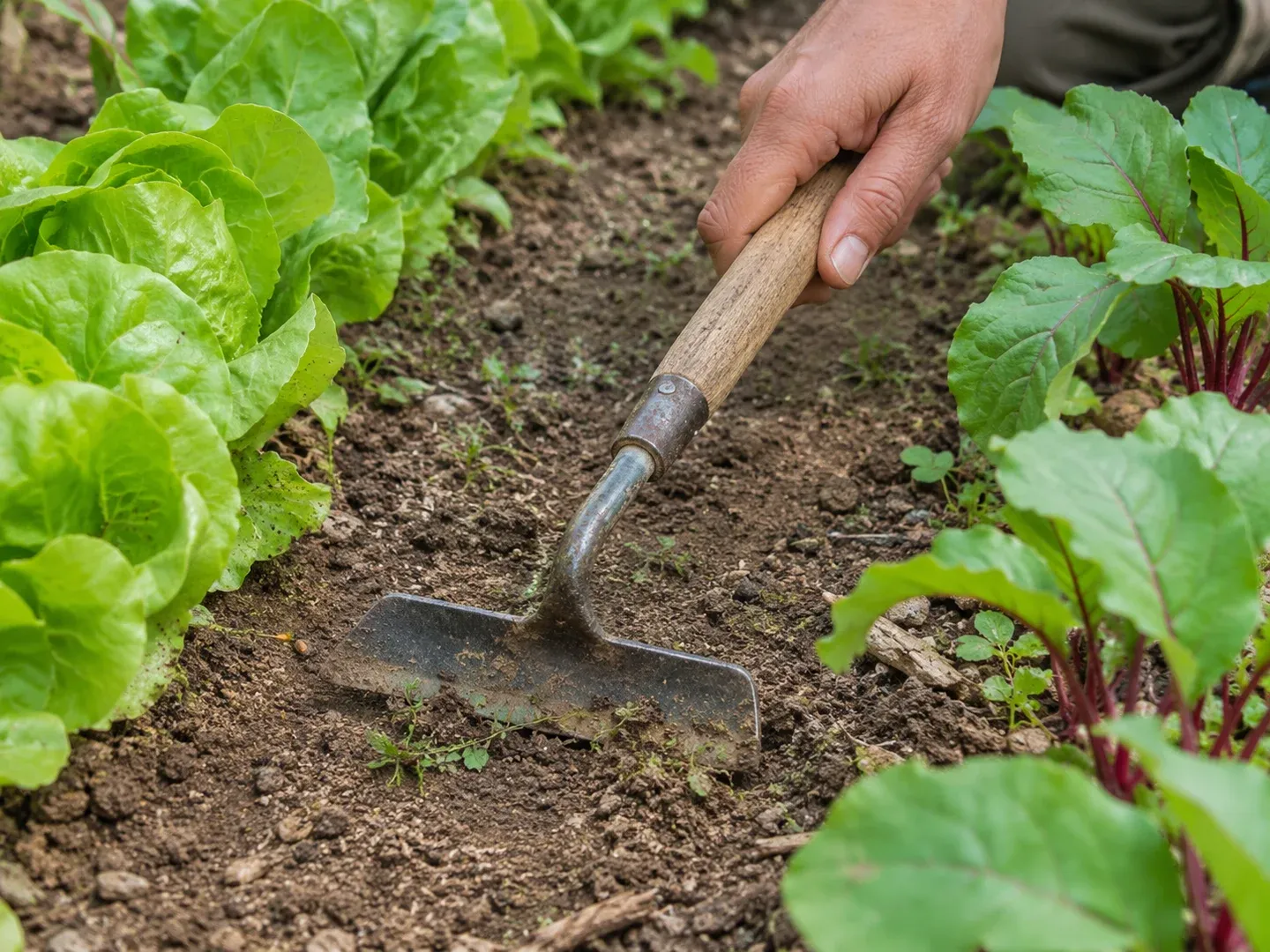
Between rows: shallow hoeing
Slide the blade just beneath the surface to cut young annuals, keeping the rows in sight. Proceed with short movements, without turning the soil. Remove plants before they produce and disperse seeds. This shallow hoeing is unsuitable for areas with bindweed or couch grass, as it would fragment their underground organs. RHS, bindweed, couch grass
Close to a crop, switch to hand-weeding or a small fork. If a weed resists and disturbs the soil around the plant, do not force it. Perennial shoots that cannot be extracted without disturbing the crop can be cut regularly to weaken them. RHS
Bindweed: remove accessible shoots and roots
Bindweed may have stems that twine around crops and funnel-shaped flowers; its persistent underground networks explain regrowth after removal. These signs aid identification but are not sufficient for all climbing plants. RHS, bindweed
In an accessible area, gently lift with a fork and remove as many roots as possible without chopping them. Near crops, remove or cut new stems when extraction would cause too much damage. Return to monitor regrowth: a single pass does not eliminate all underground reserves.
Do not spread infested soil to another bed or incorporate roots or stems into garden compost. These precautions follow the bindweed fact sheet, which describes regrowth from small fragments.
Couch grass: follow rhizomes rather than cutting them
Couch grass has a network of pale rhizomes, underground stems capable of producing new shoots. A simple tuft of grass is not enough to identify it: other grasses resemble it. Examine the underground organs in a small accessible area. RHS, couch grass
With a small fork, lift and clear rhizomes by following their path. Avoid hoeing or rotavating, which would cut them. Set aside removed fragments and monitor regrowth during the growing season; do not reuse them in mulch or garden compost. Displaced soil and clods may also carry live pieces. RHS, couch grass
For a heavily infested plot without crops, tackle an area you can monitor. Covering the ground with light-excluding material for an extended period is an option described by the RHS; the area will be unavailable for growing during that time, rather than ready for immediate replanting. Do not apply this method to areas with established crops. RHS, couch grass
After weeding: cover and observe
A weeded bed will not remain free of new shoots. Suitable mulching can limit weed emergence; keep sowings and the base of crops clear. It does not replace monitoring of established perennials. RHS
Note where the same shoots reappear. You will know where to intervene gently during cultivation and where to resume extraction once the harvest has cleared the bed.
Sources and references
- How to weed a bedRoyal Horticultural Society, in English Accessed on 18 October 2026.
- Soil: cultivationRoyal Horticultural Society, in English Accessed on 18 October 2026.
- BindweedRoyal Horticultural Society, in English Accessed on 18 October 2026.
- Couch grassRoyal Horticultural Society, in English Accessed on 18 October 2026.