
The vegetable garden notebook / Techniques
Organic mulching: choose according to the work ahead
Before selecting a material, note what you will do next in that spot: sow again, tend an existing crop, or leave a perennial planting in place. This plan helps you choose a cover that you can move and renew at the right time.
Adapt this guidance to your garden’s climate and conditions.
Practical steps
- Define the use
Distinguish between rows to be sown, established crops, and perennial plantings.
- Compare materials
Consider the decomposition rate, ease of removal, and availability.
- Plan for renewal
Choose a material whose degradation you can monitor and whose cover you can replenish.
- Assess fertilisation separately
The disappearance of mulch does not prove that the crop’s nutritional needs are met.
Start with the next task
Here, an organic mulch is a plant-based cover, raw or composted, that decomposes. The RHS describes its contribution to the soil, but this process does not occur at the same rate or provide the same nutritional value for all materials.
To narrow down your options, first note the next task planned for that location. Choosing a highly persistent material is not necessarily an advantage if you will soon need to move it. The following three scenarios translate the distinctions the ADEME makes according to how long crops stay in place into practical decisions.
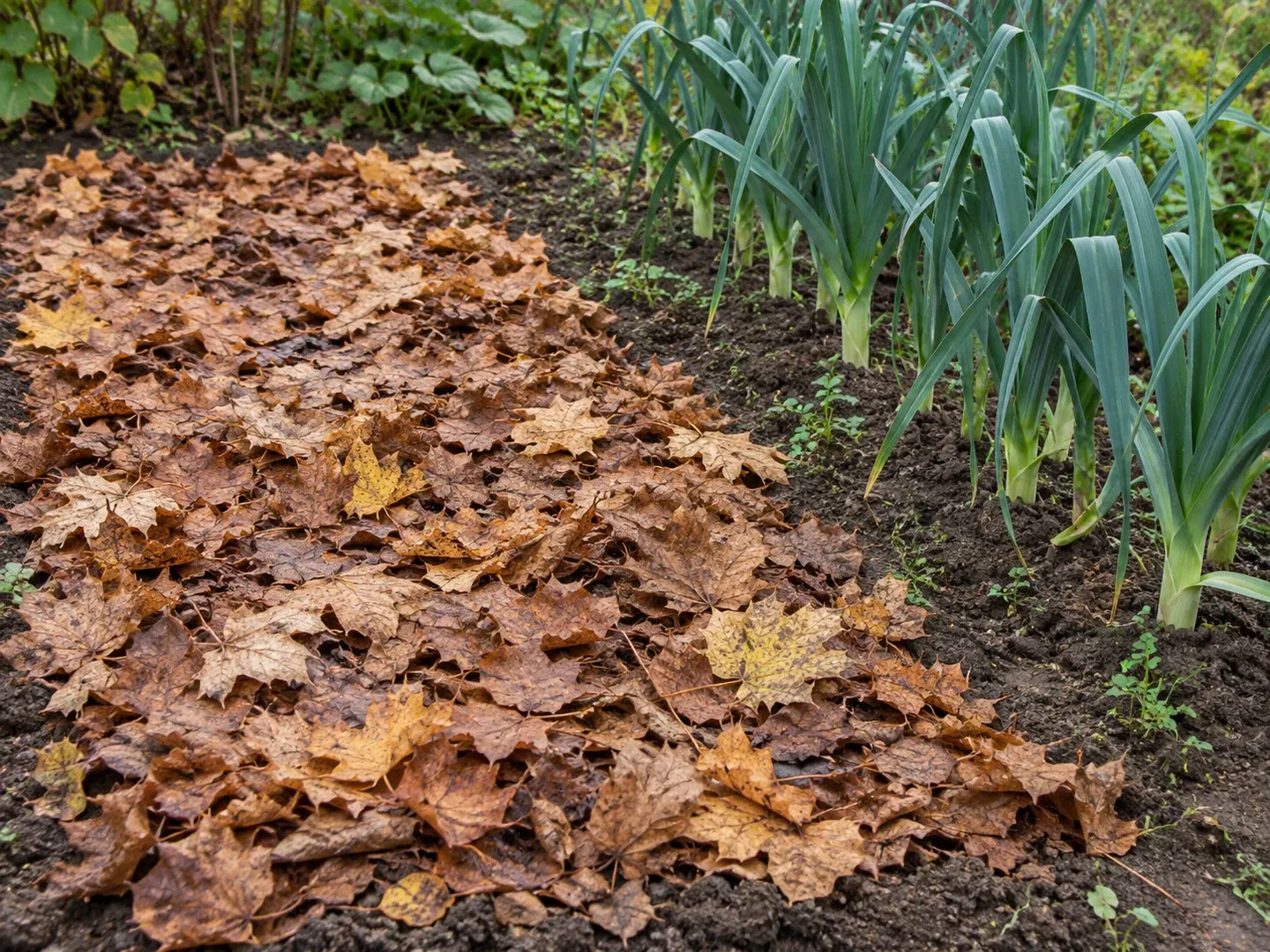
You will carry out successive sowings on the same bed
Your priority is to be able to clear a row easily. Jardiner Autrement recommends moving the mulch aside to sow directly into the soil; a cover that hinders this action does not suit your plan.
First, consider materials with a relatively fast decomposition rate, such as slightly dried lawn clippings or soft leaves, which the ADEME recommends for short-cycle crops. This does not guarantee they will have disappeared by the next sowing date: ensure you can move them aside.
If you mainly have durable wood chips, reserve them for a permanently planted area. Their availability does not justify incorporating them into the soil with each crop change to clear the row. To prepare the clear row, use the sowing guide.
You want to support an established crop
You can choose a cover intended to remain between plants while keeping access for garden work. Cereal straw is a compromise in the vegetable garden, according to Jardins de France, provided you can move it when replanting.
Also decide how you will ensure renewal. If you only have soft plant material, its faster decomposition means you need to monitor the remaining cover. If you are considering flax shives or hemp hurds, take into account their sensitivity to wind, as described by Jardins de France. The flax, hemp, and miscanthus fact sheets explain the particular requirements of each.
At the next crop change, return to the first decision: will you sow or plant? Remove the cover before digging a hole to avoid mixing it with the soil, as advised by Jardiner Autrement.
You are mulching a perennial planting
When you disturb the soil infrequently, a more persistent material becomes more appropriate. The ADEME recommends tough leaves, wood chips, and bark for perennial plantings due to their slower degradation. This selection criterion is not a recommendation for young vegetables with shallow roots.
Keep woody material on the surface. Oregon State University explains that fine particles and their incorporation increase the risk of temporary nitrogen immobilisation. Therefore, do not mix wood chips into the soil to accelerate their decomposition, and do not automatically compensate with fertiliser.
Decomposition and fertilisation remain two separate decisions
A cover that diminishes does not prove that the crop has received the necessary nutrients. The University of Maryland highlights the variable composition of soil amendments and the differing needs of plants and soils. Plan fertilisation based on previous inputs and, if necessary, a suitable analysis.
Garden compost itself can serve as a cover, as the RHS reminds us. This use does not exempt you from considering what it already provides: the word “compost” does not specify a fixed nutrient dose for all vegetables.
Note your choice before application
Keep three lines in your notebook: the planned task, the selected material, and the point to monitor to decide on replenishment. At the next sowing or crop change, re-examine this choice instead of automatically reusing the same material.
For sorting materials, assessing soil condition, choosing a depth, keeping plant bases clear, and monitoring moisture, follow the general mulching guide. These application practices complement the material decision; they are not replaced by this selection framework.
Sources and references
- How to mulchADEME Accessed on 16 October 2026.
- Mulching garden bedsJardins de France, SNHF; D. Veschambre and Fabien Robert, Astredhor Accessed on 16 October 2026.
- Mulches and mulchingRoyal Horticultural Society (RHS), in English Accessed on 16 October 2026.
- How to mulch with organic matterRoyal Horticultural Society (RHS), in English Accessed on 16 October 2026.
- The effects of mulching in the gardenJardiner Autrement, SNHF Accessed on 16 October 2026.
- Wood chips for mulch?Oregon State University Extension; Daniel McGrath, in English Accessed on 16 October 2026.
- Garden Fertilizer BasicsUniversity of Maryland Extension; Jon Traunfeld, in English Accessed on 16 October 2026.