
The vegetable garden notebook / Techniques
Miscanthus mulch in the vegetable garden: selecting and applying shredded material
To choose miscanthus mulch, consider the particle size and the crops to be covered. Start around established plants on a small area where you can monitor moisture and move the cover.
Adapt this guidance to your garden’s climate and conditions.
Practical steps
- Identify
Note the particle size and distinguish shredded material from compressed pellets.
- Prepare
Weed and ensure the soil is moist but not waterlogged.
- Distribute
Cover the surface evenly, keeping sown rows and the bases of plants clear.
- Monitor
After rain or watering, check the soil beneath the mulch before adding more water.
Which type of miscanthus should you use as mulch?
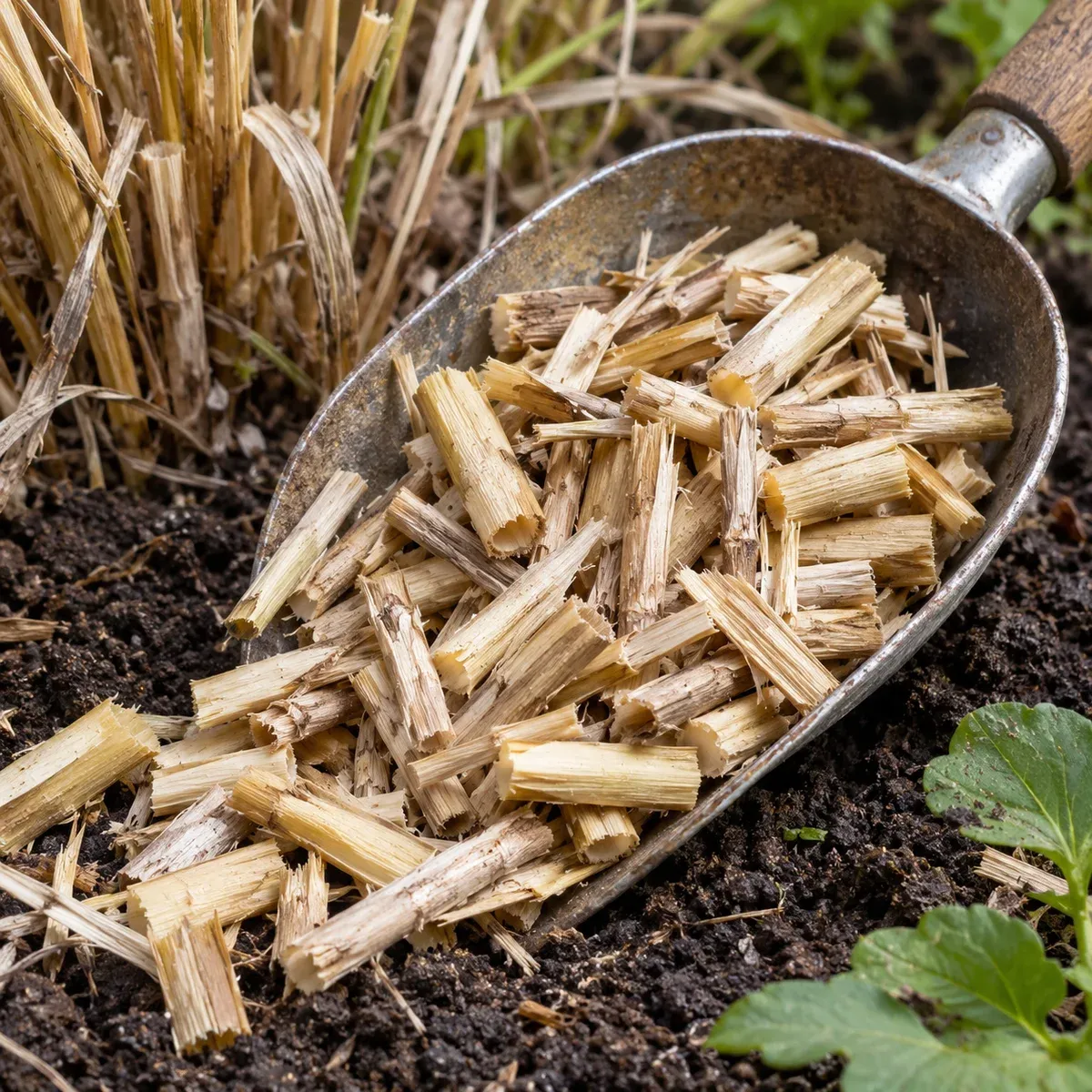
Miscanthus used as ground cover provides hollow, lignified stems—that is, containing tissues that have become rigid. It is a plant-based material that decomposes, so its coverage must be monitored and replenished as needed. Jardins de France
Check the particle size, the size of the fragments. The ASTREDHOR guide describes chips of 10–20 mm or 30–40 mm in its horticultural studies. It also distinguishes compressed straw pellets, which swell when watered. The application instructions for these forms are not interchangeable. Here, the advice concerns shredded material spread on the surface.
Before covering an entire bed, spread a small amount: you should be able to distribute the pieces evenly and move them aside around plants or a future row.
What effects can be expected in the vegetable garden?
Reducing evaporation and hindering weed emergence by blocking light are general effects of mulching. These depend particularly on the coverage achieved; they do not demonstrate the superiority of miscanthus over other materials. The RHS emphasises the importance of sufficient depth and proper application.
Therefore, choose based on your use: covering between established plants is easier to manage than a bed where sowings follow one another. Keep a test area and note the particle size, the depth applied, and any work needed.
What depth should be used?
For fine mulches of 5 to 30 mm, Jardins de France provides a general guideline of 3 to 5 cm. This is a relationship between particle size and coverage, not a proven optimal depth for every vegetable or every batch of shredded miscanthus.
Avoid using the 2 to 3 cm mentioned for miscanthus in the ASTREDHOR table as a universal rule: this table refers to container-grown crops. Above all, check that your material forms a continuous layer once laid, without piling it against the plants.
Applying according to soil condition and crops
- Weed before covering, removing perennials with their roots or rhizomes in particular.
- Wait for suitable soil conditions. Moist soil is ideal; postpone application if it is waterlogged or frozen, as advised by the RHS. In spring, move aside existing cover when seeking to warm the soil.
- Protect sowings. Open the row for direct sowing. Mulch again after the seedlings have emerged, without covering young shoots.
- Keep the root collar clear, at the junction between stem and roots, and keep the shredded material on the surface.
These steps follow the general precautions of Jardiner Autrement. The same source advises against application in strong winds. On an exposed plot, observe how well the mulch stays in place on your small test area before extending it; after a windy episode, redistribute clumps and clear any covered plants.
After rain or watering, check beneath the chips
Wet cover does not prove that the soil has received enough water. Move aside a few fragments to check the moisture underneath. The RHS notes that water must penetrate the mulch to reach the roots, even if the cover subsequently reduces evaporation.
Adjust watering based on the actual soil condition. Do not assume water savings or a set number of extra days between waterings based solely on the term “miscanthus”.
Maintaining and preparing for the next crop
Remove weeds that penetrate the cover and replenish bare areas after observation. Also monitor young leaves: mulches can harbour slugs and snails during sowing periods, as noted by Jardins de France. Miscanthus should not be chosen as a guaranteed protection against their damage.
Before sowing or replanting, move aside any remaining fragments. Avoid incorporating them when working the soil: Jardiner Autrement highlights the risk of temporary nitrogen immobilisation linked to the decomposition of buried mulches. Surface cover and incorporated soil amendment are not used in the same way.
Sources and references
- Mulching garden bedsJardins de France, SNHF; D. Veschambre and Fabien Robert, Astredhor Accessed on 16 October 2026.
- Mulching techniques for horticultural plants, pages 81 to 89ASTREDHOR; Sophie Bresch and Anaïs Marie Accessed on 16 October 2026.
- The effects of mulching in the gardenJardiner Autrement, SNHF Accessed on 16 October 2026.
- Mulches and mulchingRoyal Horticultural Society, in English Accessed on 16 October 2026.
- How to mulch with organic matterRoyal Horticultural Society, in English Accessed on 16 October 2026.