
The vegetable garden notebook / Techniques
Flax Mulch in the Vegetable Garden: Flakes, Application, and Precautions
Flax mulching primarily requires preparing your next steps: where to sow, where to plant, and how to check moisture beneath the flakes. Start with a small area to observe how it holds up in your garden.
Adapt this guidance to your garden’s climate and conditions.
Practical steps
- Identify
Check the material used and reserve areas for sowing.
- Prepare
Weed and wait if the soil is waterlogged or frozen.
- Distribute
Apply to the surface in calm weather, without covering the base of plants.
- Observe
Monitor the flakes' stability and the soil beneath the cover.
Flax Shives and Flakes: Which Part of Flax Is Used?
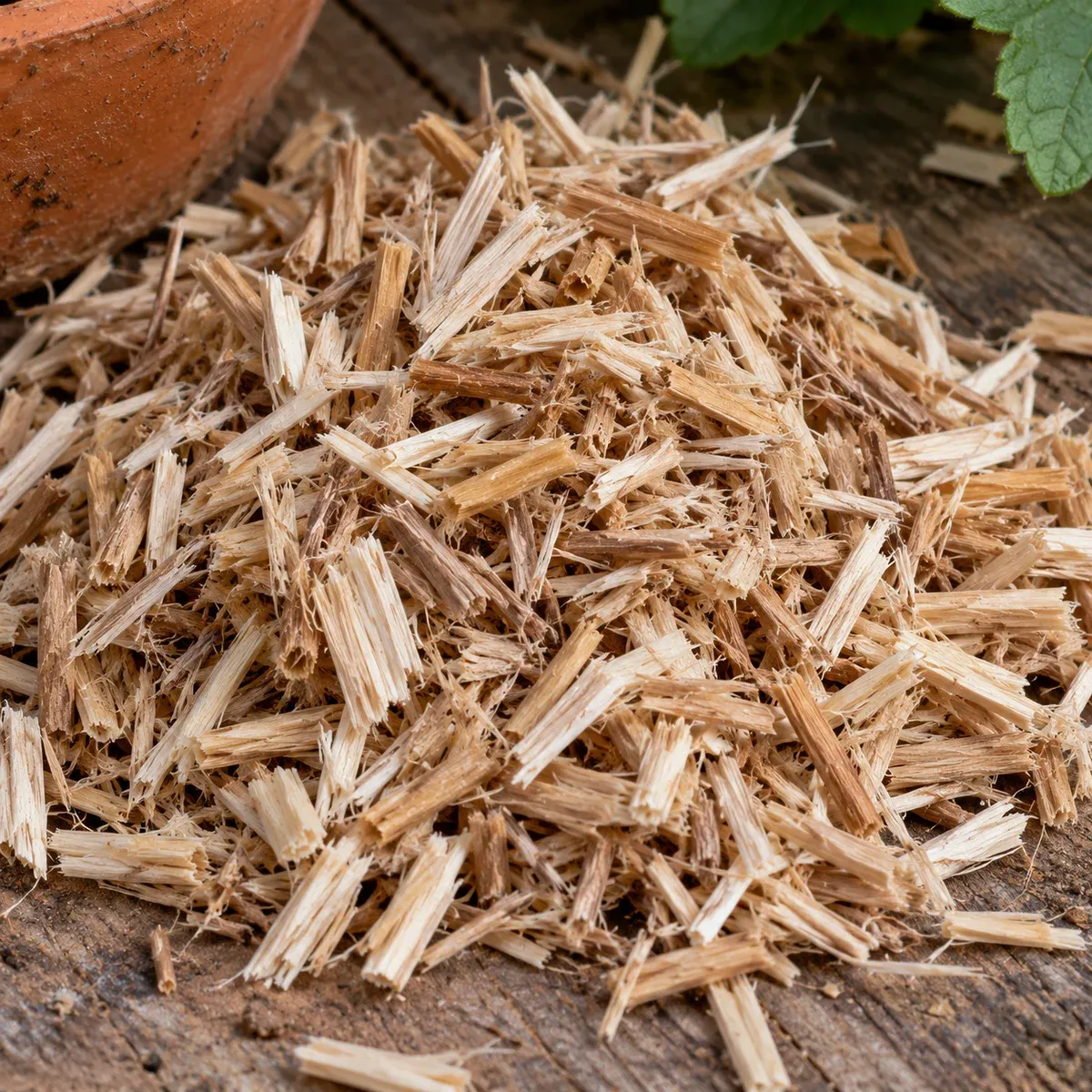
Shives are the woody part recovered after scutching, the process that separates flax fibres. Their use as mulch is described by Jardins de France. This guide covers the material in bulk, in the form of small fragments or flakes.
Check the indicated composition: another horticultural fact sheet also describes mulches derived from flax stems grown for their seeds. The advice below applies to loose material spread over the soil, rather than a mulch mat.
What Can Be Expected from Flakes?
Jardins de France mentions their ability to retain water, in a presentation of uses for flowerbeds and drought-sensitive areas. This property of the material does not quantify the water saved on a vegetable plot.
Reducing evaporation and limiting light received by weeds are general effects of mulching, explained by the RHS. They do not demonstrate that flax outperforms another material. To choose based on your resources and crops, consult the general mulching guide.
Choose the Area Before Covering
Start by trying it between established plants and reserve rows for sowing. Jardins de France highlights the need to allow for repeated work in the vegetable garden.
Next, observe the soil. The RHS recommends applying mulch to moist soil, delaying if it is very wet or frozen. Heavy soil still saturated with water therefore requires waiting; soil that is already moist does not need automatic prior watering. In spring, move the mulch aside if you want to warm the soil before sowing, according to Jardiner Autrement.
Applying Flax While Considering Wind
- Remove weeds, including roots and rhizomes of perennials.
- Distribute the flakes on the surface without incorporating them into the soil.
- Keep the root collar—the junction between stem and roots—as well as shoots uncovered.
These precautions follow Jardiner Autrement. Apply in calm weather: flax is sensitive to wind. Jardins de France suggests moistening after distribution to help the particles bind together. Then check their stability.
Choosing the Layer Thickness and Calculating Volume
Note the composition and fragment size on the bag, then its application instructions. In its presentation of mulches, Jardins de France recommends 3 to 5 cm for fine fragments of 5 to 30 mm, which compact together and limit light penetration. This particle-size guideline does not become a universal thickness for any product labelled “flax”; the source also describes materials and uses for flowerbeds. Values for long straw do not transfer directly. Jardins de France
Example volume, without a fixed dose: if the instruction suited to your batch is 4 cm and the area to cover measures 2 m², the calculation is 2 × 0.04 = 0.08 m³, or 80 litres. Subtract from the area the spaces left free around plants and rows reserved for sowing. A quantity given in kilograms cannot be converted to litres without knowing the product.
After moistening and settling, check if the layer remains evenly distributed or reveals gaps and bare soil. Fill in any gaps if the cultivation plan allows, without covering the bases of plants or automatically adding the initial quantity. Record the actual depth: because the material is meant to settle when laid, the volume you spread may not correspond directly to the depth you measure afterwards. Jardins de France
Sowing, Watering, and Monitoring After Application
For sowing or planting, move the flakes aside without burying them. Mulch can hinder seedling emergence; Jardiner Autrement advises mulching after germination is well underway. Keep young shoots uncovered. Find preparation techniques in the sowing guide.
To decide whether to water, check the soil beneath the flax. Moist flakes do not prove that roots have received water. The RHS points out that water must penetrate the mulch to reach them. Adjust how much you water based on this observation with the watering guide.
If leaves are nibbled, inspect the plants and their surroundings. Flax should not be considered a slug barrier: Jardins de France advises monitoring mulches in the vegetable garden when the weather is humid.
Before adding more, examine what remains. Biodegradable mulches decompose gradually, according to the RHS. Decide whether to top up based on the remaining cover and the next crop, rather than a fixed timetable.
Sources and references
- Flax, from yesterday to todayJardins de France, SNHF; Clémentine Calais Accessed on 16 October 2026.
- Mulching, the gardener’s allyJardins de France, SNHF; Jean-François Coffin Accessed on 16 October 2026.
- Mulching garden bedsJardins de France, SNHF; D. Veschambre and Fabien Robert, Astredhor Accessed on 16 October 2026.
- The effects of mulching in the gardenJardiner Autrement, SNHF Accessed on 16 October 2026.
- How to mulch with organic matterRoyal Horticultural Society (RHS), in English Accessed on 16 October 2026.
- Mulches and mulchingRoyal Horticultural Society (RHS), in English Accessed on 16 October 2026.