
The vegetable garden notebook / Crops
Growing Watermelon: Heat, Pollination, and True Maturity
Watermelon requires space and a sufficiently long warm season to mature after pollination. First, select a variety suited to your location, then allocate its space and monitor each fruit rather than relying on a fixed harvest date.
Adapt this guidance to your garden’s climate and conditions.
Choosing a Variety for the Available Warm Season
Watermelon, Citrullus lanatus, differs from melon Cucumis melo. Select an early variety with documented cultivation in your context. Sainte Marthe, for example, offers ‘Sugar Baby’, with red flesh and seeds: “few seeds” does not mean “seedless”. Sainte Marthe, Maryland
Triploid seedless varieties require a nearby diploid seeded variety to provide pollen. Clarify the mix and its arrangement with the seed supplier; two seedless plants do not fulfil this role. For a first attempt, a seeded variety avoids this additional constraint. Maryland
Sowing in Warmth and Planting After Frost
For ‘Sugar Baby’, Sainte Marthe recommends sowing in pots from mid-March to mid-May, depending on the protected-cropping plan. Their data sheet indicates seedling emergence in 5–10 days at around 25 °C, with the seed covered to its own depth. Provide light and keep moisture consistent after the seedlings emerge, without turning the potting compost into a sponge. Do not sow too early if you cannot maintain the plants in good conditions. Sainte Marthe
Iowa suggests starting pots three to four weeks before the planned planting date, then gradually hardening off the young plants outdoors. Wait until the end of frost risk and the soil has warmed: the university indicates approximately 16–21 °C in the soil as a benchmark. These conditions take precedence over dates on an American calendar. Plant without breaking the root ball or damaging the roots. Iowa, Utah, cultivation
Allocating Soil, Shelter, and Space for Vines
Choose full sun, fertile and well-drained soil. Add mature garden compost according to soil condition; excess nitrogen may impair fruiting. Maryland describes vines ranging from about 1.8 m for compact forms to 6 m: small fruit does not mean a small plant. Utah, cultivation, Maryland
For ‘Sugar Baby’ in its warm protected-cropping protocol, Sainte Marthe recommends 1 m in all directions between plants. Subsequently, maintain space for the vines and access without trampling them. This benchmark is not the space needed by mature plants of every variety. Sainte Marthe
In a short or cool summer, a greenhouse or polytunnel increases possibilities, with an adapted variety: this is the approach recommended by the RHS for watermelon in the British climate. The shelter must be ventilated and accessible to pollinators from flowering onwards. RHS, Utah, cultivation
Trellising and Pots: Verify the Entire Setup
Trellising primarily concerns small-fruited varieties, with an individual flexible support that dries quickly under each fruit. Plan a structure capable of supporting vines and harvest; tendrils alone cannot support a large watermelon. Maryland
The selected references do not define a final pot size suitable for all watermelons. To attempt container growing, confirm with the producer the cultivar, its root volume, and vine space, then ensure adequate drainage, water, and nutrition. Do not equate the sowing pot with the container for the entire season.
Monitoring Water and Flowering Without Pruning Like a Melon
Maintain consistent moisture at root level, especially during flowering and fruit enlargement; avoid saturation and abrupt fluctuations. Water at soil level to limit foliage wetting. Excess water near harvest may also promote splitting: adjust according to observed moisture, without imposing a complete stop. Iowa, watering
Mulch once the soil has warmed and weed early, without damaging superficial roots. Guide vines within the allocated space; this guide does not cover melon pinching, as it is a different species. If growth is disappointing, check temperatures, light levels, watering, and drainage before adding fertiliser. Utah, cultivation
Female flowers bear a small swelling beneath the corolla; they must receive pollen from male flowers. Each is receptive for only one day, according to Iowa. Rain, wind, and cool temperatures may limit bee visits: a small fruit beneath a flower is not yet successful fruit set. Iowa
Examining Plants and Fruits That Stop Developing
Note the stage: a young plant collapsing at the stem base, a wilting vine, spotted or deformed leaves, or misshapen fruit each require different investigation. Utah describes, in particular, white powder on older leaves, wilting, and mottled or deformed leaves. These signs must be cross-referenced with root condition, weather, and progression; they alone do not identify a disease. Utah, cultivation
For a fruit that no longer grows, revisit pollination, warmth, and water supply before concluding a pest issue or adding calcium. Photograph the fruit and the entire plant to monitor progression. Iowa
Combining Maturity Indicators Before Harvesting
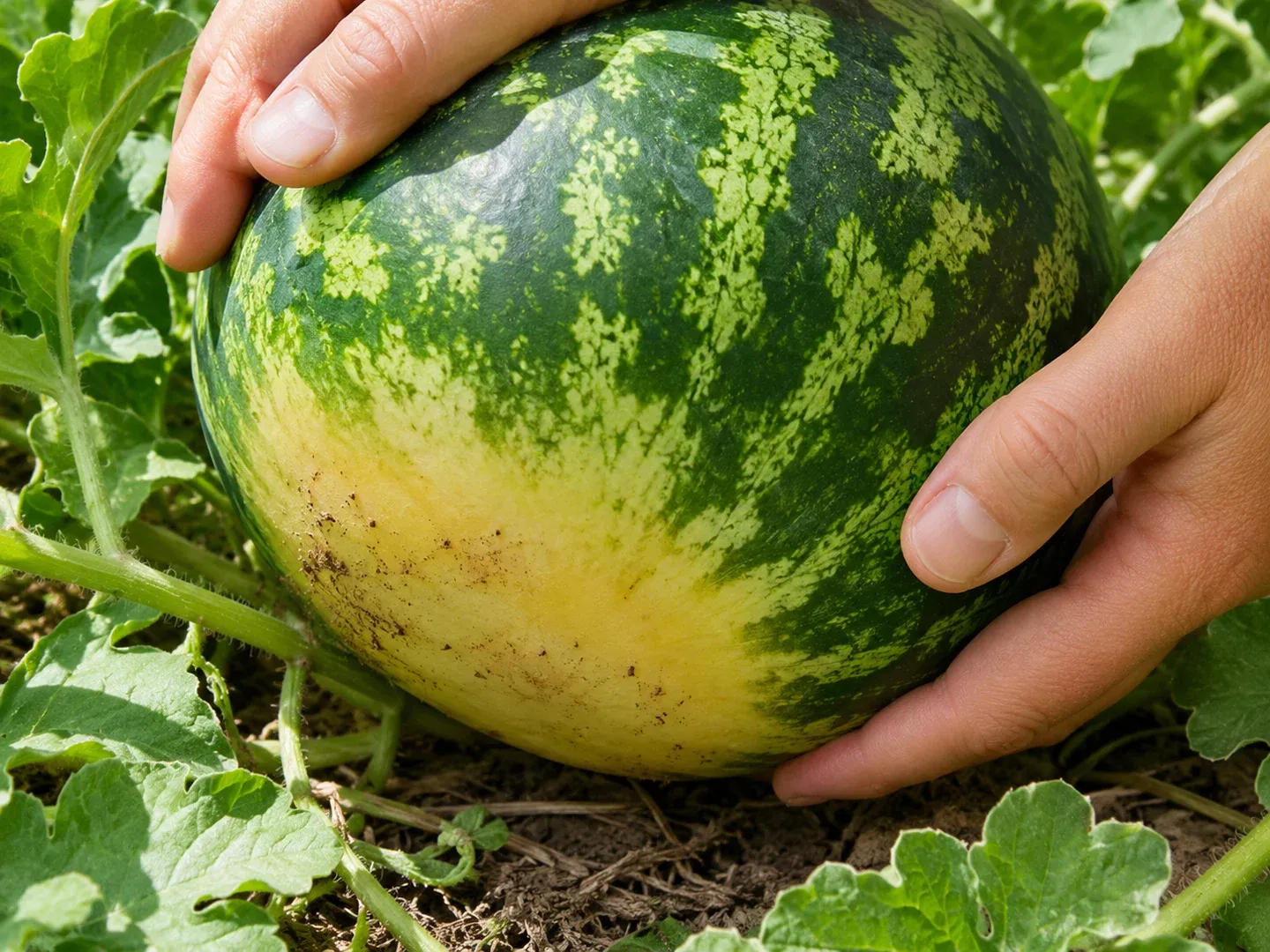
Record the fruit-set date for each fruit as a monitoring reference. Utah describes five to six weeks after pollination, varying with cultivar and temperature. Combine the colour of the ground-spot, often turning cream or yellow, the loss of rind sheen, and the progression of the adjacent tendril. Iowa warns that this tendril may dry before maturity in some varieties; tapping the fruit is also unreliable. Utah, harvest, Iowa
Confirm the signs for your variety, especially for a light-coloured or suspended fruit. Flesh may be red, yellow, or orange; the expected colour depends on the cultivar. Cut the fruit off with a short piece of stalk attached, and avoid knocks. Sugar content does not increase after harvest: bringing in an immature fruit does not replace its ripening on the plant. Purdue, Utah, harvest
Storing the Harvest and Ending the Crop
For a whole, healthy, ripe watermelon, Utah indicates approximately 5–7 days at room temperature; consume it promptly and check its condition. Wash the rind before cutting. Then store pieces in the refrigerator in a sealed container; Purdue states up to five days. These are two distinct storage situations. Utah, harvest, Purdue
Watermelon is a frost-tender annual: plan a new sowing the following season. Remove crop residues at the end of the season and record variety, fruit set, maturity, and issues in the crop rotation log. Consider its relationship with other Cucurbitaceae and observed problems before selecting the next crop. Maryland, Utah, cultivation
Key points for this crop
Practical guidance
- Species
- Citrullus lanatus, frost-tender annual with trailing stems
- Planting
- Soil warmed and end of frost risk before planting
- Fruit set
- Pollen transferred between male and female flowers; specific requirements for seedless types
- Harvest
- Combine varietal indicators: a dried tendril alone is insufficient
Sources and references
- Organic Sugar Baby watermelonLa Ferme de Sainte Marthe, seed supplier Accessed on 18 October 2026.
- Growing Watermelon in the Home GardenIowa State University Extension and Outreach, in English Accessed on 18 October 2026.
- Growing Melons in a Home GardenUniversity of Maryland Extension, updated 20 February 2023, in English Accessed on 18 October 2026.
- How to Grow Watermelon in Your GardenUtah State University Extension, Rick Heflebower and Dan Drost, in English Accessed on 18 October 2026.
- Harvest and Handling — CucurbitsUtah State University Extension, production guide, in English Accessed on 18 October 2026.
- Watermelon — FoodLinkPurdue Extension, in English Accessed on 18 October 2026.
- How to grow melonsRoyal Horticultural Society, in English Accessed on 18 October 2026.