
The vegetable garden notebook / Crops
Planting strawberries: choosing plants and the right time
To prepare your strawberry bed, note two details on the label: the variety and the type of plant. These are as important as the season for deciding when to plant and what to expect from the harvest.
Adapt this guidance to your garden’s climate and conditions.
Summer-fruiting or everbearing: which to choose?
A summer-fruiting strawberry concentrates its production over a limited period; varieties crop at different times. An everbearing variety produces further crops during the season. The SNHF lists ‘Gariguette’ among summer-fruiting varieties and ‘Mara des bois’ among everbearing ones.
For a more concentrated harvest period, consider summer-fruiting varieties; for staggered picking, consider everbearing ones. These categories do not guarantee a specific quantity of fruit nor uninterrupted strawberries. Keep the variety name and check its local adaptation with the nursery: the Chambers of Agriculture include climate among varietal selection criteria.
When to plant strawberries?
In France, the SNHF provides a general guideline of mid-August to mid-October, with March-April also suitable for everbearing varieties. This guideline does not cover every type of planting stock sold: the CTIFL distinguishes fresh bare-root plants, fresh plants with intact root balls and cold-stored plants, each used for different growing methods.
| What you are buying | What to check before setting the date |
|---|---|
| Potted or plug plant | The variety and the recommended planting period for this plant. Being in a pot does not tell you when it should be planted. |
| Fresh bare-root plant | The expected delivery date and the producer’s planting instructions; do not automatically apply the cold-stored plant schedule to it. |
| Cold-stored plant, kept refrigerated by the producer | The planting schedule supplied with the delivery. The RHS recommends planting these prepared plants quickly; do not purchase them to keep until another season. |
This table helps prepare your purchase: ask for the exact type of plant if the listing only states “strawberry”. For planting, also wait until excess water has drained from the soil and it is no longer waterlogged. The Chambers of Agriculture recommend a site that warms up easily. The months mentioned remain guidelines: they do not replace the soil condition or the instructions related to the delivered plant.
Where to plant and at what depth?
Choose humus-rich, well-draining, slightly acidic soil. The SNHF recommends full sun in most regions and partial shade in southern France.
- Inspect plants upon receipt. Check the roots and the centre; report any necrotic parts or insects to the supplier. This check is recommended by the Chambers of Agriculture.
- Plan for space. For row planting, the RHS suggests 35 to 40 cm between plants and about 75 cm between rows. These are cultivation guidelines, to be adjusted according to the supplier’s instructions.
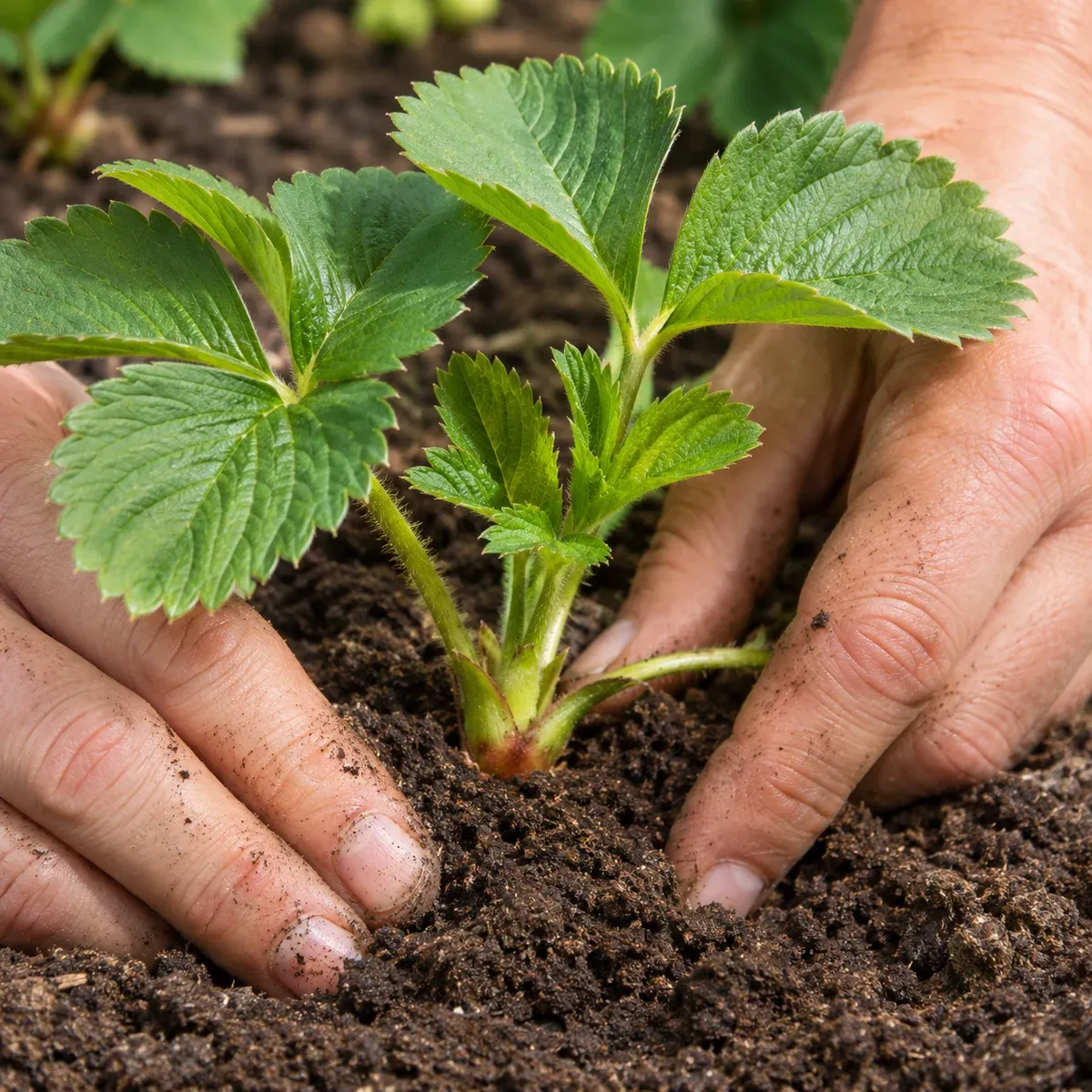
- Dig a large enough hole. Spread out bare roots without crowding them. For a potted plant, maintain the planting depth it had in its container, as indicated by the University of Minnesota.
- Check the crown after watering. This junction between roots and above-ground growth should be level with the soil; the centre from which leaves emerge must remain exposed. The SNHF emphasises this point.
Watering, mulching, and maintenance
After planting, keep the root ball moist. Then adjust watering based on the soil and the crop’s needs: the Chambers of Agriculture bulletin does not provide a schedule valid for all soils. Check moisture before adding water. Water at the base, minimising foliage wetting; the University of Minnesota recommends watering in the morning if the foliage is wetted, so it has time to dry.
When fruit forms, place dry straw under the strawberries to keep them off damp soil. Keep space around the centre: mulch should not cover it. Remove this straw in autumn, as it can become a damp refuge for diseases and slugs. These tips come from the RHS.
Remove weeds by hand to avoid deep cultivation near the roots, according to the University of Minnesota. Cut off runners you do not wish to keep to prevent overcrowding, as advised by the RHS. Identify them: these are the long stems bearing new small strawberry plants.
Can you plant strawberries in pots?
Yes, in a container filled with potting compost, keeping the crown level with the surface. The RHS suggests about 20 cm between plants in containers; this does not replace the spacing for open ground given above. Choose a sheltered, bright spot, considering the partial shade recommended in southern France by the SNHF.
The pot alone does not change the suitable period for the plant type: refer back to the section “When to plant strawberries?”. Its substrate can dry quickly; check it regularly and adjust watering without a fixed schedule. The RHS stresses this extra care for container-grown plants. The watering guide specifies how to drain excess water.
Should you feed strawberries in pots?
In fertile open ground regularly enriched with organic mulch, the RHS often considers additional feeding unnecessary. In containers, it advises a liquid fertiliser during growth, then a potassium-rich one from the first flower buds. First check how long the nutrients in the potting compost are stated to remain active; follow the instructions and apply to moist substrate, as per its container maintenance sheet. A poor harvest does not alone indicate a deficiency.
Black-centred flowers or no strawberries: what to check?
First, see if the plant has buds, open flowers, or young fruit, then examine the centre of the flowers. A black centre surrounded by petals that remained white after frost suggests floral damage described by the RHS. A flower thus destroyed will not produce a strawberry; other flowers on the same plant may remain intact. Partial damage can also deform the fruit.
If frost is forecast while the plants are flowering or bearing young fruit, place a temporary cover overnight, as advised in the RHS cultivation sheet. Remove it during the day to allow pollinators access, as specified in its frost damage sheet. Protection does not repair already damaged flowers.
Without these signs, note the varietal type, flowering periods, watering, and weather. Gaps in cropping occur in everbearing varieties, but they do not explain every halt in production. Also check that the crown is level and the centre remains exposed. If the plant declines or flowers dry without clear cause, have the problem identified before adding fertiliser or treatment.
What damage to look for before harvest?
- Soft, brown strawberry with grey-brown fuzz: this may indicate botrytis described by the RHS. Carefully remove affected parts without shaking them, and avoid overcrowding and persistent dampness. Not all rot can be identified by the appearance of a single spot.
- Fruit eaten near the ground: look for slugs and snails, especially under damp straw, a refuge noted by the RHS. Observe the animal before attributing all holes to the same pest.
- Potted plant wilting despite moist substrate: examine the crown and, if necessary, gently remove the root ball to inspect the roots. The RHS describes vine weevil larvae as white, C-shaped, legless, with a light brown head. Adults make notches on leaf edges; these alone do not prove larvae are present at the roots.
Photograph the damage, any insects, and the entire plant. Rapid decline, multiple affected plants, or uncertain identification justify seeking advice; do not propagate suspect plants.
How to propagate strawberries by runners?
Select a young strawberry plant growing on a runner, set it on the surface of the growing medium in a small pot beside the mother plant, and secure it with a small tie. Keep the runner attached to the mother plant while it roots, keep the substrate slightly moist, then cut the runner once the new plant is rooted. This is the method described by the RHS.
Do not propagate a declining plant or one suspected of having a viral infection: the propagated material may transmit viruses. The RHS then recommends starting with certified virus-free plants, without diagnosing based solely on leaf appearance. Some types produce few runners: also consult the choice between everbearing and summer-fruiting varieties.
Harvesting and brief storage
Pick at maturity: strawberries do not continue to ripen after harvest, notes the University of Minnesota. Wait for the colour specific to your variety. Regularly inspect plants and handle fruit gently. Its cultivation guide advises picking dry fruit, separating diseased fruit from the healthy harvest, and refrigerating quickly.
Plan to eat them promptly, even when refrigerated. The CTIFL describes very short storage dependent on conditions. Rinse strawberries under running water just before consumption, as advised by the University of Minnesota.
Note the first and last harvest dates, along with the variety name. You will then have your own benchmarks for choosing future plants. To organise other seasonal tasks, see the vegetable gardening guides.
When to renew an old strawberry bed?
The RHS suggests renewal after three to four years, in a different location, to limit the accumulation of problems. Note the age of the plants and their production. Replant with healthy material; do not use runners from declining plants.
To choose companion plants and maintain access for picking, use the space, light, and water criteria from the companion planting guide. Companion planting does not replace renewing a weakened strawberry bed.
Key points for this crop
Practical guidance
- Selection
- Concentrated or repeated harvests depending on the variety
- Soil
- Well-draining, humus-rich, slightly acidic
- Depth
- Crown level with the soil, centre exposed
- Harvest
- At maturity, for prompt consumption
Sources and references
- Strawberry plantFrench National Horticultural Society (SNHF) Accessed on 15 October 2026.
- How to grow strawberriesRoyal Horticultural Society (RHS), in English Accessed on 18 October 2026.
- Organic strawberry production — technical bulletin no. 44, March 2025Chambres d’agriculture de Nouvelle-Aquitaine Accessed on 15 October 2026.
- Strawberry — Foodservice GuideCentre technique interprofessionnel des fruits et légumes (CTIFL) Accessed on 15 October 2026.
- Growing strawberries in the home gardenUniversity of Minnesota Extension, in English Accessed on 15 October 2026.
- Cottage food uses for your strawberry cropUniversity of Minnesota Extension, in English Accessed on 15 October 2026.
- How to grow strawberries — containers and propagatingRoyal Horticultural Society (RHS), in English Accessed on 17 October 2026.
- Strawberry virusesRoyal Horticultural Society (RHS), in English Accessed on 17 October 2026.
- Container maintenanceRoyal Horticultural Society (RHS), in English Accessed on 18 October 2026.
- Strawberry black eyeRoyal Horticultural Society (RHS), in English Accessed on 18 October 2026.
- Grey mouldRoyal Horticultural Society (RHS), in English Accessed on 18 October 2026.
- Vine weevilRoyal Horticultural Society (RHS), in English Accessed on 18 October 2026.