
The vegetable garden notebook / Crops
Everbearing or summer-fruiting strawberry: which to choose?
First choose the harvest pattern that suits you: a concentrated harvest or repeated harvests during the season. The variety name and your ability to provide ongoing care matter just as much as the 'everbearing' label.
Adapt this guidance to your garden’s climate and conditions.
A concentrated harvest or repeated pickings?
Summer-fruiting strawberries produce over a limited period. There are early, mid-season, and late varieties: not all yield fruit at the same time. The SNHF classifies ‘Gariguette’ and ‘Ciflorette’ in this group, and ‘Charlotte’ or ‘Mara des bois’ among the everbearing varieties, which produce further crops during the season.
This difference allows you to choose based on your needs, without planning the number of punnets in advance.
| Your priority | Selection guideline | What to plan for |
|---|---|---|
| Gathering fruit for a recipe | Summer-fruiting, for a more concentrated harvest. | Be available during its production period; the quantity remains uncertain. |
| Picking a little at several times | Everbearing, for repeated pickings. | Care for the plants over a longer period, allowing for possible gaps between harvests. |
| Diversifying a strawberry patch | Combine varieties that crop at different times or have different fruiting patterns. | Keep a label for each variety to compare the actual harvests obtained. |
The table turns the harvest patterns described by the SNHF into practical criteria. Fruit from summer-fruiting varieties can also be eaten fresh, and fruit from everbearing varieties can be used in recipes: neither type is restricted to a particular use.
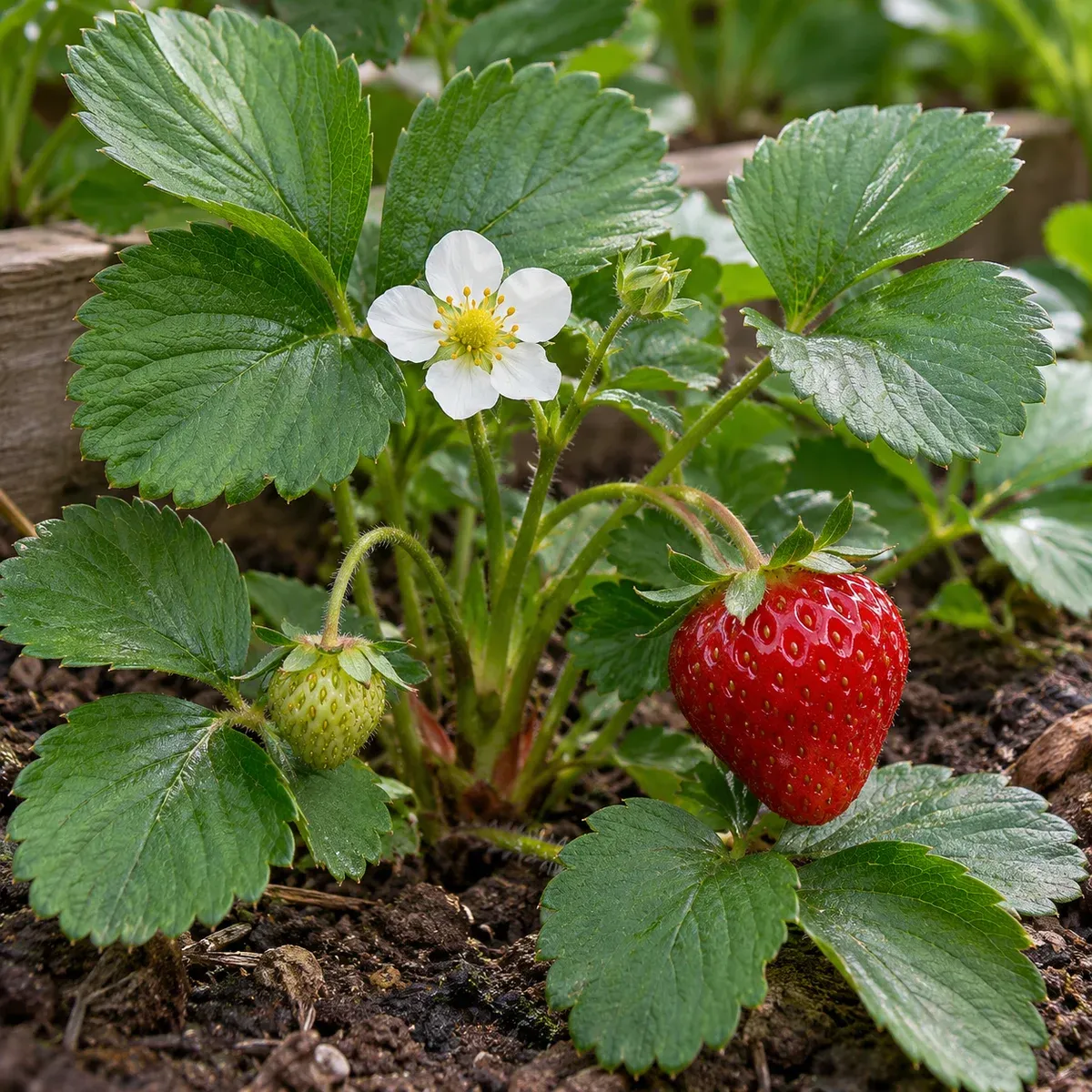
Why “everbearing” does not mean “continuously”
The RHS describes its perpetual strawberries as producing small flushes of fruit. A succession of harvests thus includes intervals without ripe strawberries.
Temperature also matters. For varieties described as day-neutral, the University of New Hampshire specifies that flower formation remains subject to favourable temperatures, even if these plants are less sensitive to day length. It also notes differences in rhythm between varieties. The term therefore does not guarantee regular production during heatwaves or up to a fixed date.
Do not choose a plant based solely on the promise of “all summer”. Ask for the variety name, its behaviour in your region, and the growing conditions recommended for the plant being sold. To prepare for planting, consult the strawberry planting guide.
Do the English terms refer to exactly the same groups?
The University of Minnesota distinguishes three categories: June-bearing, with a concentrated harvest; ever-bearing, described with two main harvests; and day-neutral, with production over a larger part of the season. The RHS groups perpetual and everbearers together.
These naming systems do not mean that every French strawberry labelled “remontant” can automatically be called day-neutral in English. In a foreign catalogue, check the variety and the description of its fruiting; June-bearing is also not a guarantee of a June harvest in your garden.
With little space, also consider water and runners
Strawberries can be grown in containers, but the RHS highlights the rapid drying of the growing medium, particularly in hanging baskets. On a balcony, your ability to check moisture levels therefore influences the number of plants you choose. A long picking season requires ongoing monitoring.
Runners, long stems bearing new plants, also take up space. The University of Minnesota notes that its day-neutral types produce fewer runners than June-bearing ones. This observation does not mean that all everbearing varieties are compact or runner-free. Check this characteristic for the chosen variety and remove unwanted runners to avoid overcrowding.
The strawberry guide details care and removal of unwanted runners, as well as rooting a runner you wish to keep.
For a first trial, select a small number of clearly identified varieties. Then compare the enjoyment of picking, the space occupied, and the care required, rather than a theoretical yield per plant.
Care continues after the first harvest
The end of the harvest for a summer-fruiting variety does not mean the plant no longer needs water: the University of Minnesota advises continuing watering after harvest. Adjust it to soil moisture, using the watering guide as a reference.
Do not cut back all your plants as soon as the final berries of the first flush have been picked. The RHS distinguishes between removing old leaves after summer-fruiting varieties have cropped and tidying perpetual varieties, for which only dead, damaged or diseased leaves are removed at the end of the season.
To decide what to replant, record when you actually harvested fruit and any gaps between harvests, along with the variety. The choice “everbearing or summer-fruiting” gives an expected harvest pattern; your observations will help verify if it matches your use and your garden.
Key points for this crop
Practical guidance
- Summer-fruiting
- Concentrated harvest, with early, mid-season and late varieties
- Everbearing
- Repeated harvests, with possible interruptions
- Small space
- Also choose based on watering and runner management
- Comparison
- The type alone does not guarantee quantity or flavour
Sources and references
- Strawberry plantSociété nationale d’horticulture de France (SNHF), Jean-Daniel Arnaud Accessed on 16 October 2026.
- How to grow strawberriesRoyal Horticultural Society (RHS), in English Accessed on 16 October 2026.
- Growing strawberries in the home gardenUniversity of Minnesota Extension, in English Accessed on 16 October 2026.
- Growing fruits: Day-neutral strawberries in New Hampshire: Variety selection & production tipsUniversity of New Hampshire Extension, in English Accessed on 16 October 2026.