
The vegetable garden notebook / Crops
Growing Parsnips: Direct Sowing, Seedling Emergence, and Winter Harvest
Parsnips occupy their place in the vegetable garden for a long time. Prepare deep soil, use fresh seeds, and keep the row marked: slow seedling emergence should not be judged by the same standards as radish emergence.
Adapt this guidance to your garden’s climate and conditions.
Choosing a Variety and Reserving Its Space
The parsnip, Pastinaca sativa, belongs to the Apiaceae family, like the carrot. The SNHF lists several varieties, including ‘Demi-long de Guernesey’ and ‘White Gem’. Compare the expected root size with the depth of soil available. The RHS prefers shorter forms in shallow, stony, or heavy soil. SNHF · RHS
Reserve a sunny spot and prepare the row without large clods or obstructive stones. The RHS advises against adding organic matter just before sowing, as this may encourage forked roots. Their approach of improving soil the previous year differs from automatically adding garden compost on the day of sowing. RHS
When and How to Sow in France?
The SNHF provides a window from February to June, to be adapted to the soil and variety. The RHS warns that early sowings emerge poorly in cold soil: being within the suggested sowing months is not enough reason to sow. Wait for workable soil and conditions compatible with the chosen seeds. SNHF · RHS
Sow directly in place: the taproot does not respond well to transplanting. The RHS covers seeds with approximately 1 cm of soil; the SNHF spaces rows 40 cm apart and keeps the soil moist until seedlings emerge. Label the row with the name and date before waiting for the first leaves. RHS · SNHF
No Seedlings Emerging: Wait or Sow Again?
Both sources emphasise the importance of fresh seeds. However, an old packet is not doomed by age alone: the germination test helps assess the batch and its conditions.
The RHS describes seedling emergence taking 14 to 30 days, depending on conditions. This indicative period does not guarantee success by the thirtieth day. While waiting, monitor the moisture of the row and competing weeds, without disturbing it daily. RHS
Thinning and Caring for Young Plants
The SNHF thins the row at the four-to-five-leaf stage; for final spacing, the RHS recommends one plant every 15 cm, to be adjusted based on your variety’s size. Do not confuse extra seeds to compensate for uncertain seedling emergence with adult plants to be kept close together. SNHF · RHS
Weed carefully near the roots and water during dry periods. The RHS recommends consistent moisture to limit growth variations and cracking; they suggest mulching around plants once the soil is warm and moist. The mulching guide outlines precautions for sowing. RHS
Which Problems to Monitor?
Distinguish between the shape of the root and an area that is deteriorating. The RHS provides several clues:
- Forked or deformed root: Re-examine the presence of stones, compaction, and recent organic additions.
- Split root: Note growth and moisture variations; a single split does not indicate canker.
- Orange to brown rot area: This may suggest canker, as cited by the RHS, particularly on an already damaged root. Photograph its location and progression to seek confirmation.
Avoid damaging the top of the roots while weeding. Against carrot fly, the RHS recommends protection from the start with insect-proof netting: the netting guide explains installation and closures. Netting does not prevent other root problems.
In crop rotation planning, remember the relationship with carrots: switching from carrot to parsnip does not change the family. The crop rotation guide explains the limitations of small gardens.
Harvesting and Maintaining Access During Winter
The SNHF suggests starting to lift roots approximately four months after sowing, then as needed; this does not replace observing the development of your variety. Lift roots with a fork, working alongside to minimise breakage. SNHF · RHS
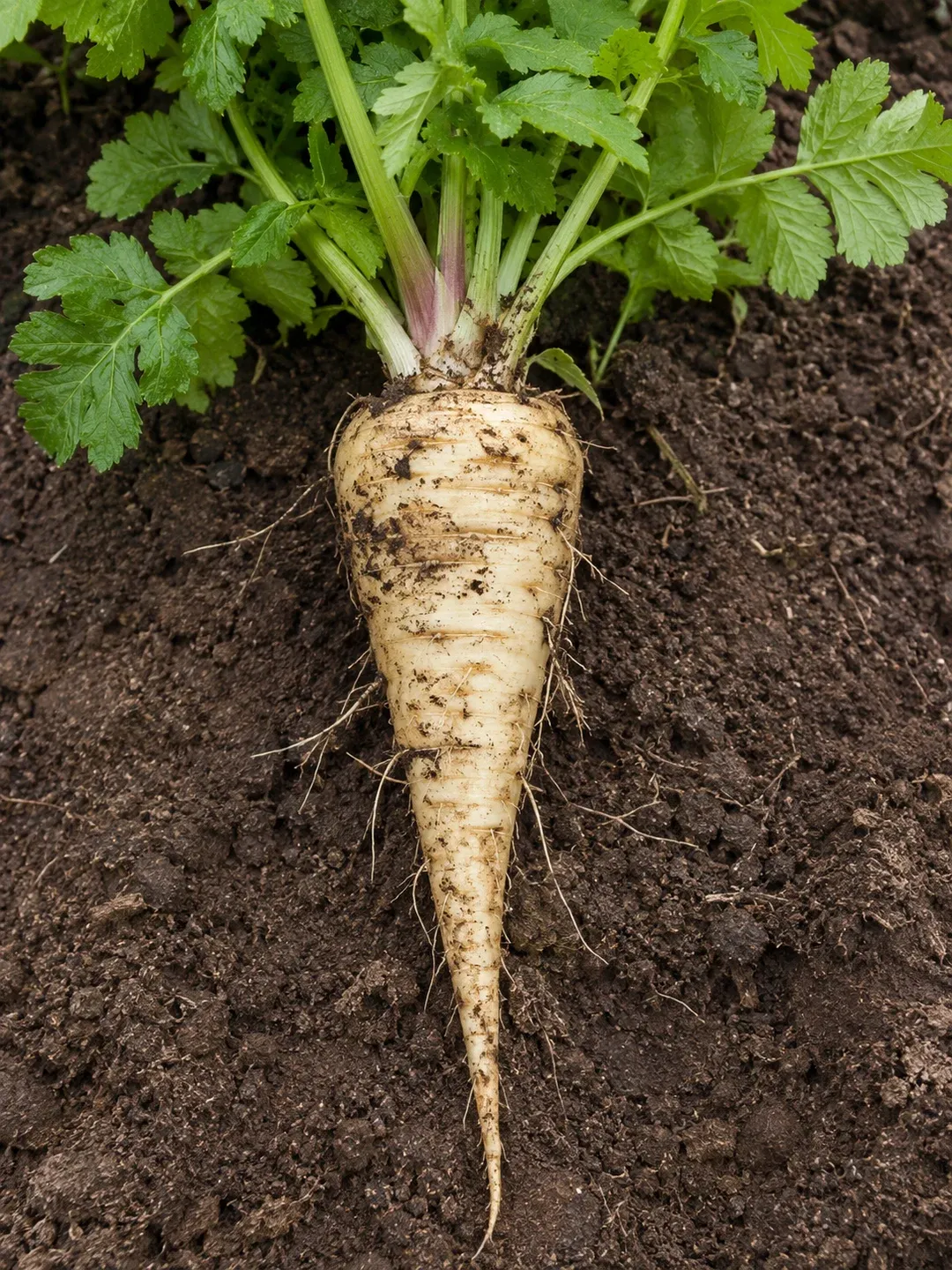
Roots can remain in the ground over winter, but frozen soil makes harvesting difficult. Mark the row before the foliage disappears and plan insulating cover or some early harvests based on your conditions. Check the condition of harvested roots rather than assuming identical storage duration everywhere. RHS
Why Do Some Plants Flower the Following Year?
Parsnip is a biennial: the SNHF describes roots left in place that flower in the second year. Keeping a seed plant thus occupies space beyond the usual root harvest. This is not a reason to wait for flowering before harvesting the rest of the row. If you wish to produce seeds, treat this as a separate goal and check the variety’s seed-production requirements before saving your seeds. SNHF
Key points for this crop
Practical guidance
- Species
- Pastinaca sativa, a member of the Apiaceae family grown for its root
- Establishment
- Direct sowing, no transplanting of the taproot
- Seedling emergence
- Fresh seeds and consistent moisture; emergence time varies
- Harvest
- Fully developed roots, lifted without breaking
Sources and references
- ParsnipSociété nationale d’horticulture de France, Jean-Marc Muller Accessed on 18 October 2026.
- How to grow parsnipsRoyal Horticultural Society, in English Accessed on 18 October 2026.