
The vegetable garden notebook / Crops
Growing nasturtiums: sowing, flowers and seeds
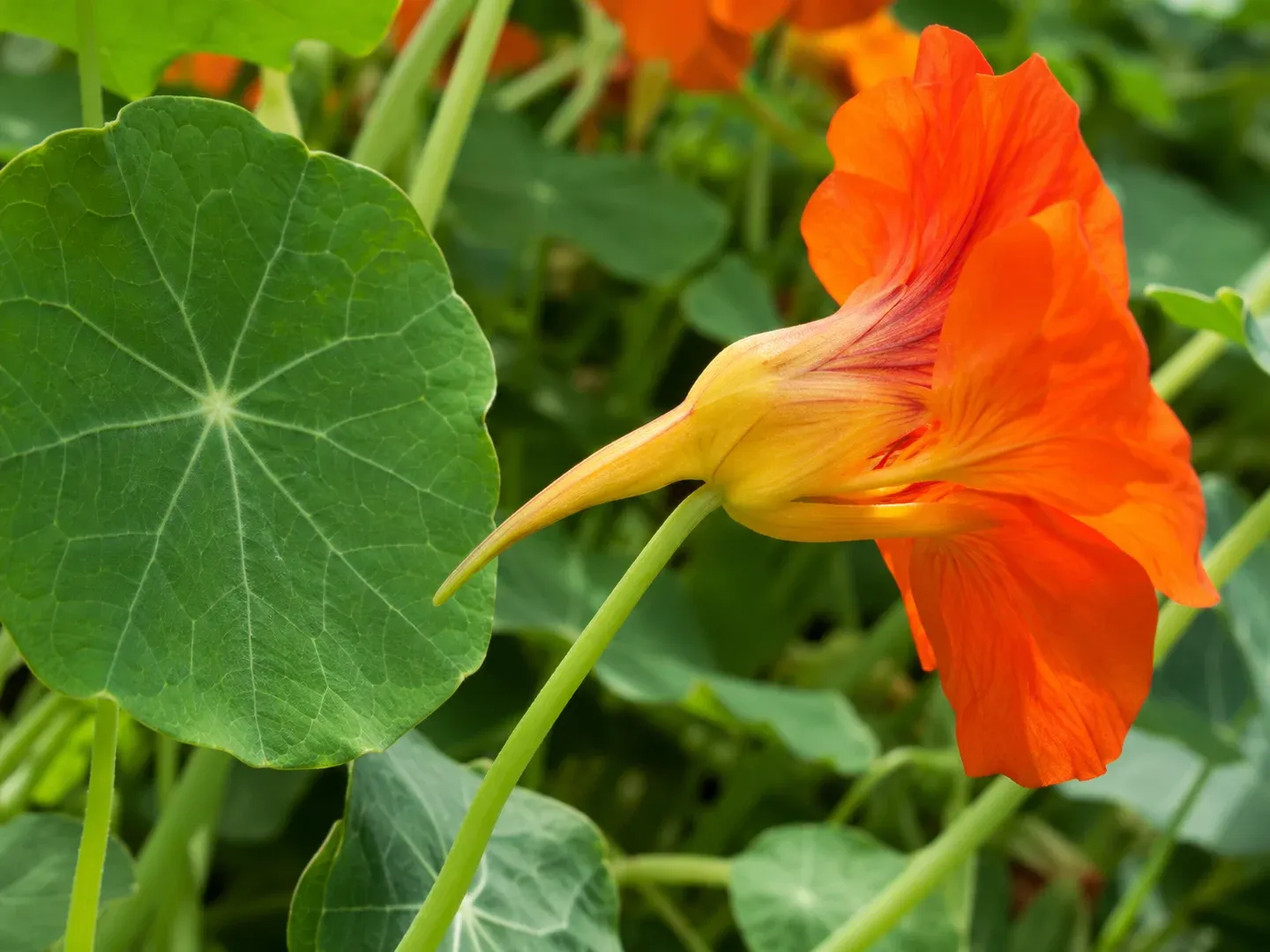
The garden nasturtium provides leaves and flowers to pick when young. Choose its location based on stem length and leave a few flowers if you wish to harvest seeds for resowing.
Adapt this guidance to your garden’s climate and conditions.
Choosing garden nasturtiums and allowing room for their stems
This guide concerns Tropaeolum majus, the garden nasturtium. Check the packet name: nasturtiums also include Tropaeolum minus, often more compact, and other species. Watercress (Nasturtium officinale) is another plant entirely. Wisconsin
For trailing growth or growing up a support, Wisconsin cites ‘Jewel of Africa’ and the ‘Troika’ series among the trailing majus varieties. Choose based on the stated growth habit, available space, and access to flowers. A lengthening stem is not necessarily a problem. Keep it from covering neighbouring young vegetables. Wisconsin
Sowing after frosts or planting a young plant
Direct sowing is done once the risk of frost has passed. Prepare a weed-free patch of soil with a fine tilth. The RHS guideline for T. majus is 2 cm deep, with rows 30 cm apart, then thinning to approximately 30 cm between plants. You still need to allow room for the long stems. Wisconsin, RHS sowing
Keep the sown area moist without waterlogging. Wisconsin generally indicates seedling emergence in 7 to 10 days, depending on soil temperature. Remove competing weeds while plants are small. Wisconsin, RHS cultivation
Starting under cover is possible. Keep young plants in light, frost-free conditions, in a just-moist substrate; harden them off before planting outdoors, keeping each root ball intact. A few staggered sowings can renew plants, provided there is enough time left in the season before cold weather. RHS cultivation
Sun, Well-Drained Soil and Containers
Choose well-drained soil in a sunny spot. Overly rich soil produces abundant leaves at the expense of flowers: do not systematically enrich the plot. RHS species
In pots or hanging baskets, plan for trailing growth without obstructing passage. Select the container based on the cultivar and number of plants. Ensure proper water drainage. RHS cultivation
Watering and Supporting Flowering
Monitor young plants during the first few weeks. After that, water plants in the ground mainly when heat and drought make it necessary. In containers, the substrate dries faster: check it regularly using the watering guide. The RHS distinguishes between border plants, which need no extra fertiliser, and the feeding needs of plants in pots; take into account whether potting compost is already fertilised. RHS cultivation
Guide stems towards thin supports and tie them if necessary. Deadhead to prolong flowering, except on stems reserved for seed production. No general pruning is necessary. RHS cultivation, Wisconsin
Harvesting Leaves and Flowers, Reserving Seeds for Resowing
Harvest young leaves and fresh flowers from a cultivated plant of known identity, whose treatment history you know. Older leaves may be more bitter. Pick as needed for fresh use; this guide does not cover preserving buds or fruits. Wisconsin, RHS sowing
To propagate, leave a few flowers to form fruits and then mature seeds. Harvest in dry weather, clean and dry the seeds before storing them in a labelled envelope, in a cool, dry place: this is the general RHS method. The guide on harvesting and storing seeds details the process from drying to final storage. Offspring of a cultivar may differ from the original plant. RHS seeds, RHS cultivation
Grow it as an annual where frost kills it: a self-sown seedling in spring is a new plant, not the original one surviving winter. Wisconsin
Observing Aphids, Caterpillars and Marked Leaves
Check under leaves if holes appear: white butterfly caterpillars and aphids are documented. Winding leaf mines may be caused by leaf miner larvae. Identify the organism before intervening. Once you have identified aphids, the observation and local intervention guide helps decide the next steps. The RHS also notes possible contact allergies: wear gloves when handling. Wisconsin, RHS species
A pest-infested nasturtium does not guarantee protection for the neighbouring vegetable. The RHS describes the scientific evidence for this trap-crop effect as limited. Consider primarily light, access, and competition with the companion planting guide. RHS cultivation
Key points for this crop
Practical guidance
- Species
- Tropaeolum majus, garden nasturtium of the Tropaeolaceae family
- Planting
- Direct sowing or hardened-off young plants after frosts
- Spacing
- Approximately 30 cm after thinning; also allow space for stems
- Soil
- Sunny, well-drained soil without excessive fertility
Sources and references
- How to grow annual nasturtiumsRoyal Horticultural Society, in English Accessed on 18 October 2026.
- NasturtiumRoyal Horticultural Society, gardening activity, in English Accessed on 18 October 2026.
- Tropaeolum majusRoyal Horticultural Society, in English Accessed on 18 October 2026.
- Nasturtium, Tropaeolum speciesUniversity of Wisconsin–Madison Extension, Susan Mahr, updated by Allen R. Pyle 2026, in English Accessed on 18 October 2026.
- Seed: collecting and storingRoyal Horticultural Society, general method, in English Accessed on 18 October 2026.