
The vegetable garden notebook / Crops
Growing kiwi: choosing plants and supports, and harvesting
Before purchasing a kiwi plant, verify its species, variety, and pollination requirements. Also plan for the mature size and access for pruning: the small plant will become a vine requiring long-term management.
Adapt this guidance to your garden’s climate and conditions.
Fuzzy kiwifruit or kiwiberry: which to choose?
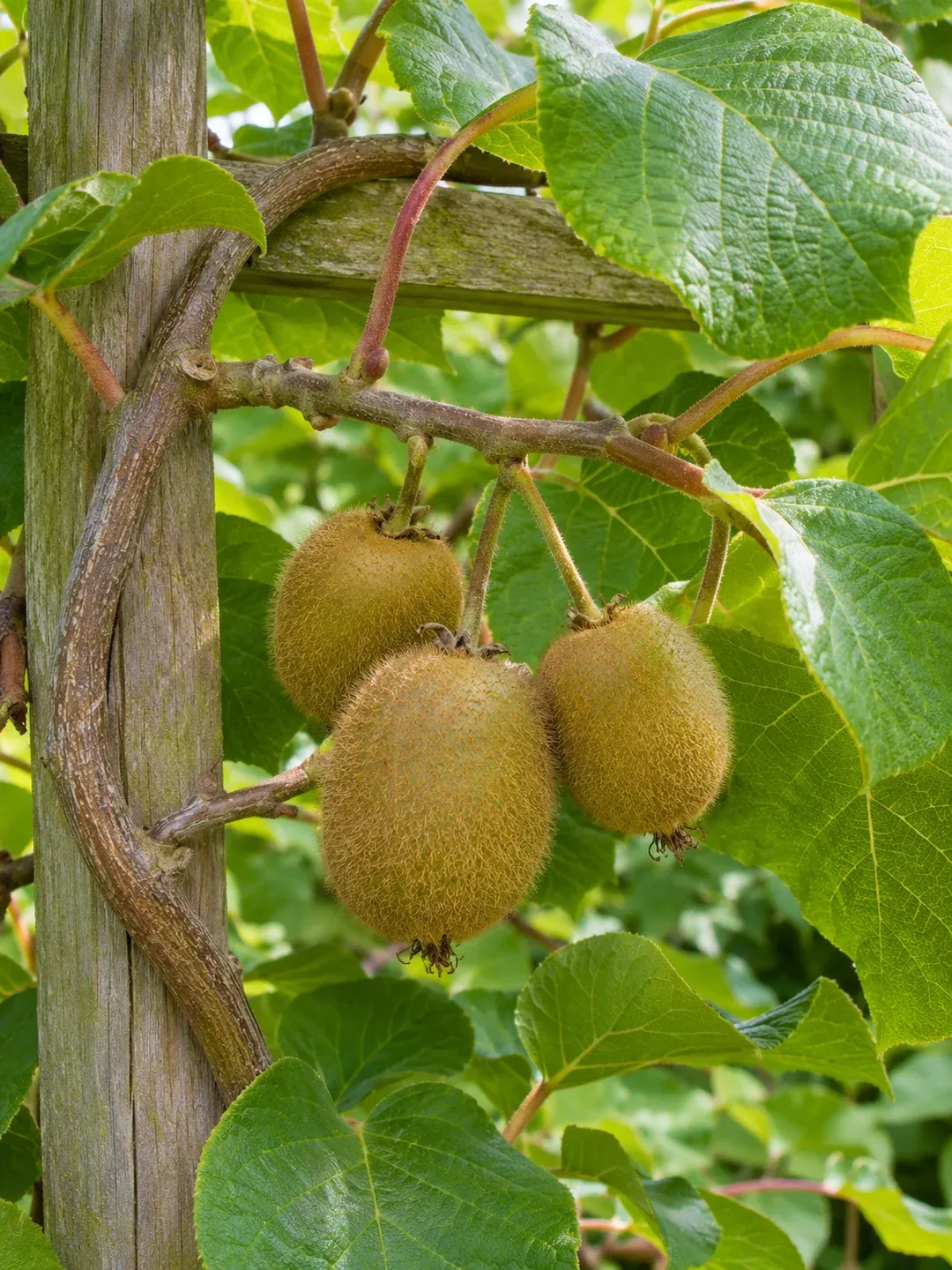
CTIFL distinguishes several types, including Actinidia deliciosa, which includes ‘Hayward’, Actinidia chinensis, comprising varieties with yellow or red flesh, and Actinidia arguta, the small-fruited kiwiberry. The RHS describes the latter as having smooth, edible skin, in contrast to the fuzzy skin of the common kiwi such as ‘Hayward’. Flesh colour alone is not sufficient to select a plant suited to the garden.
Ask for the botanical name and variety, how vigorously it grows and whether it is suited to your local conditions. The RHS classifies ‘Hayward’ as a female variety and ‘Jenny’ as self-fertile. For kiwiberries, Oregon State University describes ‘Issai’ as partially self-fertile, capable of fruiting without a male. This trait applies to the named variety, not all kiwifruit or kiwiberries.
Is it necessary to plant a male and a female?
For a female variety, plan to plant a compatible male, preferably of the same species according to Oregon State University. Both must flower at the same time, a condition emphasised in the production guide. Confirm the pair at the time of purchase; two labels simply marked “kiwi” are insufficient.
If space is limited, choose a variety explicitly labelled as self-fertile. Nonetheless, keep the labels and record flowering times: these will help explain any lack of fruit. No fixed number of females per male replaces checking compatibility and flowering synchronisation.
Plan the space and support before planting
Choose a sunny, sheltered location and well-drained soil. The SNHF stresses the importance of avoiding waterlogging. It provides spacing guidelines of 4 to 6 metres between plants on a pergola and 6 to 8 metres along a wall or trellis: these are reference points for training, to be adjusted based on variety and support.
The Oregon guide requires a permanent structure capable of supporting the weight of the vines and their harvest. An existing pergola is not automatically suitable: verify its load-bearing capacity and anchors if unknown. These planting distances do not constitute a construction plan. Also ensure access for tying, pruning, and harvesting.
The RHS distinguishes the greater winter hardiness of A. arguta from the susceptibility of young shoots of both species to late frosts. Avoid locations regularly affected in spring. A minimum temperature quoted for a dormant plant does not guarantee that its young shoots will survive: see our guide on hardiness zones.
Can kiwifruit or kiwiberries be grown in containers?
This is feasible for an identified and suitable cultivar, with long-term monitoring. The experimental guide by AU/LAB–CRETAU cites the kiwiberry A. arguta ‘Issai’ for container growing and describes hardy kiwis cultivated for several seasons in pots, with monitored irrigation, training, and winter protection.
For another named cultivar, ‘Super Issai’, its producer Lubera recommends large containers of at least 50 litres and highlights high summer water consumption. This guideline applies to their selection: it does not extend to ‘Hayward’, all kiwiberries, or the small pot in which a young plant is sold.
Before opting for container growing, plan for drainage, a permanent support, access for pruning, and regular monitoring of moisture and nutrition. Ask about repotting and winter root protection for your cultivar and climate. If you cannot provide this care or enough room for the mature plant, choose a suitable spot in the ground or another crop. Self-fertility reduces the number of plants needed; it does not reduce the vigour of the vine on its own. AU/LAB, Lubera
Planting and supporting establishment
The RHS advises spring planting when soil and weather have warmed. Adapt this guideline to the local climate and the plant’s condition; do not set a fixed national date.
For a container-grown plant, Oregon State University recommends a hole suited to the root ball, with the top level with the ground. Backfill, firm, and water. Then guide a main shoot towards the support with a tie that does not constrict it.
Monitor moisture during establishment and droughts, particularly when fruits are swelling, as advised by the RHS. The watering guide helps observe the soil. Mulching better preserves moisture; keep the base of the trunk clear.
Should fertiliser be applied?
In open ground regularly mulched with organic matter, the RHS does not recommend systematic fertilisation. If growth or harvest is disappointing, first check water, drainage, and pruning. A yellow leaf alone is not enough to identify a deficiency. If a nutritional deficiency is confirmed, choose an appropriate spring application and follow the instructions, without adopting the rates used in a professional orchard.
Maintenance without removing future fruiting wood
Distribute branches on the support and limit tangling. For fruiting plants, the SNHF recommends controlling vegetation in summer and renewing unproductive shoots in winter, when frost-free, before sap rises. If you cannot yet distinguish the age and role of the branches, ask someone to identify which ones to keep.
Identifying branches to keep
On a single-trunk training system, distinguish the permanent framework—trunk and arms attached to the support—from lateral shoots that are renewed. According to Oregon State University, flowers appear on new growth from shoots formed the previous year. For example, a shoot that grew this summer may produce flowering shoots next spring: cutting it entirely would remove this potential.
In winter, identify well-placed one-year-old shoots to replace those that have already fruited, then distribute them without overlapping. Old wood is not identified solely by thickness: follow its branching and fruiting marks. Keep the framework; do not turn renewal into cutting back all recent growth. In summer, control tangling while retaining the shoots selected to replace older fruiting wood. These principles from Oregon State University must be adapted to the support and cultivar.
The male requires different training: the Oregon guide places most of its pruning after flowering, to preserve pollen needed by females. Do not prune all plants the same way before they flower.
Kiwi not fruiting: where to look first?
The RHS indicates three to four years after planting as a possible timeframe for first fruits, with variations depending on the plant and conditions. For a young plant, first observe its establishment. For an older plant, distinguish between: no flowers, flowers present but no fruit, or fruit that begins to form then drops.
Without flowers, check for frost damage on young shoots and preservation of one-year-old wood during pruning. With flowers, review labels, plant sexes, and actual flowering synchronisation; a lone male will not produce fruit. Keep these observations from one season to the next before replacing a plant. RHS, Oregon State University
Young fruits form then drop
Start by noting the extent of the loss: a few fruits on a vine that retains others, or nearly all fruits, on a single shoot or across the plant. Also compare their size, shape, and leaf condition. An isolated drop alone does not indicate a cause.
Next, review two verifiable observations: did male and female flowering actually overlap, and did the soil remain moist without saturation? Oregon State University links poor pollination to abnormally small fruit or fruit with a groove; the RHS recommends monitoring water during fruit swelling. These points guide the investigation, without proving the cause of dropping. Only address a suspected lack of water after checking the soil; do not automatically apply fertiliser in response to fruit loss.
If the loss becomes widespread, recurs, or accompanies decline, keep photos of the fruits, vine, and its base, along with flowering and dropping dates. Have these examined before replacing the male pollinising vine or applying a treatment.
Drooping leaves, brown edges, or decline: what to check?
Leaves that droop or brown at the edges may follow drought or desiccating wind, according to the RHS. Check moisture at depth and exposure before adding water: already saturated soil requires drainage assessment. Also note any recent frost on young shoots.
If shoots keep dying after soil moisture has been corrected, examine the base of the trunk and have the roots and soil assessed. Oregon State University describes Phytophthora rot, worsened in heavy, wet soil, which may first brown leaf edges then kill shoots. These signs overlap with other stresses: they justify examination, not a certain diagnosis or automatic treatment. Do not compensate for decline with repeated fertilisers.
When to harvest, and when to eat the fruit?
For the common fuzzy-skinned kiwi, Oregon State University distinguishes harvest, when still firm, from later ripening. Black seeds are one clue, but are not enough on their own: the fruit must also have developed enough sugar. Ask about local harvest signs for your variety. Harvest before a hard frost, as advised by the RHS, but do not expect picking before frost to make fruit ripen properly if it is still too immature.
For kiwiberries, taste a fruit when it begins to soften, then harvest progressively: not all ripen at once, according to Oregon State University. Do not rely solely on colour.
Handle fruits gently. CTIFL notes that apples and bananas accelerate ripening: keep them away from the batch you wish to keep firm. Record the variety, harvest date, and ripening results to refine future indicators.
Planning neighbouring crops and keeping records
To compare space, light, water, and access for crops, use the method for planning crops that share a bed. Also keep a record of locations before planning next steps. These two methods do not promise a protective effect from a plant pairing.
For the permanently established vine, also consult reserving permanent locations, distinct from an annual vegetable rotation.
Key points for this crop
Practical guidance
- Selection
- Species, variety, and pollination must be checked together
- Support
- Permanent structure suited to the mature vine
- Frost
- Young shoots remain sensitive to frost
- Harvest
- Different harvest indicators for fuzzy kiwifruit and kiwiberries
Sources and references
- Kiwifruit — foodservice guideCentre technique interprofessionnel des fruits et légumes (CTIFL) Accessed on 16 October 2026.
- How to grow kiwi fruitRoyal Horticultural Society (RHS), in English Accessed on 16 October 2026.
- Growing kiwifruit in your home garden — EM 9322Oregon State University Extension, in English Accessed on 16 October 2026.
- Growing kiwifruit: A guide to kiwiberries and fuzzy kiwifruit — PNW 507Oregon State University Extension, in English Accessed on 16 October 2026.
- KiwiSociété nationale d’horticulture de France (SNHF), Claude Bureaux Accessed on 16 October 2026.
- Guide to rooftop vegetable production, 2023N. Roy, M.-J. Vézina, A. Cohen and E. Duchemin, AU/LAB–CRETAU Accessed on 18 October 2026.
- Self-fertile kiwiberry ‘Super Issai’Lubera, producer, in German Accessed on 18 October 2026.