
The vegetable garden notebook / Crops
Growing kale: sowing, planting and harvesting leaves
Kale provides repeated leaf harvests, but the crop needs to be planned before winter. Distinguish small sowings intended for harvesting baby leaves from mature plants that occupy the vegetable garden long-term.
Adapt this guidance to your garden’s climate and conditions.
Which kale to choose?
Kale is a non-heading cabbage: leaves are harvested as needed. It thrives in cool to temperate climates and tolerates heat poorly. Prepare moist, humus-rich and well-drained soil; light shade may be suitable in hot regions. Sainte Marthe
Varieties differ in size and foliage. Two examples help clarify your choice:
- Red Russian is listed by the RHS among coloured kales particularly suited to salad harvesting. This is a good option if you mainly want young leaves. RHS
- Demi-nain de Westland is a curly non-heading kale. Its name alone does not indicate pot size: check the size stated on your seed packet before reserving space. Westland
To identify a cabbage forming a tight head, see the heading cabbage fact sheet.
When to sow kale in France?
The seed supplier Sainte Marthe distinguishes between sowing under cover in February-March for Red Russian and in a nursery bed or directly outdoors from April to July, depending on the variety. These timeframes do not mean every variety is suitable for every date. The Demi-nain de Westland fact sheet specifies April-June under the “Sowing” section. Sainte Marthe · Westland
To harvest in winter, plan and start the crop well in advance. Cold tolerance does not mean that a variety intended for spring sowing can be sown in October.
How to sow and transplant?
Sow at a depth of 0.5 to 1 cm, then thin out overcrowded seedlings. Keep the variety label to choose the stage and planting distance. Sainte Marthe
For Westland, the “Sowing” section recommends transplanting when plants have four to five leaves. Acclimatise indoor-raised plants, firm the soil at planting and water. Westland · RHS
The RHS specifies 30 to 60 cm between mature plants depending on the variety. Do not apply these distances to a larger variety, nor the close spacing for baby leaves to plants intended for winter. RHS
Can kale be grown in pots?
The RHS suggests a container at least 30 cm wide and deep for a compact plant. Check moisture more frequently than for plants in the ground. A large kale is not managed like a small harvest of young leaves. RHS
How to maintain and protect leaves?
Water young plants regularly; in the ground, established plants mainly require monitoring during prolonged dry periods. A fine-mesh insect net on supports reduces damage from cabbage pests. Crop rotation includes kale among brassicas. RHS
With kale, leaves are the harvest: small holes or wilting warrant close inspection, even without a head to protect. Examine the underside, heart and base of the plant, then use the cabbage pest guide to guide your search for the cause and choose preventive measures.
When and how to harvest?
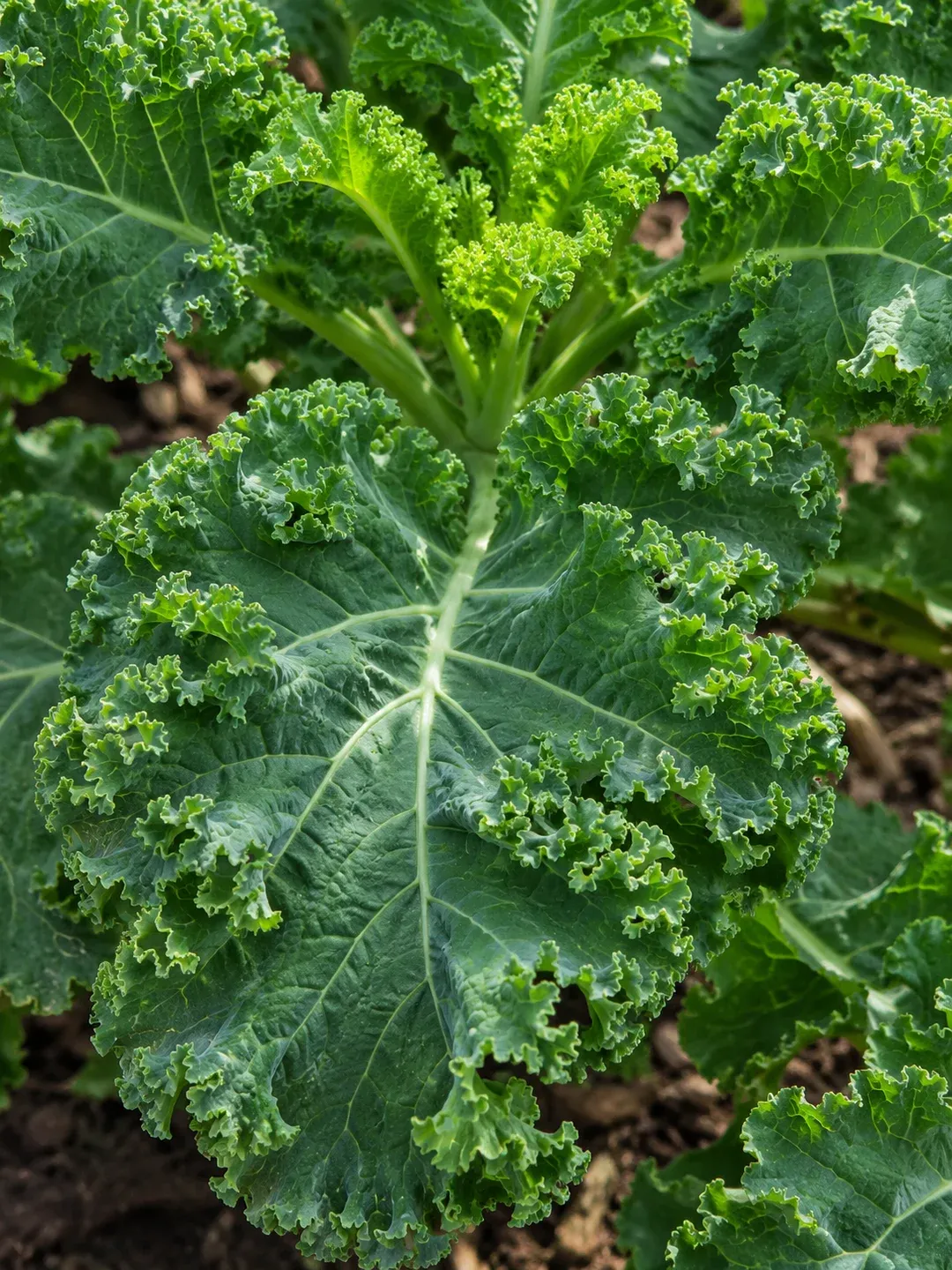
To begin leaf-by-leaf harvesting, NC State suggests a visual cue: leaves the size of an adult’s palm. Pick lower leaves, leaving at least five large leaves, as well as the small central leaves where new growth starts. This cue helps assess the plant before cutting; the American fact sheet’s timeline is not a schedule for your garden. NC State
Limit each harvest to a few lower leaves, as the RHS also recommends. For baby leaves, the RHS gives the stage of 10 to 15 cm in height. The two methods differ in duration and space required in the garden. RHS
Hard frosts may justify protective fleece. Growth may slow in winter; choose a variety suited to your local cold. Sainte Marthe
Why does kale bolt, and should it be replaced?
A non-heading kale can still flower. Most varieties are biennial: they produce leaves then flower in their second year. The RHS distinguishes these kales from perennial forms, such as Daubenton kale, which can produce for several years. The behaviour of the latter does not apply to every kale seed packet.
In overwintering biennials, a cold period prepares the plant for flowering, which then occurs when conditions become favourable again. The required cold duration depends on the crop and variety, explains Oregon State University. Observe the elongation of the central stem and the appearance of buds; a fixed month does not predict bolting across France.
Flowering marks the end of the usual leaf-harvesting period for these biennial kales. If your goal remains regular leaf production, prepare a new batch of plants with a variety and sowing period suited to your garden. A perennial kale needs different care from a biennial kale left to flower. RHS
Key points for this crop
Practical guidance
- Type
- Non-heading cabbage, harvested for its leaves
- Period
- Sowing in spring or early summer depending on the variety
- Soil
- Moist, fertile and well-drained; cool to temperate climate
- Harvest
- Leaves progressively picked from an established plant
Sources and references
- Growing kale successfullyLa Ferme de Sainte Marthe, seed supplier Accessed on 18 October 2026.
- Curly kale ‘Demi-nain de Westland’La Ferme de Sainte Marthe, seed supplier Accessed on 18 October 2026.
- How to grow kaleRoyal Horticultural Society, in English Accessed on 18 October 2026.
- Winter vegetable production on small farms and gardens west of the CascadesOregon State University Extension and partner universities, publication PNW 548, in English Accessed on 18 October 2026.
- Crop Guide – KaleNC State University, Plants for Human Health Institute, in English Accessed on 8 November 2026.