
The vegetable garden notebook / Crops
Growing cauliflower: choosing the season and harvesting the curd
Success with cauliflower begins with a variety adapted to the harvest season. Keep its name and cultivation instructions: not all cauliflowers overwinter, and not all curds need covering.
Adapt this guidance to your garden’s climate and conditions.
Choosing the type before sowing
The RHS distinguishes between summer and autumn types, generally faster-growing and less hardy, and winter and spring types, which are slower-growing and bulkier. These names refer to the harvest period: a winter cauliflower is not necessarily sown in winter. Modern varieties may overlap these groups.
Select a variety whose sowing period, harvest time, and stated cold resistance match your garden. Keep these details; no single calendar suits all of France.
Two projects to compare before purchase
Under the British conditions described by the RHS, ‘Nautilus’ is a summer/autumn type: its cycle starts with a spring sowing, followed by planting out when the young plant is ready. Aim to harvest a compact curd before the first frosts. It suits a project that clears the bed before winter, provided the seed packet instructions confirm this schedule for your region.
For a harvest after winter, the RHS cites ‘Jerome’, a spring type that tolerates cold. This second project begins earlier than its harvest name suggests: winter/spring types are sown around late spring or early summer in this reference, then occupy a large space over winter. Only consider it if your climate, drainage, and seed packet instructions allow for this; plan to protect the curd. These are contextual examples, not national calendars.
If the project involves a container, opt for the mini-cauliflower method from this stage: large winter types are not interchangeable with mini-plants.
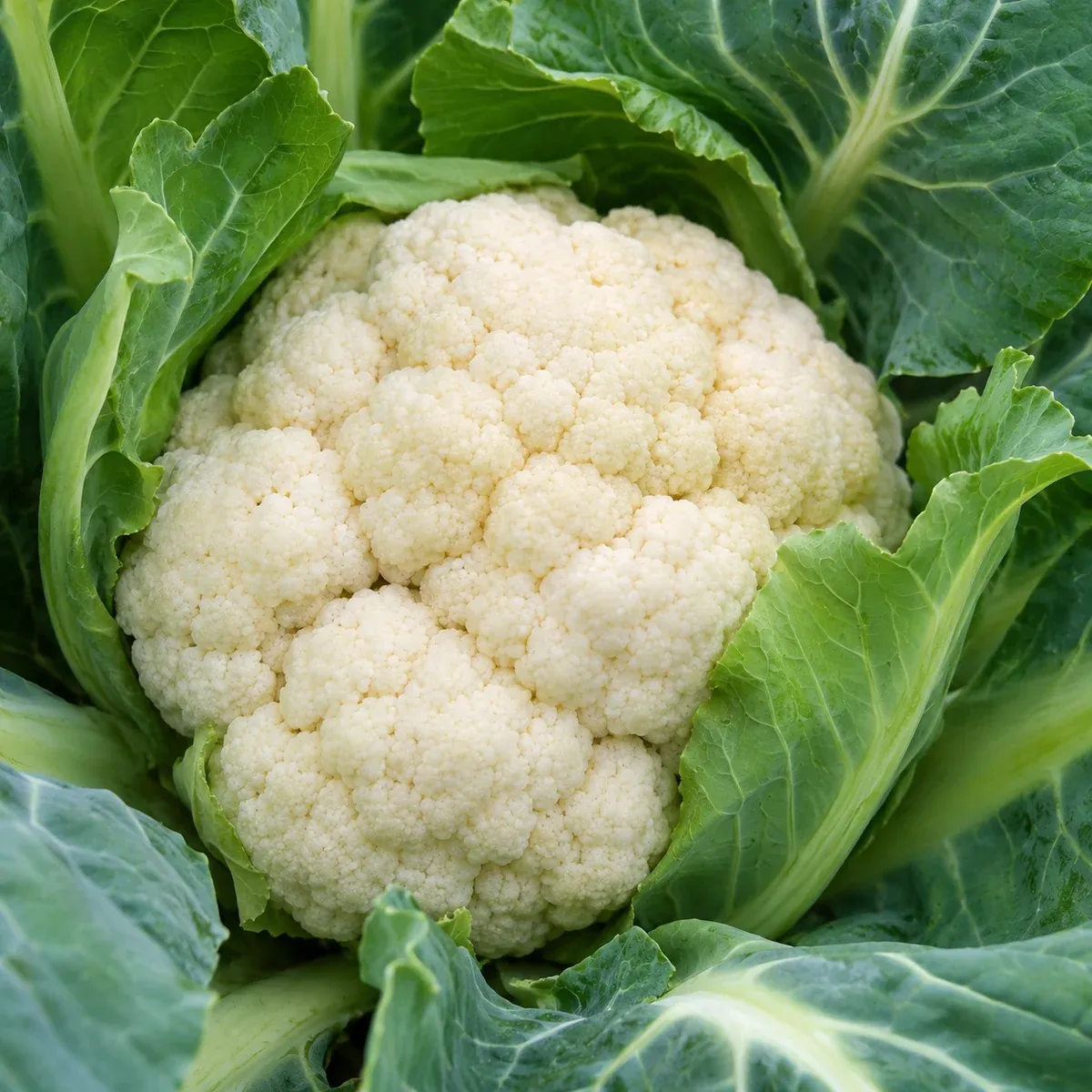
The curd is an inflorescence, distinct from the large leaves surrounding it. Its colour also depends on the variety: the SNHF describes white, orange, and purple curds, among others.
Sowing and planting out young plants
Individual modules limit root disturbance during transplanting, according to the RHS. Follow the depth indicated on the packet and our guide to sowing seeds.
The SNHF recommends sturdy plants with four to five leaves for transplanting. Gradually acclimatise indoor-raised plants to sun and wind while maintaining watering, as recommended by the University of Minnesota.
Plan the final spacing before sowing. As a guide, the RHS suggests:
- summer and autumn: 45 to 60 cm between plants, 60 cm between rows;
- winter and spring: 70 cm in both directions (between plants and rows).
Check the spacing for your variety; mini-cauliflowers require specific management.
Preparing the soil and managing water
Choose fertile, deep, well-draining soil in a sunny location, as advised by the SNHF. Mulch after transplanting. Incorporate this brassica into your crop rotation.
The University of Minnesota recommends well-rotted compost or manure; additional fertiliser is not always necessary after these inputs. Tailor fertilisation to soil condition and, if needed, a soil analysis, avoiding universal rates.
Maintain consistent moisture. Check soil moisture depth with a small trowel, as suggested by this university, then adjust watering based on rainfall and soil. Our watering guide helps organise this monitoring.
Protecting the crop and the curd
The RHS recommends fine insect netting. Prepare it before pests arrive and verify the setup with the guide to installing and checking netting. For varieties overwintering, protect the curd from hard frosts with suitable fleece.
For a white variety, draw leaves over the visible curd to shield it from the sun. Self-blanching varieties may not require this. Do not tie the leaves of orange, green, purple, or Romanesco types to blanch them: the University of Minnesota specifies that their colour needs light. In hot weather, allow air to circulate under tied leaves, following guidance from the University of Maryland.
Harvesting based on the curd’s condition
Harvest the curd when it is firm and compact, before its parts separate. Cut it, leaving a few leaves around it: the University of Maryland recommends this protection and notes that an over-mature curd becomes grainy.
A small curd that stops growing may result from a plant that was too old at transplanting or from temperature stress, according to the same source. This symptom alone is not sufficient to decide on adding fertiliser. Record the variety, planting date, any periods of stress, and condition at harvest to adjust the next attempt.
Can cauliflower be grown in a pot?
Choose a mini-cauliflower, with its own season. The RHS describes up to four mini-plants in a deep pot 40 cm in diameter, filled with potting compost. This guideline does not apply to large winter types. Place the pot in a bright, sheltered spot and monitor the substrate to prevent drying out.
Missing, tiny, or deformed curd: what to check?
If no curd is visible, first verify the variety, its season, and planting date: winter and spring types have a longer development period. Do not expect the same earliness from all plants. RHS
For a tiny or deformed curd, trace growth interruptions: late transplanting and disturbed roots, poorly firmed soil, lack of or irregular watering, cold in spring, or heat in summer. The RHS links these conditions to small curds and bolting. Prevent such setbacks from the young plant stage; late fertiliser will not correct them.
If the plant wilts or the leaves are eaten, also inspect the leaves, stem base, and roots with the pest guide for brassicas. This process helps distinguish leaf damage from root damage before choosing preventive measures; a missing curd alone does not identify a pest.
Key points for this crop
Practical guidance
- Part harvested
- The floral curd, distinct from the surrounding leaves
- Selection
- Harvest season and variety before sowing day
- Growth
- Fertile, well-draining soil kept consistently moist
- Harvest
- A curd that is still firm and compact
Sources and references
- How to Grow CauliflowersRoyal Horticultural Society (RHS), in English Accessed on 16 October 2026.
- CauliflowerSociété nationale d’horticulture de France, Jean-Marc Muller Accessed on 16 October 2026.
- Growing cauliflower in home gardensUniversity of Minnesota Extension, Marissa Schuh and Jill MacKenzie, in English Accessed on 16 October 2026.
- Growing Cauliflower in a Home GardenUniversity of Maryland Extension, in English Accessed on 16 October 2026.