
The vegetable garden notebook / Crops
Growing broccoli: choosing the type and harvesting before flowering
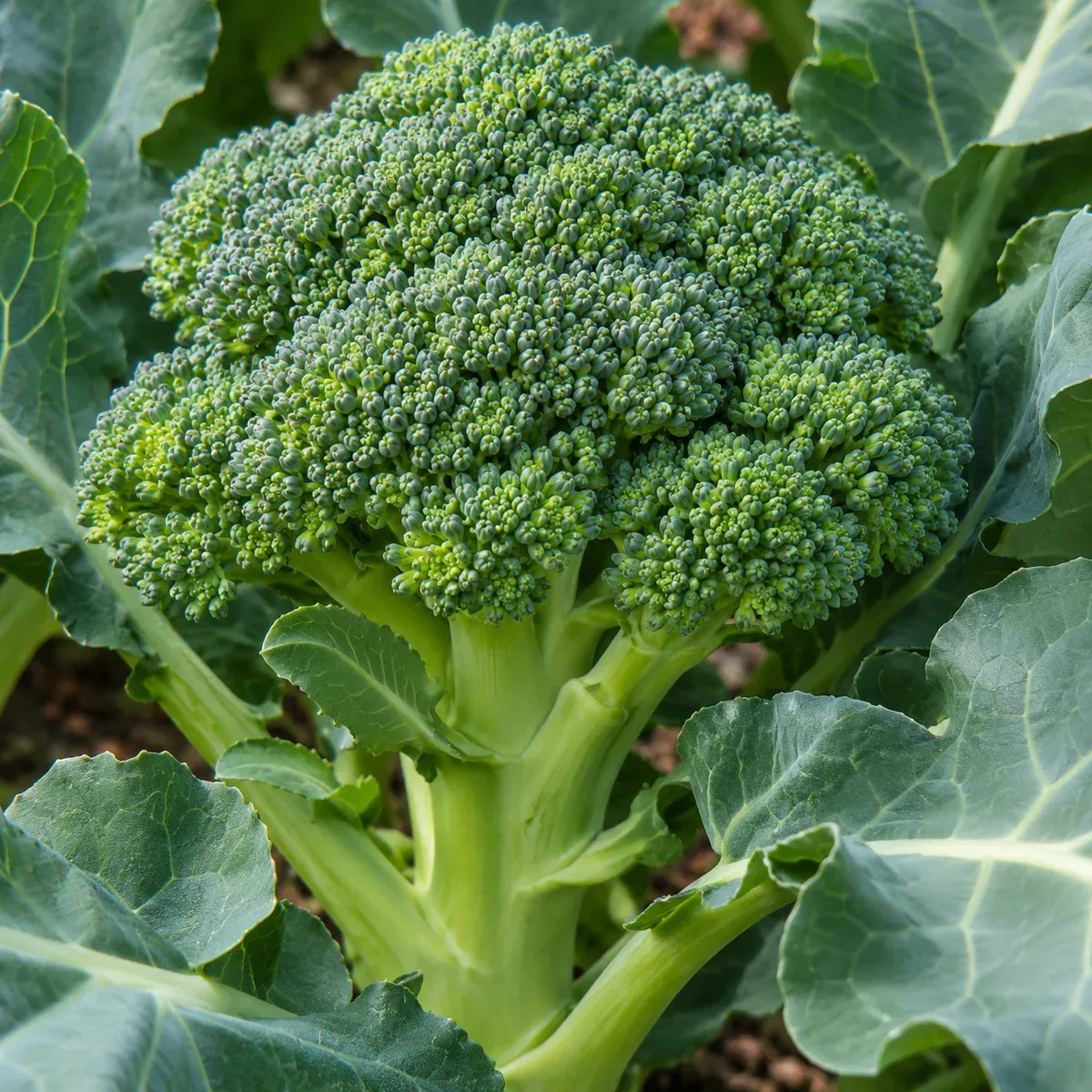
Broccoli includes types with a single large green head and others that produce many shoots. Their cycles and space requirements differ: read the variety details before setting dates and monitor the buds to harvest on time.
Adapt this guidance to your garden’s climate and conditions.
Calabrese or sprouting broccoli: what does the choice change?
Calabrese first produces a large green head; lateral heads may follow. In RHS terminology, sprouting broccoli refers to broccoli with small clusters of buds on leafy stems. Traditional types overwinter and occupy the bed for a long time; faster varieties exist. The two types do not follow the same growing schedule. RHS calabrese · RHS sprouting
Before purchasing, note the type, sowing window, harvest stage, and mature size. In a small garden, include the space it will occupy until removal in your garden plan: the available space at sowing is not sufficient to choose a large overwintering variety.
When should you sow and plant in France?
The SNHF suggests a guideline of sowing in March–April followed by planting in May–June, as well as direct sowing from early June. This general framework must be adjusted according to the variety and climate; it does not apply to all winter sprouting broccoli. The same factsheet recommends deep, well-drained, humus-rich soil. SNHF
For calabrese, the RHS recommends modules to limit root disturbance, followed by hardening off before planting. It advises against transplanting in hot weather, which favours growth checks and premature flowering. Do not treat its British sowing months as dates for the whole of France. RHS calabrese
How much space should you leave between plants?
Spacing varies considerably with the type. The SNHF indicates 50 cm between rows for medium varieties, 65 cm for large ones. For large sprouting broccoli, the RHS suggests 60–80 cm between plants and between rows, depending on their final size. Do not add these distances together: follow the distances specific to your variety. SNHF · RHS sprouting
Broccoli in pots
Choose a compact variety: this is the recommendation from Oregon State University. A large sprouting broccoli that occupies the bed until spring remains cumbersome on a balcony; check its mature size and cycle before purchase.
For a trial, use a well-drained container of at least approximately 20 litres, with 30–45 cm depth. These figures are rounded from the five US gallons and 12–18 inches given by the University of Wisconsin. Reserve the space for a single plant and its foliage rather than crowding several brassicas into the pot. Use a potting compost suitable for vegetables and keep drainage holes clear.
Monitor the moisture of the potting compost during dry periods: the available volume does not eliminate the need to track growth. In a greenhouse or polytunnel, do not try to speed up head formation by increasing the temperature; calabrese may flower prematurely in hot conditions. RHS calabrese
How should you water and protect the crop?
Pay particular attention to young plants and during dry periods. The RHS links a growth check in calabrese to a risk of premature flowering and recommends fine netting on supports against birds and certain insects. For tall, exposed sprouting broccoli, also provide support against wind. RHS calabrese · RHS sprouting
Broccoli is a brassica for crop rotation. Switching from cauliflower to broccoli therefore does not change the plant family in your rotation. RHS sprouting
Why is the head not forming?
Start by checking the label and sowing date. A winter sprouting broccoli is not late because it has not produced a large calabrese head in summer. Compare the stage with the advertised cycle, then distinguish three situations:
- Many leaves, no head: first check the variety’s growing schedule and any spells of intense heat. The University of Maryland guide describes broccoli remaining in the vegetative stage under very hot conditions; it does not tell you how long plants will take to catch up in your garden.
- A very small head already formed on a small plant: premature head formation can follow transplanting plants that are too old or various forms of stress. The same guide mentions lack of water and pest or disease damage in particular. Review the planting history and observe the plant before attributing the problem to a deficiency.
- Clusters of buds loosening and flowers opening: the crop is moving past the ideal harvest stage. Cut the small heads while their buds are still closed, rather than waiting for a large head; the RHS advises this quick harvest in case of early flowering.
If the broccoli wilts or has holes in its leaves, continue with the cabbage pest observation guide: it distinguishes foliage damage from root issues before choosing prevention. Note the signs and their progression, even under netting.
When should you harvest before flowering?
Harvest before the flower buds open. The SNHF starts with the main shoots, then the side shoots. For calabrese too, the RHS requires a still-tight head and prompt harvesting when ready, especially in heat. After the first cut, observe the regrowth instead of automatically uprooting the plant. SNHF · RHS calabrese
Key points for this crop
Practical guidance
- Family
- Brassicaceae; include with other brassicas in crop rotation
- Choice
- Calabrese with a central head or sprouting broccoli
- Environment
- Well-drained soil; sensitive to high temperatures
- Harvest
- Buds still tightly closed, before they open
Sources and references
- BroccoliSociété Nationale d’Horticulture de France Accessed on 18 October 2026.
- How to grow calabreseRoyal Horticultural Society, in English Accessed on 18 October 2026.
- How to grow broccoliRoyal Horticultural Society, in English Accessed on 18 October 2026.
- Broccoli — Quick Garden TipsOregon State University Extension, Food Hero, April 2022, in English Accessed on 18 October 2026.
- Growing Vegetables in ContainersUniversity of Wisconsin–Madison, Extension, in English Accessed on 18 October 2026.
- Mid-Atlantic Commercial Vegetable Production Recommendations 2024–2025 — Cole CropsUniversity of Maryland Extension and partner universities, in English Accessed on 18 October 2026.