
The vegetable garden notebook / Techniques
Green Manures in the Small Vegetable Garden: Choosing and Clearing Space in Time
A green manure occupies a bed between two vegetable crops. In a small garden, its value also depends on the space, water, and effort required to terminate the cover at the right time.
Adapt this guidance to your garden’s climate and conditions.
Practical steps
- Plan
Start with the next vegetable to check the actual available duration.
- Choose
Consider the plant family, season, and method of termination.
- Monitor
Observe growth and intervene before flowering to prevent self-seeding.
- Clear
Control regrowth and check the bed’s condition before vegetables return.
A Living Cover Crop Needs Planning
Green manures are sown to temporarily occupy an area before being terminated. They can cover the soil and provide organic matter; their growth must remain compatible with the small available space. This is the qualification highlighted by Jardiner Autrement.
Start with a single bed. On the garden plan, note the next vegetable and its planting period, then set aside time to terminate the cover and prepare for the vegetable crop. The available duration begins after the last previous harvest and ends before the next sowing or planting.
Living Cover Crop or Mulch: Which Should You Choose?
| Your situation | Practical choice to consider |
|---|---|
| Bed freed early, next crop still some way off | Consider a cover whose establishment and termination fit within this interval. |
| Late harvest, vegetables to be replanted soon | Prefer a movable cover rather than trying to fit a living cover crop’s growth and termination into too short a period. |
| Very small space between existing vegetables | Maintain access and space for priority vegetables; do not sow a mix without allowing for the space it will need. |
| Unable to provide water for emergence or cut the crop when needed | Consider a mulch suited to available materials. |
This table offers an organisational choice, without requiring a cover crop in every gap between vegetable crops. The RHS notes that it demands effort and sometimes water to establish in dry summer conditions. The mulching guide details the alternative and its precautions.
Choose the Species to Suit the Following Crop
The cover’s family matters in crop rotation, just as a vegetable’s does. Jardiner Autrement advises against mustard before or after cabbages and turnips, which also belong to the Brassicaceae family.
To compare a packet or mix, note the species names, their local sowing season, and the intended termination method. A label such as “winter mix” does not alone describe how easily the bed can be cleared.
| Candidate | Point to check before sowing |
|---|---|
| White mustard | Compatibility with previous and following crops; do not choose it in a succession of Brassicaceae. |
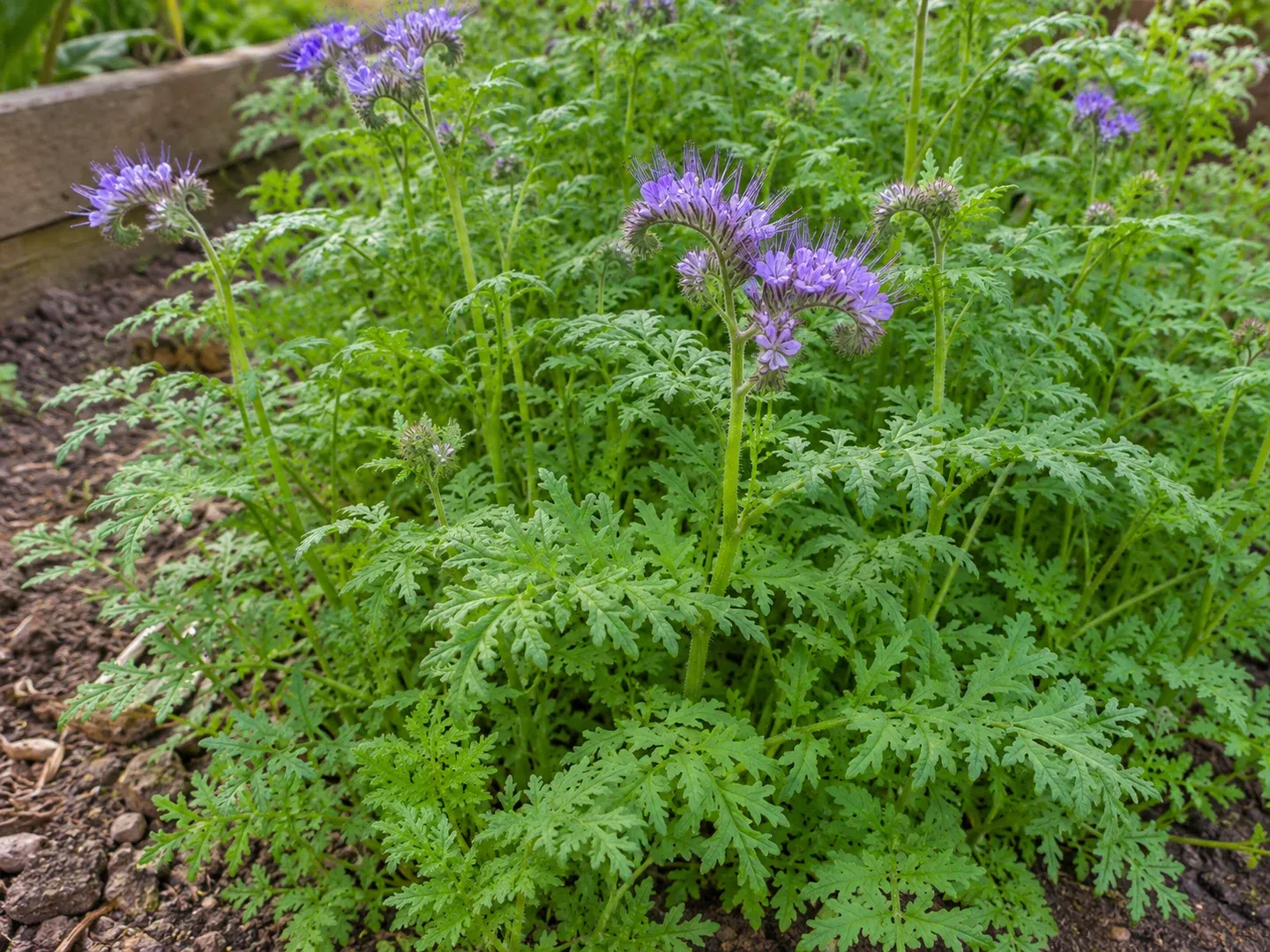
| Phacelia | Plan an intervention: it may overwinter in mild regions, according to the RHS; frost should not be your only termination method. |
| Crimson clover | The RHS describes cutting at ground level without regrowth; do not generalise this practice to other clovers. |
| Mix containing a perennial, e.g., lucerne | Check how to eliminate regrowth; for a first manual trial, its management requires special preparation. |
The points specific to overwintering and termination come from the RHS.
Example Schedule: White Mustard Before a Summer Planting
Suppose a bed is freed in April, outside a succession of cabbages, turnips, or other Brassicaceae, and the next planting of a different family is planned for August according to its growing guide. Jardiner Autrement places white mustard sowing between April and October and describes broadcast sowing. Check the sowing window and seed quantity stated on the packet for your plot; you must also be able to provide the conditions needed for emergence. Jardiner Autrement
In this example, first note the vegetable’s return in August, then set aside at least four to five weeks after incorporation. The source mentions that mustard can be mown after eight to ten weeks but primarily requires cutting before flowering. An April sowing therefore means monitoring the stage in spring; these weeks are not a countdown allowing flowering. Cut, leave to wilt for a few days, then work it shallowly into the soil only if the ground is workable. Jardiner Autrement
If the bed is only free in June or termination is delayed, recalculate: do not shorten the wait before planting to maintain the original plan. Mulch may be better suited to this short gap between crops. This succession is an organisational example, without quantified yield or fertilising effect.
Which Function Are You Seeking?
To capture available nitrogen, the source describes mustard; to fix atmospheric nitrogen, it distinguishes legumes, whose nitrogen is released gradually after the crop is finished. To improve soil structure through roots, it cites grasses and Brassicaceae. This helps compare families but does not replace rotation or the termination method: the plant suited to the function may not suit your interval. Using Covers · Role of Legumes
Decide How to Terminate the Cover Before Sowing It
To limit self-seeding, Jardiner Autrement recommends cutting before flowering. Monitor the plants’ stage: a pre-set date serves as a reminder, then observation determines the intervention.
Two methods require different preparations:
- Cut and compost the aerial parts. The RHS presents this option in no-dig management. Then check for regrowth: cutting alone does not terminate all species. For crimson clover, the source specifies cutting at ground level.
- Incorporate the vegetation into the soil. Jardiner Autrement describes cutting, wilting, then shallow incorporation. Its guideline of at least four to five weeks before the next crop applies to this method; it is neither the lifespan of each cover nor a valid delay after any termination method.
Do not incorporate a cover into waterlogged soil to meet a schedule. If the return of vegetables becomes incompatible with the planned intervention, revise the succession for this bed.
Check the Space Before Replanting Vegetables
Before the next planting, check for regrowth, residues that obstruct the row, and the ability to prepare for sowing. Incorporating fresh vegetation requires a waiting period: decomposing materials can hinder subsequent crops. RHS
Also observe slugs near future young plants; Jardiner Autrement notes their possible presence in the cover. Record the cutting date and method in your notebook to adjust the next trial.
Finally, a legume does not guarantee all the fertilisation for the next vegetable. Its nitrogen release is gradual, as explained by Jardiner Autrement. The fertiliser guide helps you plan feeding based on the bed’s history.
Sources and references
- How to Use Green Manures in the GardenJardiner Autrement, French National Horticultural Society Accessed on 18 October 2026.
- Why Use Green Manures in the Garden?Jardiner Autrement, French National Horticultural Society Accessed on 18 October 2026.
- Green manuresRoyal Horticultural Society, in English Accessed on 18 October 2026.