
The vegetable garden notebook / Crops
Growing turnips: choosing the season, sowing and harvesting
To choose your turnips, start with the intended use: small roots for early eating, autumn harvests, or leaves. Then check the season indicated on the seed packet. The right harvest time depends on the variety and what you plan to cook.
Adapt this guidance to your garden’s climate and conditions.
Which turnip to choose, and when to sow it?
The variety name matters more than just the colour. The SNHF describes round, flat, or elongated turnips, including yellow varieties such as ‘Jaune boule d’or’. To choose your seed packet, first look for the growing season and the stated use.
Its sowing guidelines for France distinguish:
- spring and summer varieties, to be sown from March to June;
- autumn and winter varieties, to be sown between 15 July and 15 August.
These ranges should be cross-referenced with your garden’s climate and the variety’s specific instructions. The RHS notes that seedling emergence is less successful in hot, dry weather: do not sow a long row during very hot weather if you cannot monitor its moisture.
For eating small roots raw, look for a variety intended for this purpose: the RHS describes ‘Sweetbell’, for example, as a salad turnip. For a late harvest to store, explicitly check for a storage recommendation.
Are turnips and swedes interchangeable?
No. The turnip belongs to Brassica rapa, while the swede belongs to Brassica napus. The latter has a longer growing cycle and generally denser flesh, according to the University of Minnesota. Do not use its timings to harvest your turnips.
Preparing the soil and sowing in place
Choose a sunny spot in soil that retains moisture while draining excess water. Iowa State University recommends uncompacted soil; if necessary, garden compost can improve conditions. Prepare a weed-free, crumbled surface to distribute the seeds.
For direct sowing in open ground, the SNHF provides these guidelines:
- Make seed drills 25 cm apart.
- Sow at a depth of 1 cm, cover, and lightly firm.
- At the three true-leaf stage, thin to leave about 10 cm between plants.
Consider this spacing as a starting point: check the packet for variety-specific recommendations and the desired growth. Sow directly in the final location for this method. Our sowing guide details preparation and monitoring seedling emergence.
Turnips in pots: aiming for small roots
The RHS describes growing small turnips in a container at least 40 cm wide, filled with peat-free multipurpose potting compost, in full sun. Sow directly into this container and thin to 10 cm for this early harvest. These measurements do not define a universal volume or a method for large storage turnips.
Monitor moisture frequently: potting compost dries out quickly, especially in summer. To advance a harvest under cover, choose an early variety suited to this; the RHS describes this possibility but does not justify adopting its British schedule in all French gardens.
Monitoring moisture and keeping the row clear
Check the soil beneath the surface next to the plants before deciding to water. University of Minnesota Extension advises using a small trowel to see how far moisture penetrates. Adjust watering based on soil and rainfall: a fixed number of waterings does not account for every garden’s needs. Water stress can make roots more bitter or woody.
After thinning, a light mulch helps retain moisture and limit competing weeds, according to Iowa State University Extension. Weed without disturbing the soil deeply near the roots. The watering guide helps you tailor watering based on your observations.
Hollowed-out roots or holes in leaves: what to check
Flea beetles can produce numerous small holes; look for the small jumping beetles when disturbing the leaves. Young seedlings are particularly vulnerable. These signs are described for turnips by the RHS; a single perforation is not enough to identify the insect.
For a turnip described as ‘wormy’, cut open an affected root: tunnels with legless white larvae point to the cabbage root fly, for which turnips are a host. The RHS recommends protection against egg-laying and crop rotation: adults may emerge under netting placed over an already infested plot. Netting applied after damage does not remove larvae from the roots.
Wilting with irregular swellings and deformations of the root system suggests another issue: club root, a disease affecting Brassicaceae, including turnips. Confirm the cause and avoid moving suspect soil on tools; netting does not treat the soil. RHS
As turnips are brassicas affected by these three problems, the pest management guide for brassicas helps compare observations and choose mesh size based on the insect. Focus on the sections dedicated to flea beetles, root fly, and club root, rather than just the damage to the hearts of headed cabbages.
What to do with a turnip that bolts to seed?
Turnips are biennial, the SNHF reminds us, but early bolting can compromise the harvest. The RHS notes that drought particularly encourages bolting and that the root stops swelling at this stage. A flowering stem is therefore not a sign that a turnip root is ready to harvest.
If your goal is the root, lift the plant to check its texture rather than waiting for further growth. For subsequent sowings, review the variety’s season and moisture monitoring. Keeping a few plants to observe flowers and seeds serves a different purpose than harvesting tender roots.
Harvesting according to use
Observe the visible swelling at ground level and harvest a first turnip to check its texture. University of Minnesota Extension recommends harvesting roots while still young: leaving them to grow larger can make them fibrous and stronger in flavour. No single diameter suits all shapes and varieties.
For leaves, Iowa State University Extension advises cutting young outer leaves while preserving the growing point and without removing most of the foliage. If your primary goal is the root, keep this harvest modest.
For late turnips, the RHS recommends harvesting before hard frosts. Keeping them in the ground under protection is reserved for mild regions. Roots harvested in autumn can be stored for several weeks in moist sand, in a cool, frost-free place; this does not guarantee identical storage for all turnips.
Note the variety, sowing date, first harvest date, and the texture obtained. This practical feedback will help you choose the quantity and timing for your next sowing.
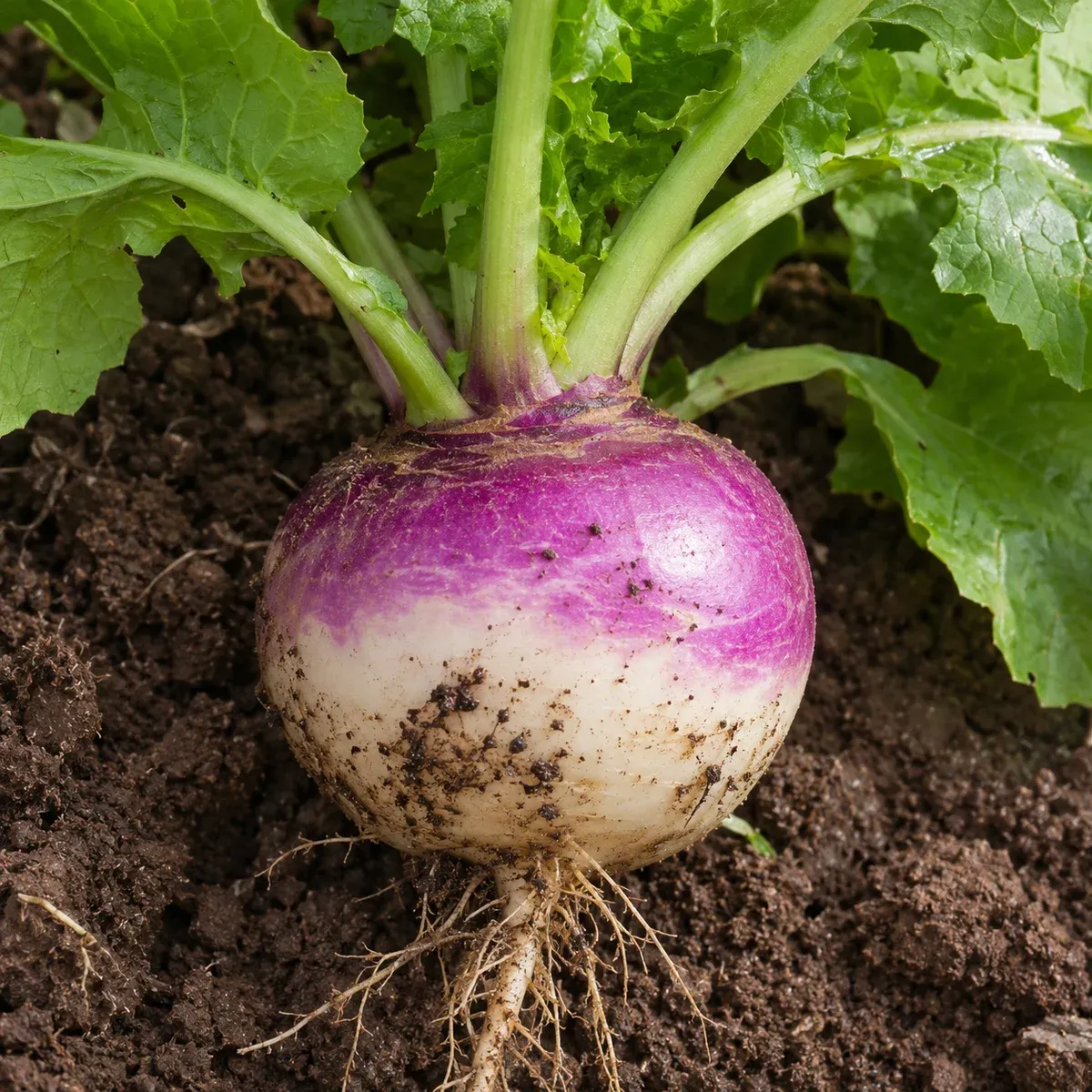
Key points for this crop
Practical guidance
- Season
- Select a variety suited to the sowing window
- Planting
- Direct sowing, followed by thinning
- Moisture
- Monitor soil during dry periods
- Harvest
- Harvest young and check texture
Sources and references
- TurnipSociété nationale d’horticulture de France (SNHF), Jean-Daniel Arnaud Accessed on 16 October 2026.
- How to Grow TurnipsRoyal Horticultural Society (RHS), in English Accessed on 16 October 2026.
- Growing turnips and rutabagas in home gardensUniversity of Minnesota Extension, Marissa Schuh and Jill MacKenzie, in English Accessed on 16 October 2026.
- Growing Turnips and Rutabagas in the Home GardenIowa State University Extension and Outreach, Aaron Steil and Richard Jauron, in English Accessed on 16 October 2026.
- Flea beetles on brassicas and allied plantsRoyal Horticultural Society, in English Accessed on 18 October 2026.
- Cabbage root flyRoyal Horticultural Society, in English Accessed on 18 October 2026.
- Club rootRoyal Horticultural Society, in English Accessed on 18 October 2026.