
The vegetable garden notebook / Crops
Growing annual or perennial savory: sowing and harvesting
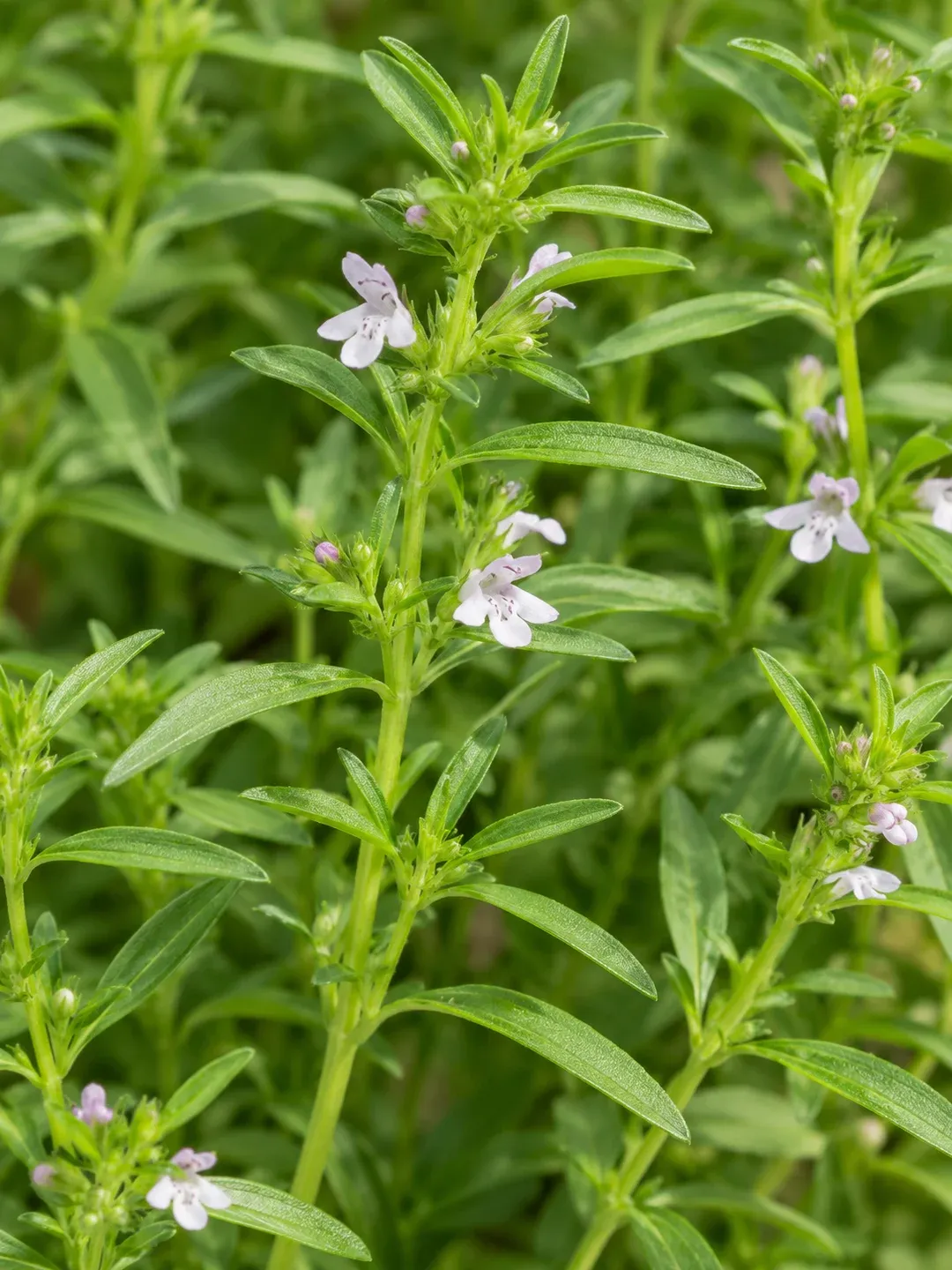
The name savory covers an annual that requires renewal and a small perennial that can remain for several years. Their peppery flavour is used in cooking, but their life cycles, propagation and care at the end of the season call for different choices.
Adapt this guidance to your garden’s climate and conditions.
Choosing between two clearly identified savories
Check the species on the seed packet or pot. This guide covers Satureja hortensis, the annual, and Satureja montana, the perennial. Other species, such as the creeping savory S. spicigera, have a different growth habit and are not automatically managed like montana. RHS
| Decision | Annual savory: S. hortensis | Perennial savory: S. montana |
|---|---|---|
| Duration | One season, then new sowing | Several years if the plant remains healthy |
| Appearance and aroma | Finer stems, milder flavour | Stiffer, woody growth, stronger flavour |
| Planting | Sowing or young plant after risk of frost | Plant, sowing, or cutting; permanent location |
| End of season | Store some leaves and plan replacement sowings | Plant survival does not mean continued leaf production |
These differences are described in the two Illinois fact sheets and by the RHS. For cooking, choose a plant sold as an aromatic herb and identified by species; the label “savory” alone leaves too much uncertainty about its life cycle. Illinois, annual Illinois, perennial
Sowing the annual and organising succession
Sow S. hortensis very shallowly in spring, under cover in a bright place: light promotes germination. Transplant the young plants, acclimatise them, then plant them outdoors after the risk of frost. Direct sowing is also possible when these conditions are met. Illinois estimates around four to six weeks to raise young plants for planting out, though this timeframe should not replace observation of root development and weather. Illinois, annual
A second small batch sown three to four weeks after the first can extend leaf availability if the season allows. This renewal by seed suits the annual; it does not serve as a maintenance schedule for the perennial. Keep the soil or compost moist without waterlogging. Illinois, annual NC State, annual
Planting and propagating the perennial
For S. montana, an identified plant allows you to reserve its location directly. Sowing remains possible in spring; the RHS recommends surface sowing for savories at around 20 °C, followed by transplanting once several leaves have formed. A plant grown under cover must be acclimatised before planting in warmed soil. RHS
In summer, take cuttings of young shoots from a healthy plant you have already identified. Layering is another option: a low stem placed in contact with the soil may root before separation. Division, as with chives, is not the standard method for this small subshrub. RHS Illinois, perennial
To proceed, the RHS softwood cuttings method details selecting a non-flowering shoot, cutting below a node, removing lower leaves, and monitoring until rooting. It also explains how to maintain a humid, aerated environment without exposing the cutting to scorching sun.
Providing space in full sun, in the ground or in pots
Both species require full sun and well-drained soil. The annual appreciates consistent moisture during growth; the established perennial tolerates drier conditions better. Both suffer in persistently waterlogged soil. In heavy soil, choose a raised area or a container with drainage holes. NC State, annual NC State, perennial
The RHS recommends at least 20 cm between savory and neighbouring plants, as well as a pot at least 20 cm in width and depth. Anticipate the perennial’s expansion and repot if necessary. A montana border remains for several seasons: preserve its light and access, without mixing it into a planter kept constantly damp. RHS
Maintenance according to age and cycle
Water young plantings during dry periods and monitor pots more closely. Once established in the ground, the perennial generally needs little watering. Routine feeding is unnecessary in the ground; a pot kept for more than a year may need a supplement during growth, depending on the substrate’s condition. RHS
Harvesting the tips helps maintain a bushy shape. For the perennial, wait for regrowth to determine which branches are dead: some apparently dry stems during dormancy may regrow. Prefer light pruning and retain live shoots; an old, sparse, and weak plant can be renewed from a healthy section. NC State, perennial Illinois, perennial
Harvesting shoots, leaving flowers, and drying
For the annual, pick leafy tips when buds begin to form; they can be used fresh or dried. Cutting may encourage new shoots if the season still allows growth. Leave some stems to flower if you want seeds for succession. Illinois, annual NC State, annual
For the perennial, harvest young shoots during growth, leaving enough foliage on the plant. The flowers attract bees: you may reserve part of the clump for this purpose. To preserve leaves, dry the stems in a dry, dark, and ventilated space, then store the thoroughly dried leaves in a labelled, sealed container. Illinois, perennial NC State, perennial SNHF
Distinguishing end of cycle, dormancy, and disease
The annual ending its season does not share the same fate as a montana slowing down in winter. When decline occurs during growth, examine the base, root ball, and water drainage before deciding to water. Illinois highlights the risk of winter rot for the perennial in poorly drained soil. Illinois, perennial
Inspect both sides of spotted leaves. The RHS lists savories among plants that may carry rust, with powdery orange, yellow, or black pustules. These are signs to confirm, not a diagnosis based on a photo of a dry leaf. Also check for the presence of an animal before attributing bites to a pest; seek advice if damage spreads. RHS, rust
Preparing two different end-of-season approaches
For hortensis, harvest and dry a supply for later use, then plan a new sowing the following year. Protecting an old plant does not turn it into a perennial. For montana, ensure good drainage; shelter pots from persistent rain without enclosing them in stagnant air. RHS SNHF
Montana foliage may diminish with cold and its growth slows: survival does not guarantee continuous harvest. Choose its neighbours based on water, space, and cultivation duration. Companion planting with French beans does not guarantee protection against their pests. Illinois, perennial NC State, perennial
Key points for this crop
Practical guidance
- Annual
- Satureja hortensis: sow afresh each year
- Perennial
- Satureja montana: small subshrub, harvest according to growth
- Location
- Full sun and well-drained soil, in the ground or in a pot with drainage holes
- Winter
- End of the annual’s cycle; monitor cold and damp for the perennial
Sources and references
- How to grow savoryRoyal Horticultural Society, in English Accessed on 18 October 2026.
- Cuttings: softwoodRoyal Horticultural Society, in English Accessed on 8 November 2026.
- Savory: SummerUniversity of Illinois Extension, in English Accessed on 18 October 2026.
- Savory: WinterUniversity of Illinois Extension, in English Accessed on 18 October 2026.
- Satureja hortensisNorth Carolina Extension Gardener Plant Toolbox, in English Accessed on 18 October 2026.
- Satureja montanaNorth Carolina Extension Gardener Plant Toolbox, in English Accessed on 18 October 2026.
- Mint rustRoyal Horticultural Society, in English Accessed on 18 October 2026.
- Herbs: a world of flavours at your fingertipsSNHF, vegetable and fruit section, April 2023 Accessed on 18 October 2026.