
The vegetable garden notebook / Crops
Growing lentils in the vegetable garden: sowing and harvesting dried lentils
Try lentils on a small plot to observe their growing cycle and harvest them dry. Allow plenty of time for shelling: a few pods will not provide a store of food.
Adapt this guidance to your garden’s climate and conditions.
Choosing a lentil to sow for a small trial
The culinary lentil is Lens culinaris, classified by Kew under the name Vicia lens, within the Fabaceae family. It produces small flowers followed by pods containing few seeds. This growing method aims for dried lentils, leaving the foliage and flowers in place so the seeds can develop. Kew
Select seeds that are identified and suited to your region. The Garden Organic garden trial compared Anicia, a green lentil, and Flora, a pale-seeded lentil; it does not identify a superior variety for all French gardens. If you experiment with culinary lentils, use only whole, dry, untreated lentils: a broken lentil is not viable as seed. Garden Organic, trial, guide
The method described is for spring sowing. The pink winter lentil, or lentillon rose, which Terres Inovia describes for winter sowing in Champagne, requires a separate choice suited to that variety and location. Do not automatically apply the spring timing to it. Terres Inovia, guide
Finding a sunny and well-drained spot
Prefer a small plot in open ground, bright and accessible for harvesting. Avoid shade from taller vegetables, waterlogging, and soil compaction. Terres Inovia also notes that lentils compete poorly with weeds early in their growth: start with a weed-free site. Garden Organic, guide, Terres Inovia, establishment
The references cited pertain to in-ground plots. If growing in a container, treat it as an observation trial, using a free-draining growing medium and a pot with drainage holes. These sources do not establish a minimum pot volume or an expected harvest. A greenhouse is not necessary for the method described.
Sowing in spring according to soil and climate
Wait for the soil to drain and warm. The French field-crop guide places sowing from mid-February in areas where the season starts early to late May at higher altitudes; this is not an interchangeable window for every garden. It recommends soil temperatures above 6 °C and a sowing depth of 2 to 3 cm: these germination benchmarks apply to a trial of the same species, without adopting the density of mechanised fields. Terres Inovia, guide
Direct sowing: the limits of the trial’s sowing rate
Garden Organic suggests rows spaced 30 cm apart for gardens. Their trial used 10 g of seeds per m², but participants sometimes found the plants too densely packed, and rot occurred in humid climates: do not treat this rate as a mandatory target. Ensure access for weeding. Garden Organic, trial
In modules: starting seedlings for transplanting
Another option is to start two or three seeds per module, then harden off the seedlings once they have true leaves and transplant the plugs at approximately 30 cm intervals, as described in the home gardening guide. It gives a seedling emergence time of around 10 days, depending on soil temperature and moisture. This method does not guarantee earlier harvest or higher yield. The seed-sowing guide helps you monitor seedling emergence. Garden Organic, guide
Monitoring water, weeds, and flowering
Keep the soil moist enough for seedlings to emerge, then observe soil and weather before watering. Lentils tolerate neither excess water nor water stress late in the cycle. Avoid alternating between waterlogged and markedly dry soil. Remove weeds while they are young, taking care not to pull up lentil plants growing among them. Terres Inovia, establishment
Do not automatically add nitrogen: root nodules enable symbiosis, but the garden trial shows they do not form everywhere. This variability does not justify systematic fertilisation. Harvesting the lentil seeds also removes nutrients: do not assume that the following crop will receive free fertilisation. Garden Organic, trial
Allow the small white, bluish, or pink flowers to form pods; do not cut back the plant to harvest leaves. If stems collapse, check soil moisture and density before adding support. The professional guide describes companion crops grown to support the lentils; sorting them after harvest adds complexity for a first trial. Kew, Terres Inovia, guide
Harvesting at maturity, drying, then shelling
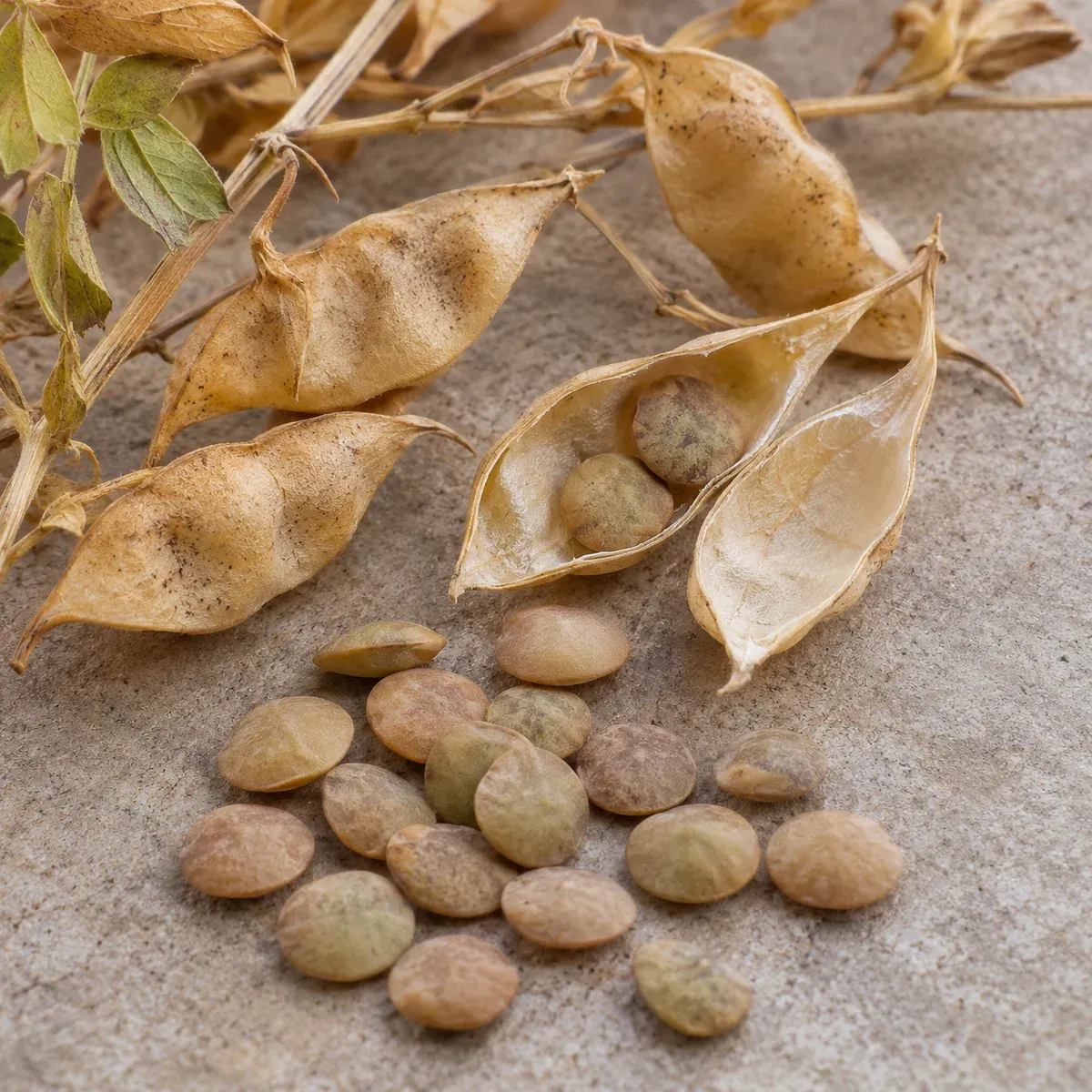
Monitor the lower pods: they may dry and split while the top remains green. For a small crop, pick brown pods in stages; the alternative method involves harvesting yellowed plants, drying them, then threshing the pods in a sack. Work over a container to catch the lentils. Garden Organic, trial, guide
Sort the lentils carefully, removing debris, seeds from other plants and damaged lentils. Complete drying before storage, then keep the dry harvest in a clean, labelled, and dry container. Set aside healthy seeds for resowing; the seed-saving guide provides further storage advice after drying. Manual threshing is time-consuming: a small harvest’s success does not prove it can feed a household. Garden Organic, guide, trial
Observing damage and planning ahead
The garden trial reported slug damage as seedlings emerged, pigeons on plants or pods, and rot in damp conditions. Check for signs and organisms before concluding; a yellowed plant is not necessarily ripe. Also photograph the roots and stem base if the plant is declining. Garden Organic, trial
In France, Terres Inovia also describes bruchid beetles whose larvae develop inside the lentil seeds. Inspect the harvest during sorting and storage; lentils with holes, or insects found among them, call for identification, without adopting the treatments from this professional field-crop guide. Terres Inovia, guide
The crop is renewed by sowing, with no perennial crown to overwinter. Keep a record of the plot’s history: lentils and certain other Fabaceae share root diseases. The French guide recommends at least five years between host crops to limit, for example, Aphanomyces; simply alternating with peas does not resolve this risk. Adjust the crop rotation plan accordingly. Terres Inovia, guide
Key points for this crop
Practical guidance
- Species
- Lens culinaris, an annual in the Fabaceae family; Kew accepts the name Vicia lens
- Location
- Full sun, well-drained and non-compacted soil
- Sowing
- In spring, depending on the climate and whether excess water has drained from the soil; French guideline for depth 2 to 3 cm
- Harvest
- Dried lentils from mature pods; ripening occurs in stages and shelling takes patience
Sources and references
- Vicia lens — General information, Lens culinaris profileRoyal Botanic Gardens, Kew, Plants of the World Online, in English Accessed on 18 October 2026.
- Lentil cultivation guide 2023Terres Inovia, technical institute, February 2023 Accessed on 18 October 2026.
- Establishing lentils under good conditionsTerres Inovia, Solana Vera, development engineer for Centre and West Accessed on 18 October 2026.
- Home grown lentils — experiment 2019Garden Organic, original report of a participatory trial in British gardens, in English Accessed on 18 October 2026.
- LentilsGarden Organic, demonstration garden guide, in English Accessed on 18 October 2026.