
The vegetable garden notebook / Crops
Growing Chinese chives: sowing, division and cut-and-come-again leaves
Chinese chives form a perennial clump of flat leaves with a garlic-like fragrance. They are cultivated for repeated harvests, requiring well-drained soil, adequate space and monitoring of seeds after flowering.
Adapt this guidance to your garden’s climate and conditions.
Chinese chives, Welsh onion or common chives?
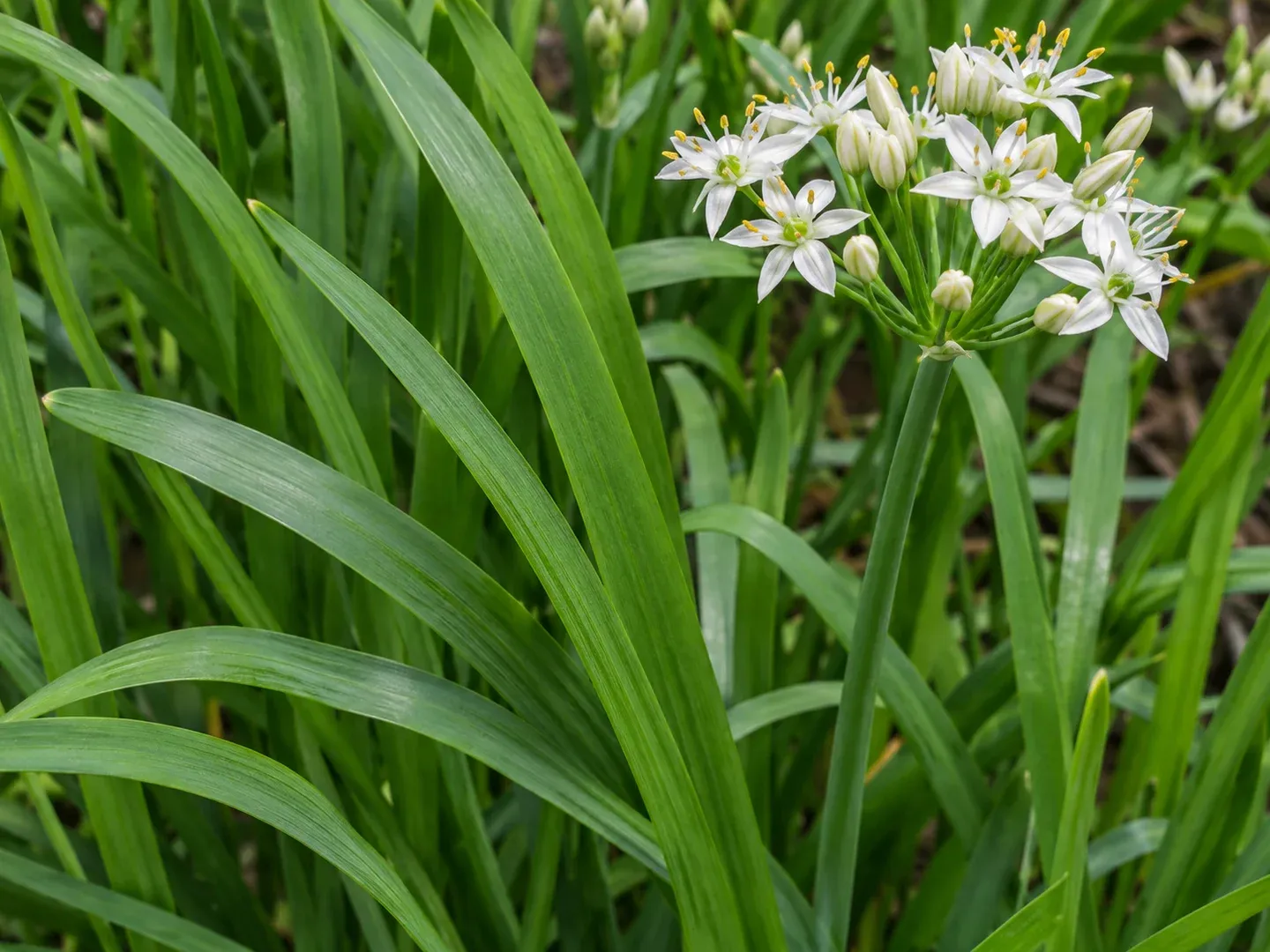
Look for the name Allium tuberosum on the seed packet or plant label. This species, also called Chinese chives, has flat leaves, a garlic-like fragrance and white flowers. Common chives, A. schoenoprasum, have fine, hollow leaves and typically pink to mauve flowers. Welsh onion, A. fistulosum, is yet another species. Illinois · RHS chives · RHS Welsh onion
An identified plant allows you to preserve the cultivar’s characteristics; Illinois cites ‘Kobold’ for a more compact habit. For sowing without a specific cultivar, verify the species and the space available for the clump. Illinois
When to sow and how to care for young seedlings?
The RHS recommends spring sowing in a cold frame. In France, start seeds in a bright location and take your garden’s cold conditions into account; outdoors, wait until the soil is workable and has warmed up. UNH indicates approximately 10 °C soil temperature as a benchmark in its cultivation table. RHS species · UNH
Cover the seeds with about 0.5 to 0.6 cm of substrate and keep it consistently moist, without saturating. UNH reports seedling emergence in 7 to 14 days under its conditions: check water, warmth and seed batch condition if seedlings are slow to emerge, rather than immediately digging over the sown area. The sowing guide details this monitoring. UNH
Establishing a clump in the ground or in a pot
Choose fertile soil that retains moisture while draining well, in full sun; partial shade is also possible according to UNH. Allow approximately 30 cm between clumps, a guideline for their development, not for each seed in a small sowing pot. RHS species · UNH
Plant the clump at the same level as it was growing, firm gently and water. In pots, use a container with drainage holes, suitable potting compost and leave room for growth. The container limits the expansion of the rhizome but does not prevent seeds from falling nearby. RHS chives · NC State
Managing watering, feeding and ageing clumps
Keep the soil consistently moist during establishment. An established clump tolerates dry periods better, but this resilience does not guarantee tender leaves without water. In pots, check the substrate more frequently and water during growth when it begins to dry. The watering guide helps assess the actual moisture reserve. Wisconsin · RHS chives
Frequent cutting may justify supplementary feeding, depending on soil fertility and the potting compost used; follow the fertiliser instructions rather than applying a universal dose. Weed around clumps to keep their base accessible. Illinois
Divide an overcrowded clump in early spring, retaining rooted sections for replanting. The RHS also suggests taking offsets in autumn. Renewal by division is useful after a few years but should not spread a declining or rotting plant. RHS species · Wisconsin
How to cut, store and manage flowers
Harvest green leaves from a growing plant, using scissors to cut approximately 2 to 3 cm above the soil. Allow a young plant to establish before increasing the frequency of cuts. Use leaves fresh or freeze them for later use; drying degrades their appearance, and they are harder to store well. Wisconsin · Illinois
You may leave a few flower heads for pollinators, then cut the stems after flowering, before seed dispersal. This species self-seeds readily. Removing faded flowers is primarily a decision to control self-seeding; there is no need to wait for a specific month to intervene. Wisconsin · NC State
Yellow foliage, tunnels or soft base: what to check
Overly wet soil may encourage rot: check drainage before adding water to a weakened plant. Yellowing alone does not identify a disease. NC State
The RHS cites Allium leaf miner and white rot among the risks for this species. Lines of white dots, tunnels and brown pupae suggest leaf miner; white mould with small black grains at the base may indicate white rot. Have uncertain symptoms assessed before taking action. RHS species · RHS leaf miner · RHS white rot
Netting can protect plants from adult leaf miners during their flight periods, provided they do not emerge from already covered soil. Do not transfer suspect soil or divisions to a new planting. Crop rotation helps plan the sequence of crops but is not sufficient to quickly eliminate established white rot. RHS leaf miner · RHS white rot
What happens to Chinese chives in winter?
In cold climates, foliage may die back and regrow in spring; in milder climates, it may persist. A perennial does not guarantee year-round harvests. A potted clump can be brought indoors to a bright location to extend harvests. Keep its position marked during dormancy. Wisconsin
Key points for this crop
Practical guidance
- Species
- Allium tuberosum, also known as Chinese chives
- Identification
- Flat leaves and white flowers, distinct from common chives
- Establishment
- Spring sowing or division; approximately 30 cm for a clump
- Harvest
- Green leaves during growth; possible winter dormancy
Sources and references
- Allium tuberosum — Chinese chivesRoyal Horticultural Society, in English Accessed on 18 October 2026.
- Garlic Chives, Allium tuberosumUniversity of Wisconsin–Madison Extension, Susan Mahr Accessed on 18 October 2026.
- How to grow garlic chives (Allium tuberosum)University of New Hampshire Extension and educational partners Accessed on 18 October 2026.
- ChivesUniversity of Illinois Extension Accessed on 18 October 2026.
- Allium tuberosumNorth Carolina Extension Gardener Plant Toolbox Accessed on 18 October 2026.
- How to grow chivesRoyal Horticultural Society, in English Accessed on 18 October 2026.
- Allium fistulosum — Welsh onionRoyal Horticultural Society, in English Accessed on 18 October 2026.
- Allium leaf minerRoyal Horticultural Society, in English Accessed on 18 October 2026.
- Onion white rotRoyal Horticultural Society, in English Accessed on 18 October 2026.