
The vegetable garden notebook / Crops
Growing celeriac: sowing, planting and storage
Celeriac occupies the plot for several months before developing its swollen base. Protecting young plants from cold, planting at the correct depth and keeping the soil consistently moist matter more than a late attempt to make an undersized celeriac grow larger.
Adapt this guidance to your garden’s climate and conditions.
Choosing a celeriac variety
Celeriac is a type of celery grown for the swelling at the base of its foliage. It belongs to the same species as stalk celery; cutting celery is mainly used as a condiment, and lovage is another species. A packet labelled simply “celery” should therefore be verified. SNHF
Choose based on earliness, shape, and the variety’s stated storage qualities. Sensitivity to bolting or diseases may also vary. The RHS describes smoother varieties, easier to prepare in the kitchen: the largest size is not the only useful criterion. Keep the varietal name to interpret results.
Allowing time for slow growth from seed, protected from the cold
The SNHF provides a sowing window in France of February to April in a bright, heated growing space, as well as a nursery sowing from late April to late May. This second sowing must remain compatible with the variety and the length of the local growing season: approximately six to seven months are needed from sowing. In a region with a short autumn, buying plants can avoid a sowing that is too late.
In a seed tray or modules, sow thinly in fine, moist potting compost with a very light covering of compost. The RHS uses approximately 15 °C for germination; germination can take three weeks and may be uneven. As soon as seedlings emerge, keep the plants in the light and above 10 °C: cold can trigger subsequent bolting. An unheated cold frame is therefore not equivalent to a heated, bright room.
Prick out into individual pots when the seedlings can be handled, or thin to one plant per module. The SNHF also describes a traditional method with two pricking-out stages in a nursery bed and trimming the root tips. This is not a step to add automatically to a plug-grown seedling: the RHS module method allows for a different approach. The sowing guide provides additional preparation details.
Planting with the crown level with the soil
Plant out acclimatised seedlings once frosts have passed and the weather has warmed. Choose the planting date according to conditions in your garden; very early planting exposed to cold can compromise the harvest. Choose loose, humus-rich soil that retains moisture without becoming waterlogged, in full sun or light shade. SNHF, RHS
The SNHF guideline is 35 cm apart in each direction. The RHS suggests a row arrangement, with 30 cm between plants and 40–45 cm between rows. Choose a layout suited to the variety, without combining these two plans. Plant with the base of the foliage level with the soil: do not bury the crown or cover it with mulch. Water after planting.
This guide focuses on open ground. The long cycle and need for moist conditions make small containers unsuitable. Cover is mainly useful at the start: it does not replace the months of growth required.
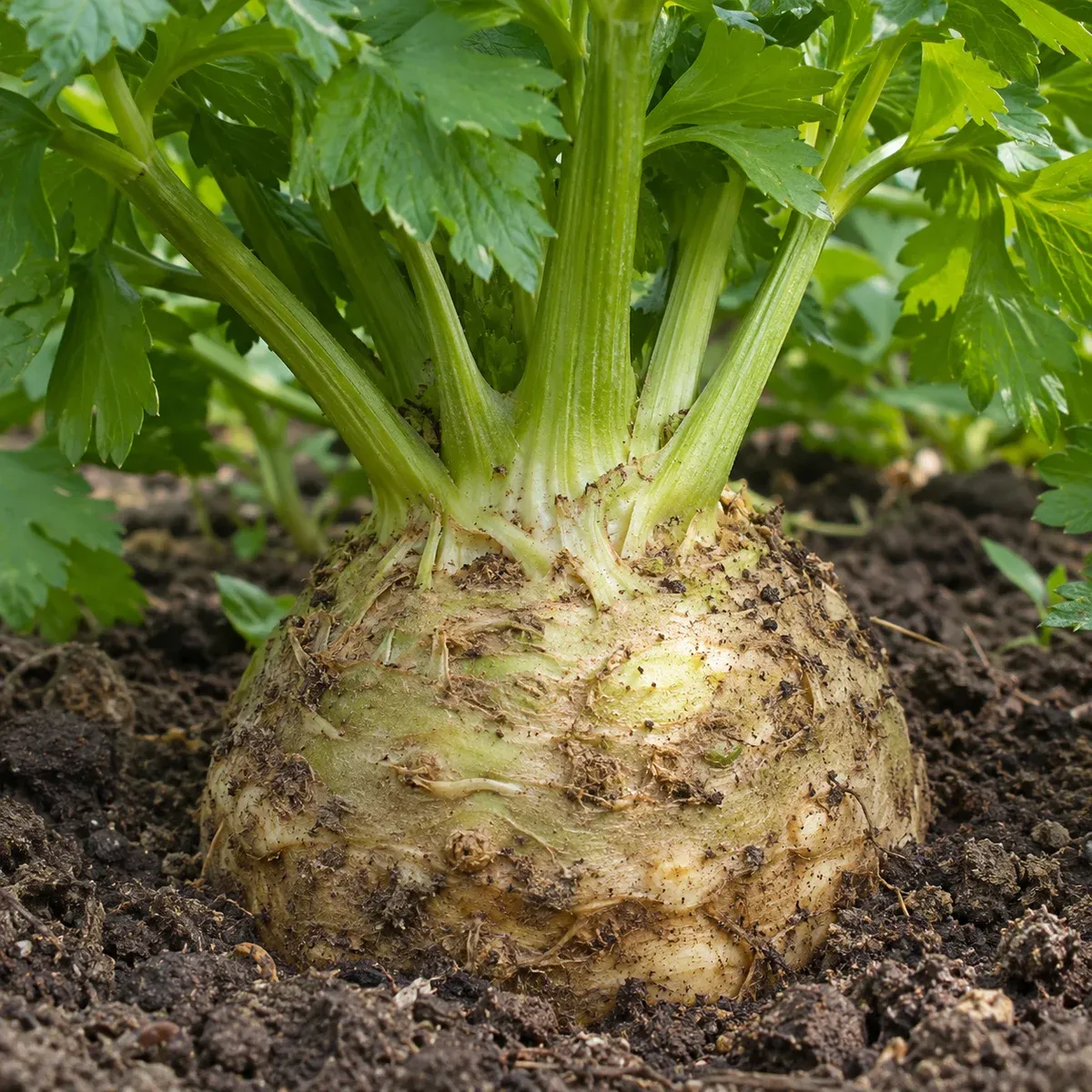
Helping the swollen base develop
Improve soil poor in organic matter with well-decomposed compost, depending on its initial state. Weed to limit competition and mulch around the plants, keeping the crown clear. Check moisture under the mulch: moist soil is different from waterlogged soil. Adjust watering based on rainfall, soil, and growth, without a universal dose. SNHF, RHS
Do not regularly strip the plant of its leaves in an attempt to enlarge the swollen base. The RHS describes a gradual removal of only the outer leaves when they droop horizontally, and of damaged leaves; this does not involve cutting active foliage or pulling roots beneath the swollen base.
Undersized celeriac, spotted leaves or flowering: what should you check?
If the swollen base remains small, review the history: sowing date, actual time available, spacing, buried crown, drought, and foliage condition. These elements guide observation; size alone does not identify a deficiency. A flower stalk indicates bolting, sometimes caused by cold experienced when young. Keeping this plant for another year does not guarantee the expected growth: celeriac is biennial. SNHF, RHS
Septoria can significantly reduce growth by destroying the foliage. Look for brown spots with small black dots, followed by leaf drying. Remove affected parts, monitor other plants, and avoid prolonging leaf wetness through overhead watering. Isolated yellowing is not a diagnosis. Jardiner Autrement
Dry patches in the leaves may also accompany leaf miner infestation; slugs attack young leaves and sometimes the swollen base. Observe the leaves and swollen base before concluding that disease or a nutrient deficiency is the cause. RHS
Harvesting, leaving in the ground or lifting for storage
Harvest when the swelling has reached a useful size for cooking, after several months of growth. The expected diameter depends on the variety and season; a large celeriac is not automatically woody. Lift the plant gently with a fork to minimise damage. RHS
In well-drained soil, where winter conditions allow, celeriac plants can remain in place for staggered harvesting. The RHS advises protecting the soil from frost in colder conditions; this facilitates lifting but does not make harvesting possible in already frozen ground. In heavy or waterlogged soil in winter, prefer autumn lifting.
Preparing a box for storage
The SNHF describes storing celeriac in sand in a cellar; the RHS specifies that it must be moist, with a box in a dark, frost-free location.
- Sort the celeriac when lifting it: set aside healthy specimens for storage. Separate damaged ones for priority use if still edible, and discard rotten ones.
- Remove foliage, shake off loose soil, and handle without bruising the swelling.
- Store in layers in moist sand, then keep the box accessible to check the celeriac again. The sand limits their wilting; it must not become a stagnant water bath.
- Remove any celeriac that deteriorates and review conditions if the problem spreads.
A heated cellar does not meet the required cool conditions; a waterlogged location does not become suitable simply because it is underground. If you lack suitable conditions, reduce the quantity stored and prioritise another harvest preservation method, rather than assuming that the celeriac will keep for a set period.
Plan for the long period for which this crop occupies the bed. The SNHF recommends three to four years before returning celery to the same spot, including when alternating stalk celery and celeriac. Consult the crop rotation guide to place subsequent crops; no companion planting removes the need to keep track of crop rotation.
Key points for this crop
Practical guidance
- Cultivated type
- Apium graveolens var. rapaceum, grown for its swollen base
- Cycle
- Approximately six to seven months from sowing
- Planting
- Spacing: 35 cm apart in each direction, with the crown level with the soil
- Soil
- Fertile, loose, and moist, without becoming waterlogged
Sources and references
- Celery, celeriac, cutting celery and lovageFrench National Horticultural Society (SNHF) Accessed on 18 October 2026.
- How to grow celeriacRoyal Horticultural Society (RHS), in English Accessed on 18 October 2026.
- Celery – Septoria leaf spotJardiner Autrement, SNHF Accessed on 18 October 2026.
- Root vegetables: storingRoyal Horticultural Society, in English Accessed on 8 November 2026.