
The vegetable garden notebook / Crops
Growing Belgian endive: producing the roots then forcing the chicons
Belgian endive is prepared in two stages: several months in the vegetable garden to form roots, followed by forcing in darkness to obtain the chicons. The variety chosen must be suitable for the planned forcing method and period.
Adapt this guidance to your garden’s climate and conditions.
Choose witloof suited to your forcing method and timing
Belgian endive, or chicon, comes from witloof chicory (Cichorium intybus, Foliosum Group). It is not grown like escarole, frisée or sugarloaf chicory. The pale head that is eaten develops from the bud of a root cultivated beforehand. SNHF
Before sowing, check the seed packet for the forcing period and whether or not soil cover is required. Traditional strains generally require a layer of soil above the bud to form a closed chicon. Hybrids have been selected to produce without this layer. In both cases, darkness remains essential; “without soil cover” does not mean “in the light”. CTIFL in Jardins de France
Grow the roots in the vegetable garden first
In France, the SNHF gives a sowing window of April to June. Choose the date according to the variety and climate: sowing too early and exposed to cold can lead to bolting, while a late start leaves less time to form a root. The CTIFL article gives around 150 to 170 days of root growth for its method, with autumn lifting: this benchmark shows the necessary duration, without setting a single date for all gardens.
Sow directly in prepared soil, in full sun, in loose, humus-rich soil that allows root development. The RHS indicates a depth of 1 cm for outdoor sowing. Space rows 30 cm apart, then thin to 15 to 20 cm along the row at the three- or four-leaf stage, according to the SNHF. Maintain the moisture needed for seedling emergence, weed, and water during dry periods. Apply well-decomposed garden compost according to the initial soil condition, without trying to compensate for a lack of water with repeated nutrient applications.
Growing the roots therefore occupies bed space for a long period, like a long-season vegetable crop. The forcing container used later is not the container for root production: if you are short of space, you can start with bought-in, ready-to-force roots of a known variety and forcing season.
Lifting mature roots and preserving the bud
In autumn, wait for the maturity expected for the variety, then lift the roots with a fork before frosts, according to the SNHF method. Reserve for forcing only healthy, well-formed roots with an intact central bud. A plant that has already bolted does not correspond to the same stage as a root that has accumulated reserves and then entered dormancy. SNHF, CTIFL
Cut the foliage without damaging the terminal bud. As a cautious benchmark, the CTIFL article leaves a leaf cluster of 3 to 5 cm and trims roots to 15 to 17 cm. Other methods use different measurements; follow a method suited to your batch and container height rather than repeatedly trimming them. The future chicon depends on this bud, not on any piece of root.
Between lifting and forcing, store roots in a cool place without letting roots and buds dry out. The RHS describes storage in sand in a cool location. Monitor the batch and remove any rotting roots. Forcing a few roots at a time allows staggered harvests, provided the remaining roots are stored correctly and forced within the period suitable for that variety.
Forcing in a cellar or other dark location
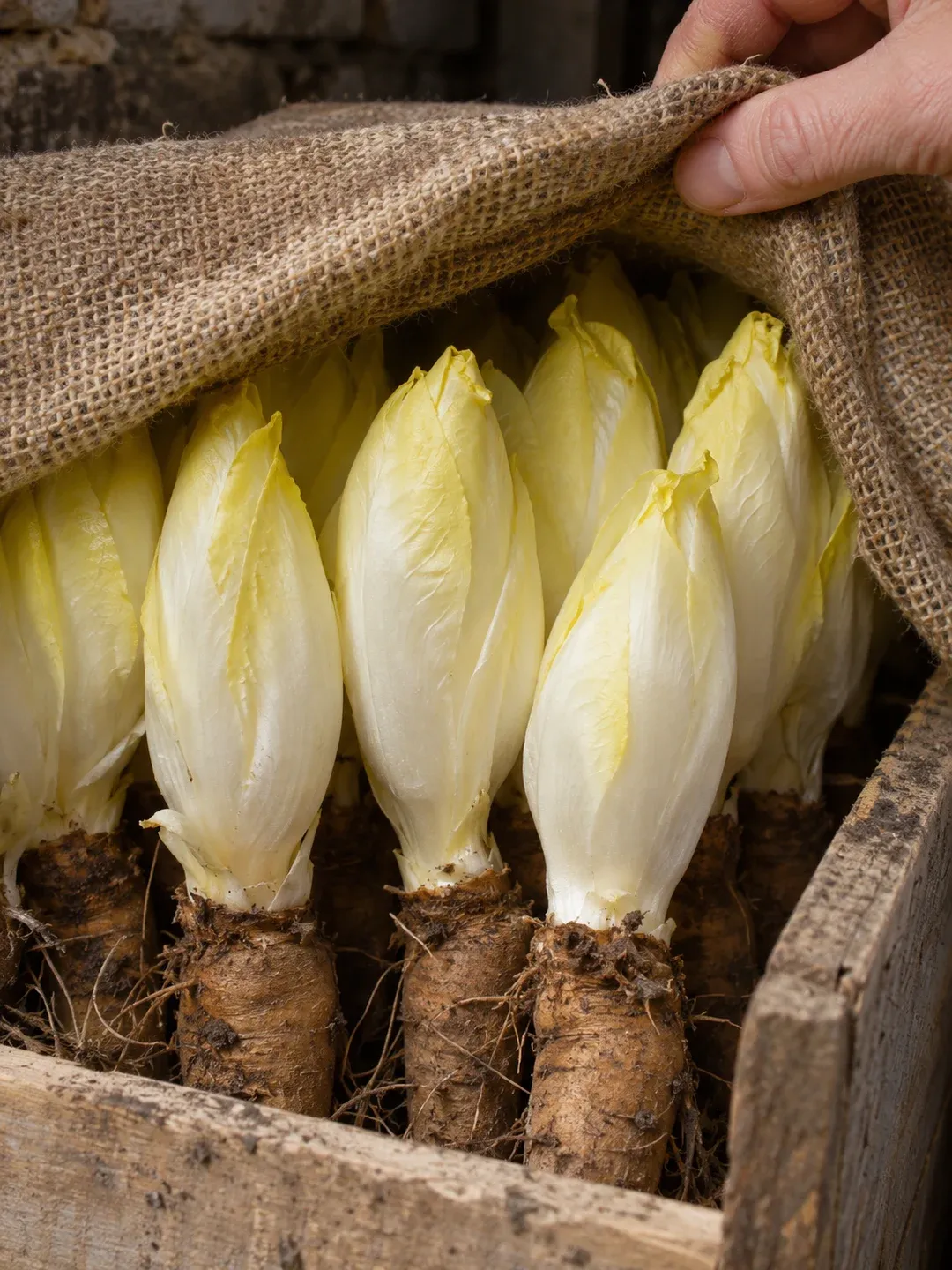
For a variety suitable for forcing without soil cover, place roots vertically, side by side, in a sufficiently tall container filled with moist substrate. Leave the buds level with the surface. The RHS describes forcing at 10–15 °C, under an upturned bucket or opaque lid allowing space for chicons; block all light entry, including holes in the decorative outer pot used as a cover.
Keep the substrate moist, without waterlogging and without watering the growing buds. The CTIFL emphasises this point: water requirements change during forcing. Regularly check moisture and root condition; a fixed watering schedule is poorly suited to different containers and temperatures.
For a variety requiring soil cover, follow the corresponding method. The SNHF describes roots placed upright in a trench, covered with 20 cm of soil, then protected by a straw layer and rain cover. This method requires dedicated space and cannot be automatically replaced by a bucket placed on the leaves in the field. In waterlogged soil or if forcing conditions are not controlled, the result remains uncertain.
Observing failures before restarting a batch
A chicon turning green first suggests checking for light entry; a red-leaved variety, however, retains its varietal character. A loose or poorly developed chicon also requires reviewing the variety, root maturity and condition, temperature, and cover method. Darkness alone does not transform any chicory into a tightly closed head. SNHF, CTIFL
A soft root, rotting tissues, or a bad smell justify isolating the affected root and examining the batch’s moisture. Do not deduce a specific organism from rot alone. In the garden, also monitor roots and hearts for gnawing: the SNHF reports damage from chicory fly and cutworms. Identify organisms and the location of injuries before any intervention.
Harvesting chicons and planning the next steps
For the heated indoor forcing described, the CTIFL article provides a benchmark of three to six weeks depending on temperature. This period begins with roots ready for forcing; it follows months of garden cultivation and does not tell you how long forcing in a cold garden trench will take. Wait for a formed, dense, and still closed chicon. The RHS uses approximately 15 cm in height as a benchmark, then cuts at the base.
Harvest as needed and keep chicons cool and protected from light before consumption: UC Davis describes their rapid greening in light. A second flush of growth is possible on some roots, but it is smaller according to the RHS.
Belgian endive belongs to the Asteraceae family. Note where the roots grew and alternate families in the crop rotation plan, taking into account any problems observed in the field. For forced batches, clean the container and start again with healthy roots. Even when forcing in winter, you still need to monitor root health throughout the first stage.
Key points for this crop
Practical guidance
- Plant
- Witloof chicory, Cichorium intybus, Asteraceae
- Two stages
- Root cultivation then forcing in darkness
- Spacing in the garden
- 15 to 20 cm between plants, 30 cm between rows
- Forcing
- Several weeks; method and season depend on the variety
Sources and references
- Witloof chicoryFrench National Horticultural Society (SNHF) Accessed on 18 October 2026.
- Belgian endive: history and growing techniquesJardins de France, Michel Marle, CTIFL/Apef engineer Accessed on 18 October 2026.
- How to grow chicoryRoyal Horticultural Society (RHS), in English Accessed on 18 October 2026.
- Belgian endive (witloof chicory)UC Davis, Postharvest Research and Extension Center, in English Accessed on 18 October 2026.