
The vegetable garden notebook / Crops
Growing wild garlic: planting and harvesting
Wild garlic is a bulbous perennial with seasonal foliage. To start, choose identified cultivated plants of Allium ursinum, give them a permanent spot, and allow them to establish before harvesting leaves.
Adapt this guidance to your garden’s climate and conditions.
Before any harvest, ensure positive identification
Anses documents severe poisonings caused by confusing autumn crocus with wild garlic. This warning also applies to the vegetable garden: do not consume any plant whose identification is in doubt.
This guide explains how to grow wild garlic; it cannot identify an unknown plant as safe to eat. Do not decide to eat it based solely on a photo, an app, a resemblance, or a scent, and do not taste it to verify.
Start with plants sold under the botanical name Allium ursinum; the RHS notes that these are available from nurseries. Keep their label and record their location. Do not add a wild clump whose identity you have only assumed. Knowing where your cultivated plants are does not remove the need to check what you pick among other plants.
Choose a moist, permanent spot
Select a location in partial shade, with fertile soil that allows water to drain. The RHS describes these conditions for the species; “moist” does not mean constantly waterlogged. A shady but very dry spot alone does not meet the plant’s needs.
Set aside an area where you can keep track of its spread. Wild garlic spreads via seeds and underground bulbs and may compete with small neighbouring plants, according to the RHS. Avoid planting it among crops you move each year without considering its long-term place. Mark this spot on your garden plan.
Growing in containers
A pot lets you keep track of a small clump, but you need to maintain the moist conditions it would have in the ground. Keep it outdoors in partial shade, away from the scorching or drying conditions of a hot balcony, following the species’ needs as described by the RHS. A heated room or warm greenhouse is not a solution for year-round foliage: summer dormancy is normal. RHS
To try container growing, start with an identified cultivated plant and a pot with drainage holes and enough space for the root ball to fit without being squeezed, with room to grow. This approach adapts the general principles of RHS bulb container planting to the species’ needs: a potting compost that retains moisture while allowing excess water to drain, monitoring the root ball during growth, and letting foliage yellow naturally. Check the root ball before watering; do not leave stagnant water beneath the pot. Ask the grower which container suits the plant you are buying, and move it to a larger one if the clump becomes crowded.
Keep the label and ensure the pot remains identifiable even when the leaves have disappeared. Avoid mixed plantings of different bulbs or similar-looking plants: growing in a container does not remove the need to check every leaf you pick.
Planting pot-grown plants
Prepare a small, accessible area, cleared of unwanted vegetation. For plants already rooted in pots, the general steps for planting perennials (RHS) provide a useful framework:
- Choose a time when the soil is moist but neither frozen nor waterlogged.
- Arrange the pots to plan the space for each clump; follow the producer’s spacing recommendations.
- Take each plant out of its pot, dig a hole to fit its root ball, and plant without burying the shoot bases.
- Backfill with soil, firm gently by hand, and water to settle the soil around the roots.
Bare bulbs require their own guidelines. The Michamps study in Belgium favours transplanting from late summer to autumn. This is a guide, not a fixed planting date for an established pot-grown plant: ask for instructions suited to the form in which your plant was supplied.
Following the seasonal cycle
During establishment, monitor soil moisture and water if it dries out, without saturating it. The RHS emphasises this for newly planted perennials. The watering guide helps you adjust watering to your soil and rainfall.
Leaves emerge in late winter or spring, then gradually disappear in summer: this is the cycle described by the RHS. This seasonal disappearance alone does not indicate the plant is dead. For other signs of decline, refer to the monitoring checks for an identified planting. Keep its marker in place and avoid working this area as if it were an empty bed.
A mulch can help retain moisture and limit competing weeds. Keep shoot bases clear, following the general precautions of the RHS.
Propagating an identified clump
The RHS indicates propagation by seed or division, with no pruning required. To expand a planting, work only from your monitored, labelled cultivated clump. Do not dig up a wild clump assumed to be edible.
For division, wait until the clump has produced several bulbs. The principle described for RHS bulb propagation involves separating healthy small offset bulbs without cutting into individual bulbs. Carefully lift part of the identified clump, separate bulbs that detach easily while preserving roots, and replant without letting them dry out. For replanting, the Michamps study favours late summer to autumn and specifies planting 5 cm deep for bare bulbs. This Belgian guidance should be adjusted to soil conditions and the grower’s instructions; the soil must be workable. Label the new location too; allow divisions to establish before harvesting.
Sowing is another, slower method. Michamps recommends sowing fresh seeds as soon as they mature, with seedlings emerging the following spring and slow development in the first year. Follow seed supplier instructions for purchased seeds: if seedlings do not appear straight away, that does not mean you need to sow again or bury the seeds more deeply. Michamps study
Monitoring an identified planting
First, compare changes to the usual cycle: summer dieback alone is not a sign of disease. During the growing period, however, note any sudden decline, its distribution, and soil moisture. The Michamps study reports few problems but describes occasional leaf mines caused by fly larvae. Check both sides of the leaf and look for mines between the leaf surfaces; a single mark is not enough to identify the specific insect.
The RHS also mentions possible susceptibility to downy mildew and allium white rot. Yellowing or wilting alone is not enough to determine the cause. If a plant declines and an examined bulb shows a rotting base, white mould, or small black spots, these are warning signs described by the RHS for white rot. Stop dividing the plants and have the plant examined before moving bulbs or soil. This disease can spread via soil on tools or shoes: clean them before moving to another planting.
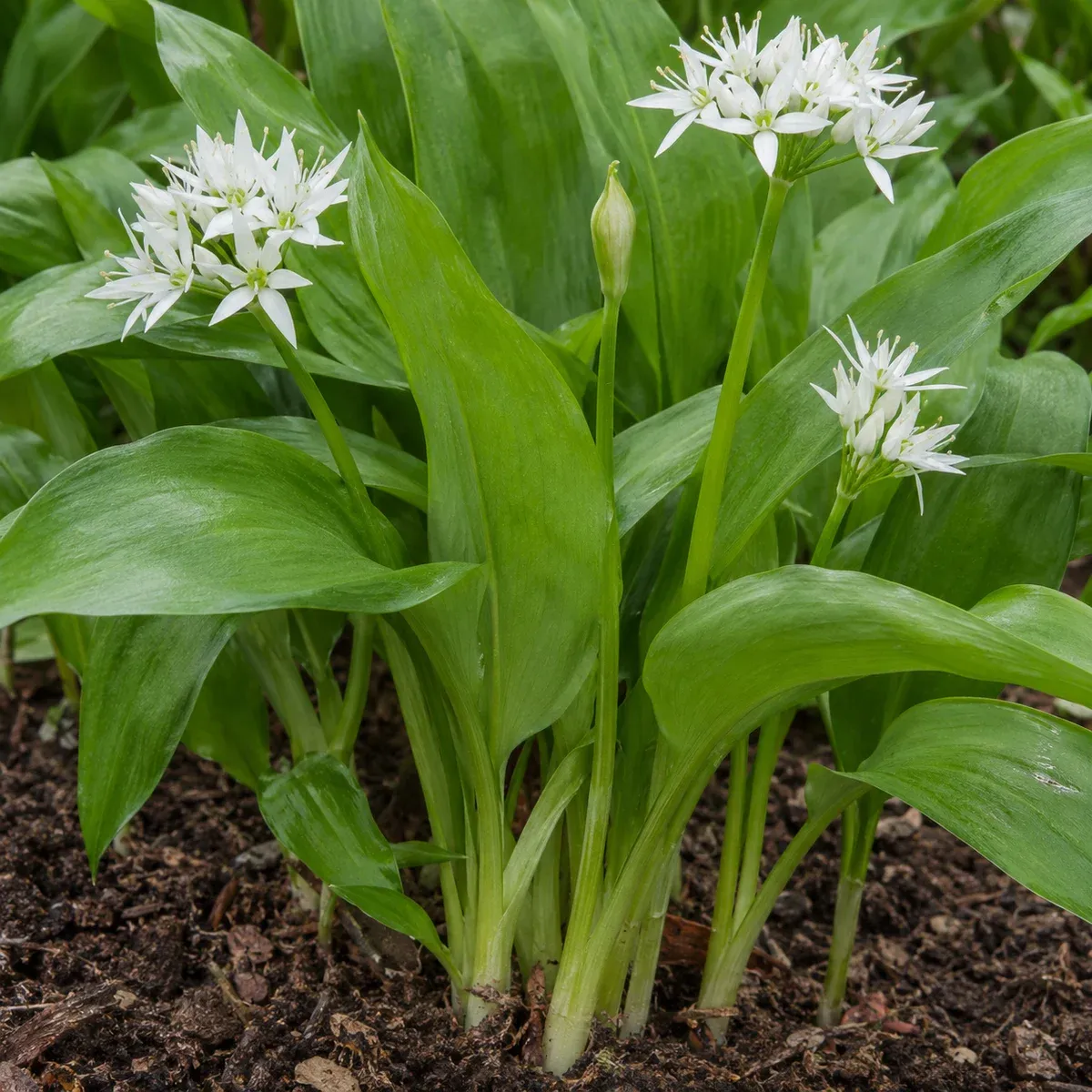
Harvest sparingly from a well-established planting
First, give the plants time to establish. In the Michamps study, the authors do not recommend harvesting before the third growing season after transplanting bulbs. This finding does not tell you the exact age of a purchased pot-grown plant; it serves as a reminder not to expect an immediate harvest from a young plant.
For a vigorous planting, this study recommends harvesting only one leaf out of every two to preserve the plants’ reserves. For a small garden, limit harvesting and leave weak plants untouched. Do not interpret this limit as permission to repeatedly strip the remaining foliage. Leave the bulbs in place if you want to keep the crop growing.
Harvest leaves individually, without picking handfuls that mix leaves from different plants, then sort them before use, in accordance with Anses precautions. If in doubt, do not consume them.
What should you do after eating a plant you cannot identify with certainty?
Anses advises contacting a Poison Control Centre even without symptoms. In France, in case of severe symptoms or signs of life-threatening distress, call 15 or 112. Instructions and contact details are provided on page 4 of the cited document.
Key points for this crop
Practical guidance
- Start
- Identified cultivated plants: Allium ursinum
- Location
- Partial shade, fertile and well-drained soil
- Cycle
- Leaves appear in spring and die back in summer
- Harvest
- Let plants establish and leave some foliage
Sources and references
- Plants responsible for frequent or severe poisonings — Vigil’Anses No. 26, July 2025Anses, Sandra Sinno-Tellier and Gaël Le Roux Accessed on 16 October 2026.
- Allium ursinum — ramsonsRoyal Horticultural Society (RHS), in English Accessed on 16 October 2026.
- Wild garlicRoyal Horticultural Society (RHS), in English Accessed on 16 October 2026.
- Perennials: plantingRoyal Horticultural Society (RHS), in English Accessed on 16 October 2026.
- Study on the cultivation potential of edible wild plants — Wild garlicHaute-Sûre Forêt d’Anlier Nature Park, LEADER Programme 2016–2020, trials at Michamps Accessed on 16 October 2026.
- How to plant bulbs in a potRoyal Horticultural Society (RHS), in English Accessed on 18 October 2026.
- Bulbs: propagationRoyal Horticultural Society (RHS), in English Accessed on 18 October 2026.
- Onion white rotRoyal Horticultural Society (RHS), in English Accessed on 18 October 2026.