
The vegetable garden notebook / Crops
Growing swede: sowing, bulking and winter harvest
Swede requires space and several months of growth. Its cultivation aims for a tender root to harvest in cool weather, with consistent moisture and monitoring for brassica pests.
Adapt this guidance to your garden’s climate and conditions.
Swede or turnip: which to choose?
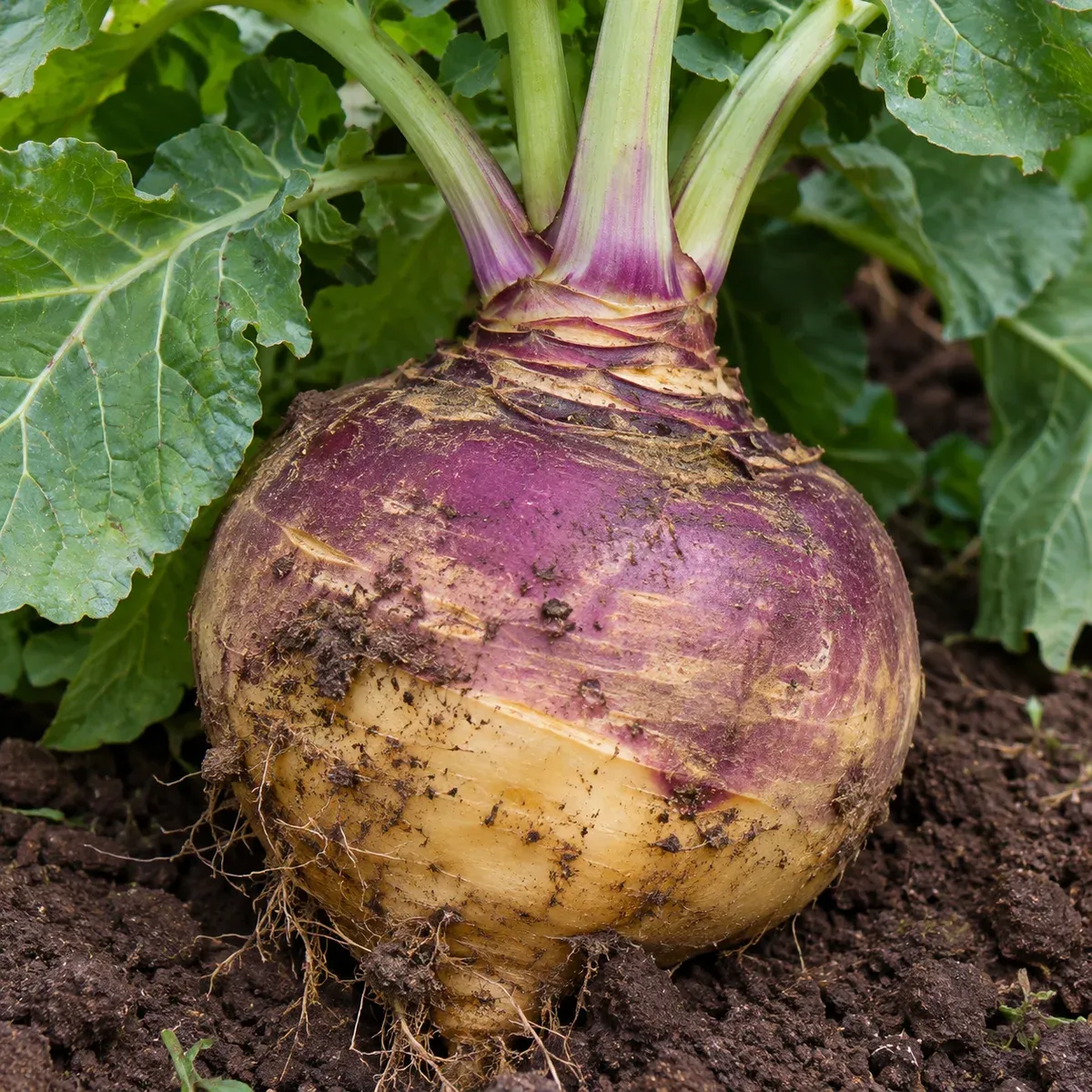
Swede, also known as rutabaga, is Brassica napus group Napobrassica; British sources use the name swede. The turnip belongs to Brassica rapa. Their names sometimes overlap, but their growth rates differ: do not apply the schedule of a small turnip to a swede. Minnesota · RHS
The SNHF lists ‘Jaune à collet rouge’, ‘Jaune à collet vert’ and ‘Blanc hors terre’. For cooking, check the intended use and flesh type indicated on the seed packet. For an extended harvest, also compare their ability to remain tender and store well. SNHF · RHS
When to sow and which soil to prepare?
The SNHF provides a French guideline from spring to early summer. Adjust this based on the variety, soil drainage, and available growing time before winter. Sowing in soil that is still unworkable is not justified by the calendar alone. SNHF
Choose a sunny spot with humus-rich, well-drained, non-compacted soil. A raised bed can help if the ground becomes waterlogged. Enhance fertility with mature garden compost; avoid fresh manure, which may encourage branched roots. Adjust other inputs based on soil fertility, without systematically adding nitrogen. Iowa · Minnesota
Sowing, thinning or planting a plug
Sow directly in place where possible, in prepared and moistened rows. The SNHF recommends covering seeds with 1 to 2 cm of soil, spacing rows 40 cm apart, then thinning to 25 cm between plants. Keep the surface moist during establishment. The sowing guide helps prepare and mark rows. SNHF
Starting in modules is possible: the RHS advises transplanting young plugs before the main taproot develops, disturbing roots minimally and after acclimatisation. Containers are best suited for small roots harvested young, not for large storage swedes. RHS
Supporting bulking without damaging the root
Water when the soil dries out and ensure moisture reaches the root zone. Drought can result in hard or bitter roots; a large swelling is not a sufficient water reserve for the entire season. Minnesota
Hoe shallowly, as roots develop near the surface. After thinning, a light mulch helps retain moisture and reduce competition. If growth slows, first check spacing, moisture under the mulch, and soil structure before considering additional inputs. Iowa
Leaves with holes or weak growth: what to observe?
On seedlings, look for small round holes and beetles that jump when approached: this suggests flea beetles. Insect-proof netting can be a preventive measure; a few holes on a large plant have less impact than on a young seedling. RHS flea beetles
If persistent wilting occurs, also inspect the roots of an affected plant. Significant deformations and loss of fine roots may indicate clubroot, though foliage alone does not confirm it. Avoid transferring suspect soil on tools or with plants. Have uncertain cases confirmed before making multiple soil amendments. RHS clubroot
Include swede with brassicas in your crop rotation: following it with cabbage or turnip does not change the family. This prevention does not guarantee the remediation of soil affected by clubroot. Minnesota · RHS clubroot
Harvesting at the right stage and responding to bolting
The SNHF suggests an initial harvest three to four months after sowing; the RHS also describes crops lasting up to six months. These are variable guidelines. Test a root for tenderness; the typical harvest size may reach 10 to 13 cm, though waiting for this size is not mandatory. SNHF · RHS · Iowa
An elongating stem and flowering signal a shift in purpose: bolting in root vegetables can stop the roots bulking up. Do not wait for flowers to decide on harvesting, nor rely on cutting them to restore root quality. RHS bolting
Leave in the ground or store for winter?
Lift roots with a fork placed alongside, then remove foliage and avoid damage. Very cold or persistently wet soil makes early lifting preferable before winter difficulties; elsewhere, protective covering allows extended harvesting. Minnesota · RHS
For storage after lifting, the RHS suggests crates of moist sand in a cool, frost-free location. Monitor roots: drying causes shrivelling, while damaged or rotting roots should be discarded. Storage durations of several months described by universities rely on controlled temperature and humidity; they are not a guarantee for every cellar. RHS · Minnesota · Iowa
Key points for this crop
Practical guidance
- Identity
- Brassica napus, Napobrassica group; distinct from turnip Brassica rapa
- Planting
- Primarily direct sowing, from spring to early summer depending on conditions
- Spacing
- SNHF guideline: rows 40 cm apart, thinning to 25 cm
- Harvest
- Harvest while the root is tender and usable; leave it in the ground over winter only if soil conditions allow
Sources and references
- RutabagaSociété nationale d’horticulture de France, Jean-Daniel Arnaud Accessed on 18 October 2026.
- How to grow swedesRoyal Horticultural Society, in English Accessed on 18 October 2026.
- Growing turnips and rutabagas in home gardensUniversity of Minnesota Extension, Marissa Schuh and Jill MacKenzie Accessed on 18 October 2026.
- Growing Turnips and Rutabagas in the Home GardenIowa State University Extension, Aaron Steil and Richard Jauron Accessed on 18 October 2026.
- Flea beetles on brassicas and allied plantsRoyal Horticultural Society, in English Accessed on 18 October 2026.
- Club rootRoyal Horticultural Society, in English Accessed on 18 October 2026.
- Bolting in vegetablesRoyal Horticultural Society, in English Accessed on 18 October 2026.