
The vegetable garden notebook / Crops
Growing rhubarb: planting, maintenance, and harvesting without depleting the crown
Rhubarb remains in the same spot for several years. Allocate it space and allow it to establish before harvesting. You will consume the petioles, commonly called stems, but never the large leaves.
Adapt this guidance to your garden’s climate and conditions.
Which rhubarb should you buy?
Compare harvest period, vigour, and mature size; for a container, choose a compact cultivar. To preserve a variety’s characteristics, opt for a plant or division rather than seed: the RHS explains that seedlings are more variable and slower to establish. Petiole colour alone is not enough to judge earliness or maturity.
Where to plant rhubarb?
Select deep, humus-rich soil that retains moisture. The SNHF recommends partial shade and 1.50 metres between crowns in both directions. Mark this location on your vegetable garden plan before planting: the large leaves will occupy the space for years.
The RHS also mentions full sun or light shade but emphasises drainage. Avoid depressions where water pools; moist soil must not remain waterlogged.
Can rhubarb be grown in a pot?
Yes, in a large, well-draining container: the RHS specifies at least 50 cm in width and depth, preferably with a compact variety. Use a soil-based potting compost suitable for long-term container growing, ensure drainage holes, and monitor water closely during growth. Keep the soil moist but not saturated, and do not leave the pot in a saucer of water. Containers can bypass waterlogged ground.
How to plant a crown?
The SNHF suggests March or early November for planting a young plant or division. Adjust this timing to your local conditions.
For a potted plant, maintain the previous planting depth. For a bare-root crown, the University of Minnesota places the top of the crown at soil level. Backfill and water to settle the roots. Label the crown with its variety and planting year: this date will help determine when to start harvesting.
What maintenance is needed during establishment?
Keep the soil weed-free and moist. The SNHF recommends watering if a dry spring dries out the crowns and removing flower stalks as they appear. Continue monitoring water after harvest; our watering guide helps tailor inputs to soil and weather.
Weed by hand or hoe shallowly, without damaging the crown, as advised by Minnesota. A mulch of well-decomposed garden compost helps retain moisture. The RHS advises keeping the centre clear to avoid burying it under material.
When can you start harvesting?
For cautious establishment, allow two growing seasons without harvest, as recommended by Iowa State University. Then harvest modestly from a vigorous crown. A weak plant needs its leaves more than it needs harvesting.
Select well-developed petioles for your variety: their length and colour vary. Minnesota describes green as well as red varieties; waiting for a green stem to turn red is not a maturity indicator.
Grasp the petiole at its base and detach it with a gentle pull and twist. Remove the leaf blade—the large, flat part of the leaf—immediately: it is not edible, as Minnesota reminds us.
For an established crown, follow the RHS cautious limit: no more than one-third of the petioles at any one time, while retaining plenty of foliage. This ceiling is not a target to harvest systematically.
When should you stop harvesting?
For an established crown grown without forcing, the SNHF sets the harvest period from May to July, then requires stopping from August to replenish reserves. This French guideline provides an end date; it does not require harvesting until the last day of July.
Stop earlier if the crown lacks vigour, suffers from drought, or has already been heavily harvested: the RHS one-third limit per harvest is a ceiling, and Iowa highlights the draining effect of prolonged harvesting. Then let healthy leaves work and wither naturally. A forced clump follows the stricter rule below: no further harvest after the year’s forced picking.
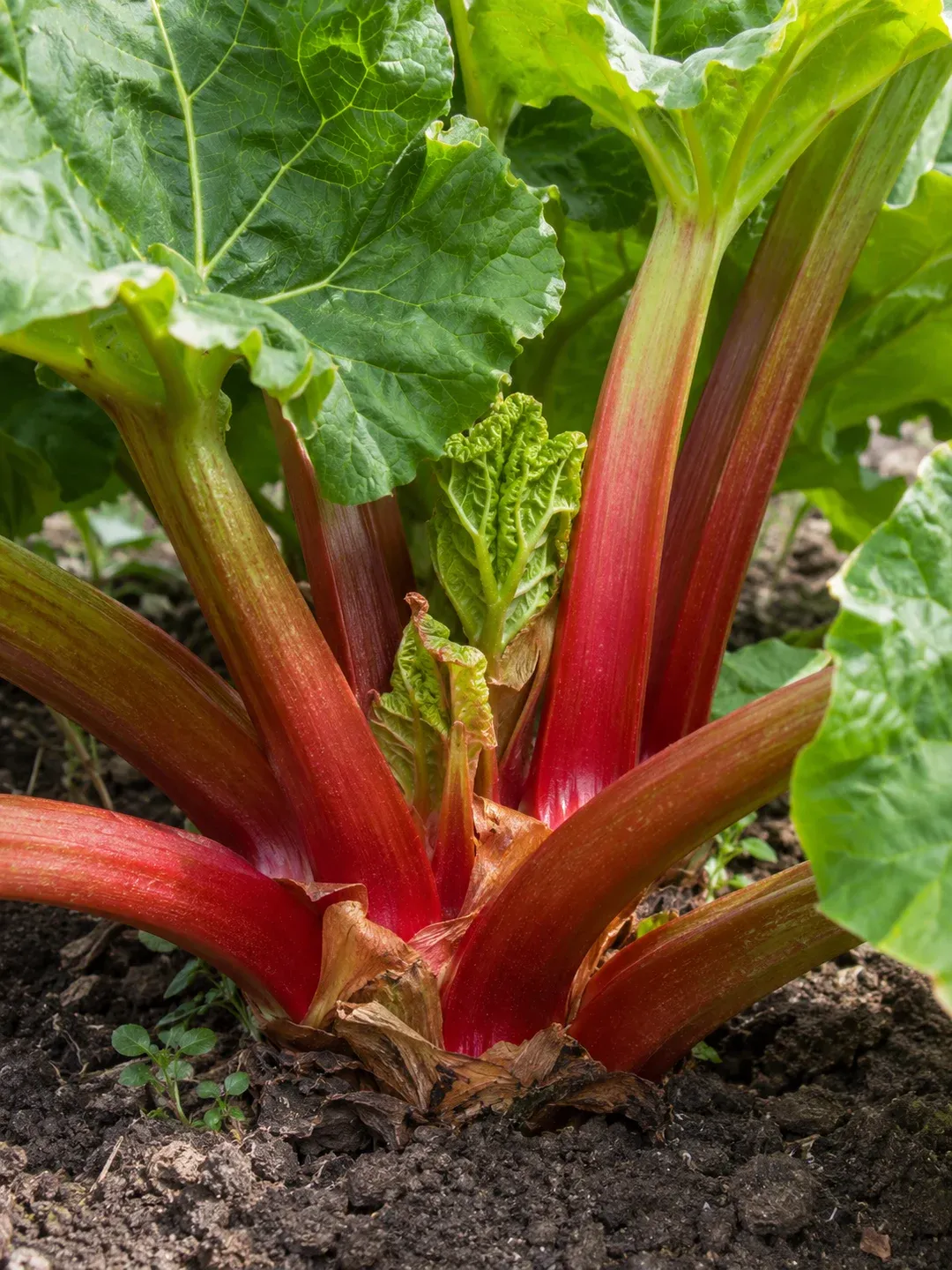
In winter: normal disappearance or struggling crown?
Foliage naturally dies back in autumn, and new shoots return in spring. The RHS advises letting leaves wither before removing them; cold contributes to regrowth after dormancy. Do not routinely bring rhubarb indoors to keep it growing. Keep the centre clear and the ground well-drained. The crown’s hardiness does not prevent late frost from damaging young shoots.
Lack of leaves in winter does not prove rot. However, petioles that collapse during growth, with lesions at their base or a deteriorating crown, require the examination described below.
Forcing an early harvest without depleting the clump
Forcing involves covering the crown with an opaque container tall enough to allow petioles to grow in darkness, in late winter before active growth. Reserve this for a healthy, vigorous clump established for at least three years. RHS advisor Deirdre McShane describes this method for early varieties like ‘Timperley Early’.
After the first forced harvest, remove the cover and let the foliage develop; do not harvest from this crown again that year. In her practice, she allows at least three years of recovery before forcing the same crown again. This cautious interval follows her method; forcing is neither a mandatory winter maintenance task nor a solution for a weak young division. RHS, forcing
Thin petioles, eaten young shoots, or collapsing crown
Thin petioles do not automatically require division. Review the planting year and harvests: a young crown or over-harvested clump must first rebuild reserves. Also check for drought, which can halt growth; a very dense old clump may then need the division described below. Iowa, RHS
If young shoots have been eaten, look for slugs, snails, and feeding traces, especially under a forcing cover. After frost, distinguish damaged shoots from ongoing decline. RHS
If petioles wilt with sunken lesions at their base, check drainage and the crown’s condition. Iowa describes crown or root rot caused by Phytophthora: lesions spread, petioles collapse, and the crown and roots turn brown or black and disintegrate. Confirm this pattern; do not assume it from a single limp petiole. Suspend harvesting and propagation from the affected crown, then seek a diagnosis if deterioration continues. Dividing rotten tissue will not renew a healthy clump.
How to renew an old clump?
An overgrown old clump producing many small petioles may benefit from division. Iowa describes the operation at the start of growth, when the soil can be worked: lift the clump, then separate portions each bearing two or three buds and a good share of roots. Replant quickly without letting the roots dry.
Retain only healthy material; the RHS excludes weak or rotten parts. Treat replanted divisions as new plantings, with a fresh establishment period before harvest.
Key points for this crop
Practical guidance
- Establishment
- A permanent location in moist, well-drained soil
- Part harvested
- The petioles; leaves are not edible
- Priority
- Root development before first harvests
- Renewal
- Dividing an old clump that has become too dense
Sources and references
- RhubarbSociété nationale d’horticulture de France, Claude Bureaux Accessed on 16 October 2026.
- How to grow rhubarbRoyal Horticultural Society, in English Accessed on 16 October 2026.
- Growing rhubarb in home gardensUniversity of Minnesota Extension, Jill MacKenzie, in English Accessed on 16 October 2026.
- Growing Rhubarb in IowaIowa State University Extension and Outreach, Richard Jauron and Aaron Steil, in English Accessed on 16 October 2026.
- How to force rhubarb for early cropsRoyal Horticultural Society, Deirdre McShane, in English Accessed on 18 October 2026.