
The vegetable garden notebook / Crops
Growing table grapes: support and appropriate pruning
A table grapevine requires a warm location and consistent management. Before planting, select the variety, its rootstock, and support; before pruning, identify the wood that will produce the shoots bearing bunches.
Adapt this guidance to your garden’s climate and conditions.
Choosing a table grape and suitable plant
The cultivated European vine is Vitis vinifera; other species and hybrids are also available. Verify the full name on the label. RHS, outdoor cultivation
Request a table grape, its ripening time, and confirmed suitability for your climate: colour and seedlessness are not sufficient. The SNHF recommends plants grafted onto a rootstock compatible with the soil and climate. INRAE explains that resistant rootstocks protect roots from phylloxera but do not make all foliage immune to the insect. Keep the label: the variety name will also be needed to choose the pruning method. SNHF, INRAE
According to the RHS, nearly all grape varieties are self-fertile; a second plant is therefore generally unnecessary. Nevertheless, verify the chosen cultivar. A heat-demanding muscat under cover does not become suitable for a cool garden simply by purchasing another plant. RHS, cultivation
Preparing the support and planting during dormancy
Choose a sunny, warm, sheltered location with well-drained soil; avoid frost pockets in spring. Install wires, trellises, or pergolas first. For a single cordon, the RHS spaces plants 1–1.5 metres apart; a single vine can cover a pergola. This training guideline does not define the space for a freely growing vine. Ensure access for tying and harvesting. RHS, cordon
Plant a dormant vine once excess water has drained from the soil; in cold areas, prioritise spring planting before growth resumes. Keep the top of the root ball at its previous level and the graft union above the soil. Backfill and water. Against a wall, the RHS requires at least 20 cm of clearance for the roots. Young shoots remain sensitive to frost, even if the vine trunk withstands winter. RHS, cultivation
Pots and greenhouses: plan for the mature plant
For a compact standard form, the RHS starts in a pot 30–38 cm wide and deep, then repots progressively to 45 cm in both dimensions. These are specific measurements for this training method, without conversion to litres. Use a stable pot with drainage holes, potting compost, and a sturdy stake; the leafy head becomes heavy. RHS, pot
In a greenhouse, maintain ventilation during flowering and fruiting. A vine also requires a cold winter dormancy period; a year-round heated room is not a suitable permanent location. RHS, cultivation
Monitoring water and nutrition without forcing growth
Water at planting and during droughts; pay particular attention to areas sheltered from rain by a wall. An established vine tolerates dry conditions better than a young plant, but prolonged water shortage can harm it. In pots, regularly check the root ball and drainage. RHS, outdoor cultivation, watering
The SNHF does not recommend systematic fertilisation in open ground and allows garden compost at the base. Avoid nitrogen-rich lawn fertilisers. In containers, feeding needs attention as nutrients in the growing medium are used up: use a suitable fertiliser and adjust applications according to its instructions and observed growth, without applying vineyard rates. SNHF, RHS, cultivation
Understanding the wood before pruning
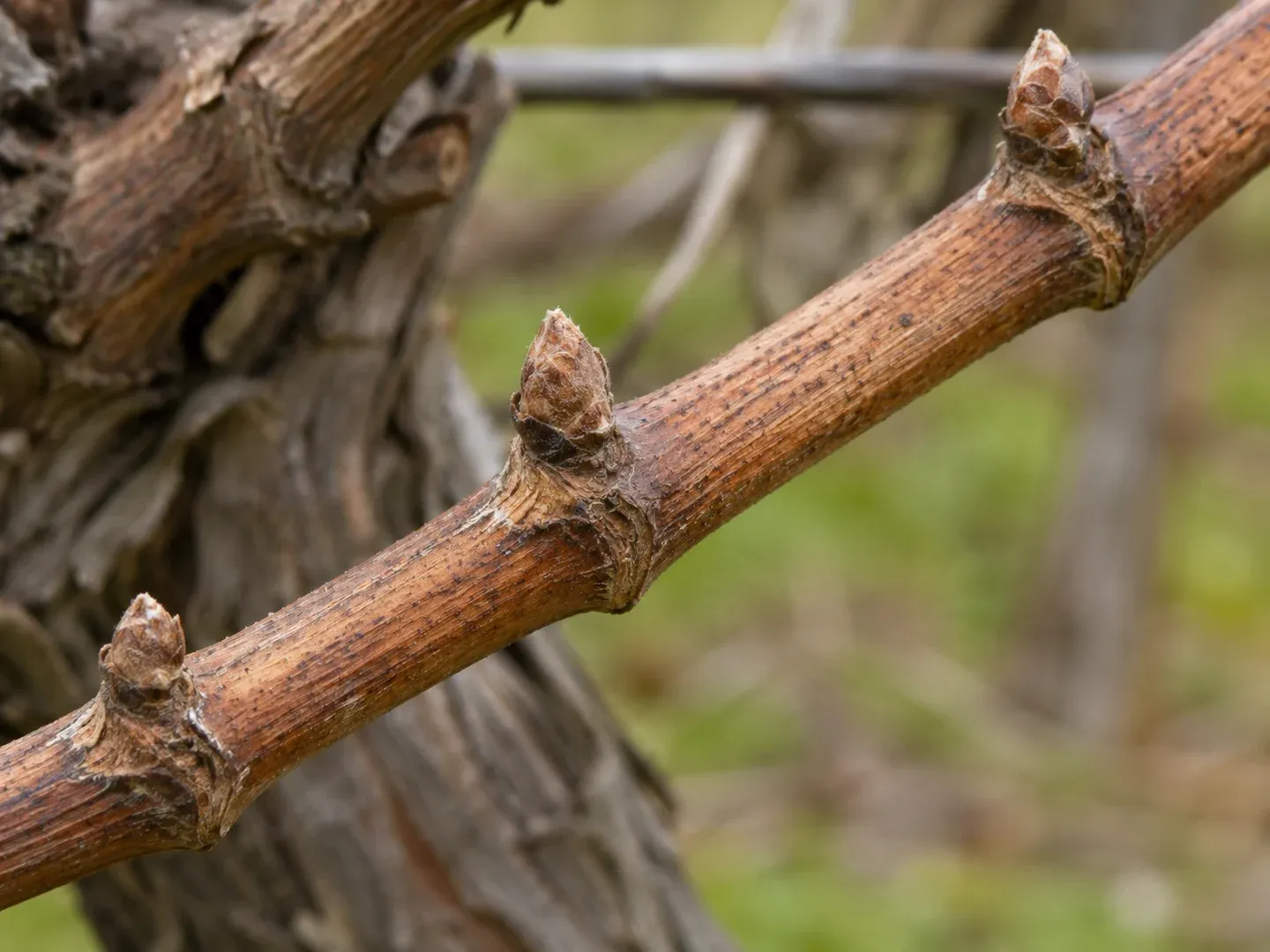
Bunches appear on the current year’s shoots arising from the previous year’s wood. Distinguish the permanent trunk and arms, the brown canes formed last summer, and the new green shoots. Pruning away all recent canes may remove the points from which fruiting shoots would grow. SNHF
Bud fertility varies: the SNHF notes the second bud in chasselas, but only the third or fourth in frankenthal or certain muscats. Do not prune all varieties back to two buds. Confirm the pruning length for your cultivar before choosing the system. Prune during complete dormancy, before sap rises; British month guidelines are not a national French date. SNHF, RHS, pruning
Cordon with spurs or renewed cane
On a cordon, a permanent framework is maintained. For a variety suited to short pruning, each year the lateral shoots are shortened into spurs, small sections bearing buds. The RHS method of one or two buds applies to this system; it does not overcome low fertility in a variety’s basal buds. On a young plant, gradually tie the chosen shoot to build the framework before expecting a heavy crop. RHS, cordon
In Guyot training, the trunk remains, and the fruiting cane is renewed. During summer, retain replacement shoots near the trunk. During dormancy, remove the cane that bore fruit, tie a cane from the previous summer in its place, and retain a short renewal spur for the following season. The number of buds retained then depends on the variety and vigour. Do not confuse this temporary cane with a permanent cordon arm. RHS, Guyot
Monitoring the same vine from one season to the next
On a vine already trained as a cordon and suited to short pruning, identify a permanent arm and a lateral shoot that grew and bore fruit this summer. During dormancy, retain the arm; shorten this shoot into a spur according to the length suited to the cultivar. The following spring, new shoots emerge from the retained buds. After their season, pruning returns to the lateral shoots; the arm remains the framework. The spur is therefore the short section retained for renewal, not a long cane to be replaced along a wire. RHS, cordon
On a vine already trained as a single Guyot, name three elements before any pruning: the permanent trunk, the horizontal cane that bore fruit, and the replacement shoots retained near the trunk this summer. During dormancy, remove the old cane while preserving these replacement shoots; tie one of the replacement canes horizontally for the next season and prune the other back to a short renewal spur. In spring, fruiting shoots emerge on the new cane. The following winter, the same role shifts to another cane. RHS, Guyot
If you cannot find a replacement shoot, identify a replacement solution before cutting the cane: the RHS notes that a shoot near the centre may sometimes serve. Do not assume that new shoots will grow from a bare old trunk. These examples explain renewal on a trained vine; they do not replace the training of a young vine or the varietal choice of pruning length.
In summer, tying and limiting tangling
On the table grape cordon described by the RHS, select shoots bearing flowers, tie them, and shorten them to two leaves beyond the inflorescence; retain only one bunch per shoot in this system. Preserve the extension intended for the framework. In Guyot training, prioritise central replacement shoots. Summer pruning must not remove all foliage or the replacement growth needed for the following winter. RHS, cordon, RHS, Guyot
No bunches or marked leaves: observe before acting
Without bunches, review the plant’s age, frost damage on young shoots, and pruning performed. Distinguish between absence of flowers and flowers that failed to set; also note flowering conditions and ventilation under cover. A young plant must first build its framework. RHS, pruning, RHS, cultivation
For diseases, examine both sides of the leaves and berries: yellowish spots with white downy growth underneath for downy mildew, white powder on leaves or fruit for powdery mildew, soft brown berries followed by grey mould for grey rot are signs described by the RHS. These guide examination but are not sufficient for diagnosis alone. Remove affected fruit, improve airflow around the vine, and have persistent symptoms identified before choosing an intervention. RHS, diseases
Tasting, cutting bunches, and planning ahead
Taste several berries: colour alone does not prove ripeness. Harvest when flavour is satisfactory, as grapes do not ripen further after picking. Cut the bunch with its stem and handle it without crushing the berries. Sort out damaged berries and promptly refrigerate healthy bunches without compressing them. The University of Minnesota indicates one to two weeks of storage for most grapes, depending on their condition; monitor them and consume the most fragile first. Minnesota RHS, cultivation
Sowing seeds does not faithfully reproduce a variety. Hardwood cuttings during dormancy can propagate it, but do not provide the phylloxera-resistant root system of a rootstock: to plant a new vine, start again with soil–rootstock selection. RHS, outdoor cultivation, INRAE, SNHF
Reserve this permanent location in the crop rotation plan; the vine does not change beds each year. Organise its neighbours according to the shade cast by the mature vine, access, and water needs, using the companion planting method.
Key points for this crop
Practical guidance
- Selection
- Table grape and ripening time suited to the location, rootstock adapted to the soil
- Support
- Vigorous climbing vine to train on a permanent structure
- Fruiting wood
- Current year’s shoots arising from wood formed the previous year
- Harvest
- Taste before cutting: grapes do not ripen further after picking
Sources and references
- GrapevineSNHF, Claude Bureaux, vegetable and fruit gardens section Accessed on 18 October 2026.
- Daktulosphaira vitifoliae — PhylloxeraINRAE Ephytia, L. Delbac and C. Deluche, updated 12 September 2020 Accessed on 18 October 2026.
- How to grow grapesRoyal Horticultural Society, in English Accessed on 18 October 2026.
- Grapes: outdoor cultivationRoyal Horticultural Society, in English Accessed on 18 October 2026.
- Grapes: pruning and trainingRoyal Horticultural Society, in English Accessed on 18 October 2026.
- Grapes: rod and spur (cordon) pruning and trainingRoyal Horticultural Society, in English Accessed on 18 October 2026.
- Grapes: Guyot training and pruningRoyal Horticultural Society, in English Accessed on 18 October 2026.
- Grapes: training as a standardRoyal Horticultural Society, in English Accessed on 18 October 2026.
- Grapevine diseasesRoyal Horticultural Society, in English Accessed on 18 October 2026.
- Growing grapes in the home gardenUniversity of Minnesota Extension, in English Accessed on 18 October 2026.