
The vegetable garden notebook / Crops
How late can you sow French beans? Deciding in your garden
For a final sowing, look beyond seedling emergence: the beans still need to flower and form pods. Consider an early dwarf variety first, but use its time to harvest and your local conditions to decide whether it is worth trying.
Adapt this guidance to your garden’s climate and conditions.
How late can you sow French beans in France?
The SNHF describes a sowing period extending into August, with harvests staggered from June to October. However, its guidance does not set a final date common to all gardens or provide a detailed schedule by variety. “Into August” therefore does not mean that every sowing made on the last day of the month will have time to produce.
This page concerns the common bean cultivated for its young pods. A schedule for dry shelling beans is not suitable for the same purpose: the SNHF distinguishes these harvests, as dry beans require more time. For cultivation practices, refer to the French bean growing guide.
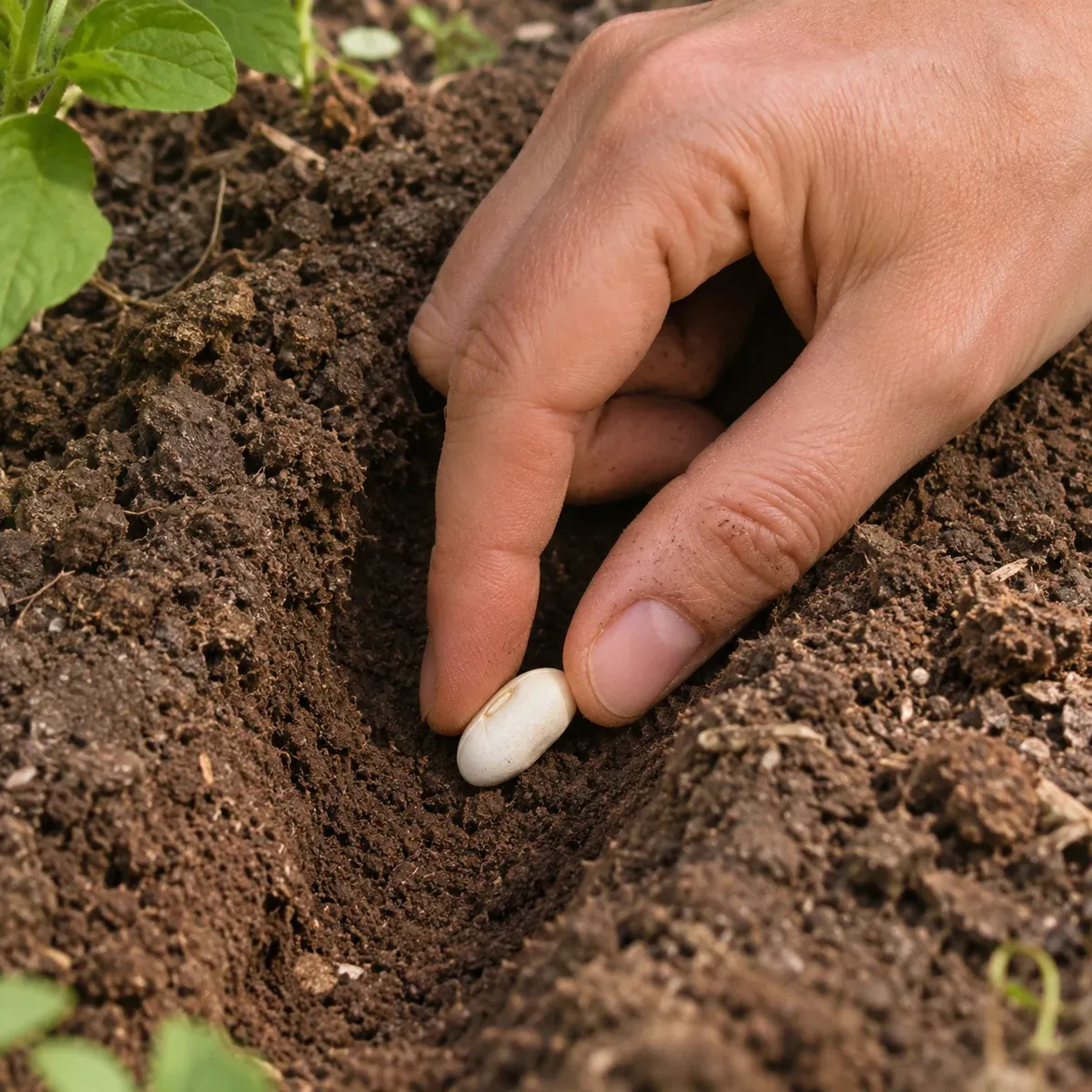
Choose an early dwarf variety or sow more climbing beans?
Dwarf varieties generally reach harvest more quickly, over a shorter period. Climbing beans start later but produce for longer, according to the RHS. When the remaining season is limited, consider first a dwarf variety advertised as fast-maturing and suited to the intended sowing date.
The term “dwarf” is not enough: compare the time to harvest and the sowing window recommended for the exact variety. Conversely, a climbing bean already in production and a new seed sown at the base of a support are not at the same stage. Before replacing a crop that is still yielding, compare its potential with that of a fresh start.
Understand the growing period without treating it as a harvest guarantee
On the seed packet or variety sheet, look for the time from sowing to first pod harvest. Check its starting point and the harvest stage; a number of days on its own is not enough for this comparison. The University of Maryland, for example, specifies that its times to harvest for beans are counted from direct sowing.
Count forward by this number of days from your planned sowing date, then check the resulting harvest period. Is it still likely to offer good growing conditions in your garden? Allow time to keep picking after the first pods appear, rather than hoping to see a few form just before cold weather arrives.
Allow some extra time when making your decision. The University of Maryland explains that reduced light and temperature slow growth and lengthen the stated growing times for autumn crops. We do not convert its American calendar adjustment into a number of days to add across France.
If the plan only works when the stated growing time is met to the day, treat it as an uncertain trial. For a harvest you truly rely on, choose a different window or another crop.
Comparing two labels: a fictional exercise
Imagine two pieces of seed-packet information invented to explain the calculation, rather than two recommended varieties: dwarf variety A takes 55 days from sowing to the first pod, while climbing variety B takes 70 days from the same starting point. From a fictional sowing on 1 August, the calculation gives 25 September and 10 October respectively. The calculated gap is fifteen days; it does not predict what will happen in the garden.
Before choosing A based solely on this calculation, ask four questions: does the actual seed packet recommend sowing at this time? Will conditions allow even emergence and steady growth? Does the resulting period still allow time for harvesting? And could falling temperatures in your garden slow the crop? The University of Maryland explains that growing times increase in autumn; we do not add a fictional national margin to these dates.
If B instead refers to climbing beans already in production, this calculation from a new seed is no longer the right comparison: keep the current crop’s progress separate from that of a new sowing.
Check the soil and remaining season
Also consult the forecast for the days following sowing. The SNHF gives 15 to 18 °C in the soil as a benchmark for sufficiently warm ground for sowing. This figure refers to soil temperature.
You must also be able to keep the soil moist, without waterlogging, until the seedlings emerge, as recommended by the University of Maryland. A space freed up during an absence, with no way to monitor moisture, is not necessarily a good opportunity to sow.
To assess the end of the season, use your observations from previous years and horticultural benchmarks for your area. Compare them with local forecasts as the deadline approaches. Météo-France notes that forecasts cover different timeframes depending on the phenomena, and that temperature near the ground remains subject to local effects.
Do not deduce a certain first frost date several weeks in advance. Frost damages bean tissue, according to the University of Maryland; a simple countdown to an average date therefore does not secure the harvest.
Sow, limit the trial, or abandon
Here is a practical decision grid based on the above conditions, without a universal ranking of regions.
| Your situation | Suggested decision |
|---|---|
| A fast-maturing variety within its sowing window, suitable soil, scope to monitor the crop and time left after the stated growing period. | Consider a small batch and record its date. |
| A sowing window nearing its end, a poorly documented growing period or a projected harvest close to the time when the weather usually turns cold. | Limit to a trial you accept may fail; do not dedicate all available space to it. |
| Cold or waterlogged soil, no way to monitor moisture, or a growing period longer than the expected favourable season. | Skip this sowing and consider a follow-on crop suited to the season. |
To plan this follow-on crop, the August vegetable garden calendar suggests other sowings, each with its own conditions. If you attempt French beans, record the variety, sowing date, seedling emergence and first actual harvest: this local result will be more useful the following year than a national deadline.
Key points for this crop
Practical guidance
- French reference point
- Sowing can extend into August according to the SNHF, with no guaranteed final date
- Variety to consider
- A fast-maturing dwarf for a short remaining season
- Growing period to check
- From sowing to pod harvest, with time to pick
- Limit
- French beans are frost-sensitive; cold slows growth
Sources and references
- BeansSociété nationale d’horticulture de France (SNHF), Jean-Daniel Arnaud Accessed on 16 October 2026.
- How to grow French beansRoyal Horticultural Society (RHS), in English Accessed on 16 October 2026.
- Growing Beans in a Home GardenUniversity of Maryland Extension, in English Accessed on 16 October 2026.
- Fall Vegetable GardeningUniversity of Maryland Extension, Jon Traunfeld, in English Accessed on 16 October 2026.
- Weather: what can be forecast, and how far ahead?Météo-France Accessed on 16 October 2026.