
The vegetable garden notebook / Crops
Growing fennel: forming a bulb and preventing bolting
To harvest plump fennel, start with a bulb variety suited to your season. Tall herb fennel needs different care: its drought tolerance does not apply to the vegetable grown for its swollen leaf bases.
Adapt this guidance to your garden’s climate and conditions.
Bulb fennel or herb fennel: which harvest do you want?
Bulb fennel, or Florence fennel, is Foeniculum vulgare var. azoricum. Its “bulb” is actually the swelling of the leaf bases, notes the RHS. Choose a variety whose sowing window matches your region and desired harvest; advertised bolting resistance reduces risk without eliminating it.
The main guidance below covers growing bulb fennel for its swollen leaf bases, from sowing to harvest. For leaves and seeds of the perennial type, skip directly to managing herb fennel.
Herb fennel forms a large perennial clump grown for its leaves and seeds. The RHS distinguishes it from the vegetable and describes stems reaching approximately 2 metres. A packet simply labelled “fennel” therefore warrants verification before allocating space to harvest bulbs.
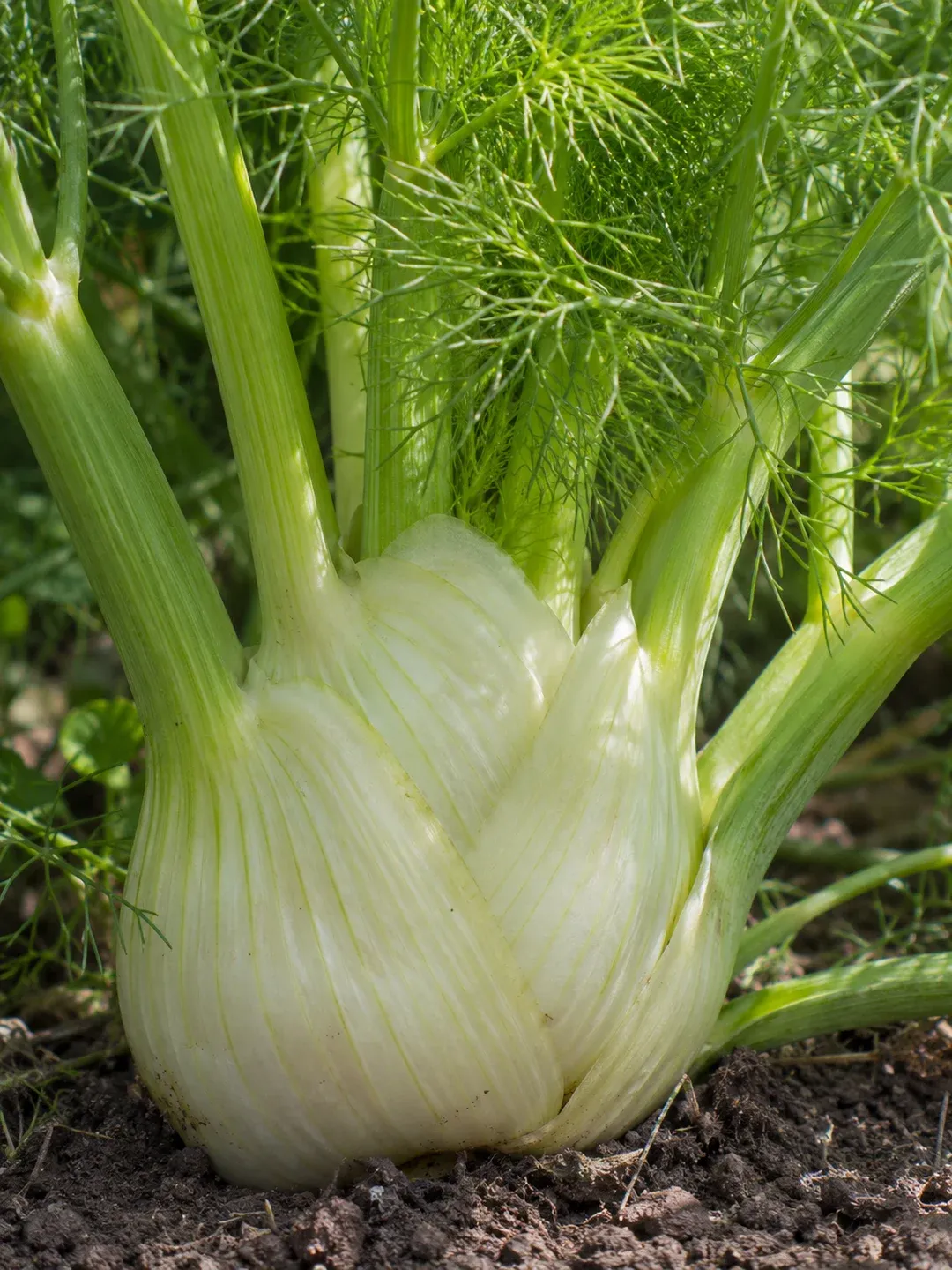
When to start bulb fennel?
For France, the SNHF recommends April to June, when the soil has warmed sufficiently, as a sowing guideline. This window alone is not enough to decide: check your variety’s instructions and take account of cold risk and your ability to maintain moisture during growth.
For a first crop, prioritise a small batch within the recommended window for your variety. The RHS notes that early starts, cold, and disturbed roots during transplanting encourage bolting. Under cover, keep young plants in good light, then gradually acclimatise them outdoors before planting after the last frosts. Starting under cover does not make the bulb frost-resistant.
Preparing the soil, sowing and keeping the root ball intact
Reserve a sunny spot in deep, fertile, and well-draining soil, as per the SNHF. If water stagnates, choose another location or a suitable container. Address soil fertility before starting the crop; Utah State University recommends determining fertiliser needs based on soil condition rather than applying a fixed dose.
You can either sow directly in place or raise one plant per cell, then transplant it with the whole root ball intact. The RHS describes a furrow of approximately 1.5 cm and emphasises root preservation. Keep your variety’s instructions; our sowing guide helps with preparation and monitoring seedling emergence.
For mature bulbs, the SNHF suggests 20 to 25 cm between plants and 40 to 60 cm between rows. Thin out overcrowded sowings. When planting plugs, maintain the previous depth, water, and avoid disturbing the roots, as the RHS advises.
Can you harvest fennel in pots?
The RHS describes up to three mature plants in a container approximately 40 cm wide, filled with peat-free potting compost. This is a width measurement; it does not establish a volume in litres or a depth. Start with few plants and allow enough space for the target size.
A closer spacing of 10–15 cm is reserved in this source for mini-fennel, harvested when the swollen base reaches around 5 cm. It does not promise large bulbs in the same space. In containers, frequently check moisture: compost dries quickly, and stress can trigger bolting.
Maintaining steady growth
Water according to soil moisture and garden conditions, without waiting for complete dryness. Alternating dry and wet conditions can crack the bases, according to Utah State University. The watering guide details how to observe before watering.
Weed gently near plants to protect bases and roots. Mulching around established plants helps limit evaporation and weed competition. As the leaf bases swell, you can draw soil around them to blanch them, as the SNHF indicates; this does not replace water management.
No pruning or staking is necessary for the bulb harvest described here. Allow enough space until harvest, with access for care. To plan succession, note the Apiaceae family in your crop rotation.
No bulb, elongating stem, or damaged foliage: what to check?
If fennel remains thin, first check which type you bought, then the space available, moisture and whether a flower stalk is appearing. Cold at start, disturbed roots, and drought are among bolting causes described by the RHS. Symptoms alone do not distinguish between them.
Slugs and snails may attack young plants; look for the animals and their trails. Utah State University also notes insects on foliage, including aphids. Inspect both sides before attributing damage to a pest. If the base deteriorates or rots, also check drainage; seek confirmation of a persistent problem before considering treatment.
Harvest before bolting and plan for cold weather
Look for a firm, compact swollen base. The RHS explains that it can be harvested while still small, before the elongation of a flower stalk, which degrades texture. Sample a first plant to check tenderness rather than waiting for a fixed number of days. Cut below the swelling or pull the plant; a base left in the soil may produce leafy shoots but will not form a second bulb.
The SNHF distinguishes summer and autumn production in cooler regions, and possible winter production in the Midi (southern France). Bulb fennel is frost-sensitive: choose harvest based on its condition and local weather, without assuming it can be left in the ground over winter in every garden. Harvest gradually for fresh consumption.
What about the leaves and seeds of herb fennel?
On herb fennel, pick young leaves as needed. For seeds, let umbels mature, cut them, then finish drying in a paper bag before storing fully dry seeds in an airtight container. Remove flowers if you do not want self-seeding. The RHS also describes cutting back dead stems before spring regrowth and possible support for tall stalks exposed to wind. These steps for perennial herb fennel will not make a bulb fennel swell again after it has bolted.
Key points for this crop
Practical guidance
- Selection
- Bulb fennel for its swollen leaf bases, herb fennel for leaves and seeds
- Location
- Sun, deep well-drained soil and consistent moisture
- Planting
- Direct sowing or planting out with the root ball intact, depending on variety and season
- Harvest
- Before the flower stalk elongates
Sources and references
- FennelSNHF, Marie-José Bonnefoux, Vegetable and Fruit Gardens Section Accessed on 18 October 2026.
- How to Grow Florence fennelRoyal Horticultural Society, in English Accessed on 18 October 2026.
- How to Grow FennelRoyal Horticultural Society, in English Accessed on 18 October 2026.
- How to Grow Fennel in Your GardenUtah State University Extension, in English Accessed on 18 October 2026.